

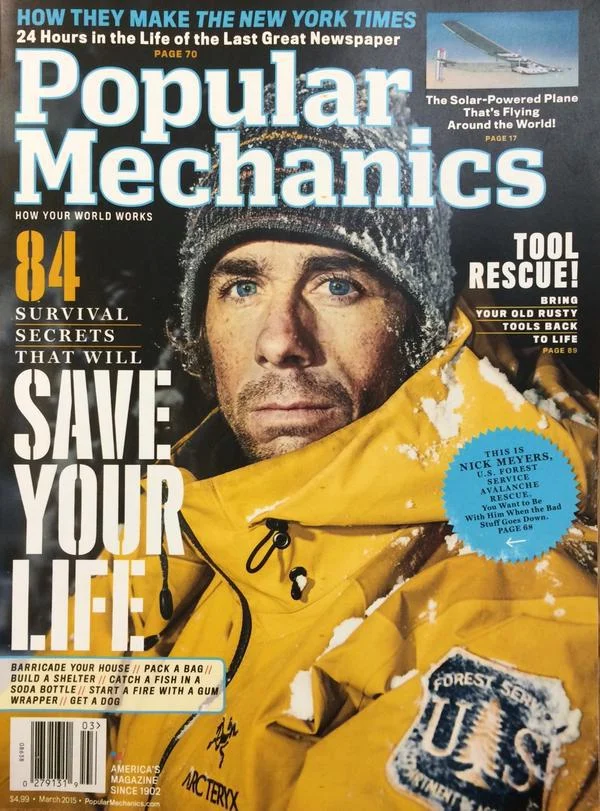
Nick Meyers, the Director of the Mount Shasta Avalanche Center (MSAC) and the Lead Climbing Ranger for the U.S. Forest Service on Mount Shasta, has been formally recognized for his extensive expertise in mountaineering and alpine safety through a featured cover story in Popular Mechanics magazine. The publication, which focuses on the intersection of science, technology, and practical application, selected Meyers to provide insight into the critical gear and decision-making processes required for survival in high-risk alpine environments. This recognition highlights the professional rigor of the Mount Shasta ranger program and the vital role that avalanche forecasting plays in modern outdoor recreation management.
Meyers, a veteran of the Shasta-Trinity National Forest, has spent over a decade overseeing safety operations on one of the most prominent peaks in the Cascade Range. His dual role involves both the administrative oversight of the avalanche center and the physical demands of high-altitude search and rescue (SAR). The Popular Mechanics feature, titled "10 Survival Essentials an Avalanche Rescue Expert Always Carries," serves as a technical guide for backcountry enthusiasts, emphasizing that survival in the wilderness is as much about preparation and equipment as it is about physical endurance.
Professional Profile and Career Trajectory of Nick Meyers
Nick Meyers’ career is defined by a deep-seated commitment to the geography of Northern California and the safety of those who traverse its vertical landscapes. Serving as the Lead Climbing Ranger on Mount Shasta, Meyers manages a team responsible for maintaining trails, educating the public, and executing complex rescues on a mountain that rises to 14,179 feet. His appointment as Director of the Mount Shasta Avalanche Center further solidified his position as a regional authority on snow science.
Under Meyers’ leadership, the MSAC has evolved into a critical resource for the outdoor community. The center provides daily avalanche bulletins during the winter months, offering detailed analyses of snowpack stability, weather patterns, and hazard levels. Meyers’ work involves the meticulous collection of field data, which includes digging snow pits to analyze layers, monitoring wind-loading patterns, and assessing the impact of temperature fluctuations on the mountain’s many glaciers and snowfields.
The recognition by a national outlet like Popular Mechanics underscores the transition of avalanche safety from a niche discipline to a mainstream public safety concern. As backcountry skiing, split-boarding, and mountaineering have increased in popularity, the demand for expert-led education has grown proportionally. Meyers has been at the forefront of this educational push, advocating for a "know before you go" philosophy that prioritizes data-driven decision-making over instinct.
The Technical Framework of Alpine Survival
The core of the Popular Mechanics feature focuses on the "10 survival essentials" that Meyers utilizes in his professional capacity. While the standard list of outdoor essentials—navigation, sun protection, insulation, illumination, first-aid, fire, repair kits, nutrition, hydration, and emergency shelter—remains foundational, Meyers’ specialized list incorporates the technical tools necessary for avalanche-prone terrain.
Key among these tools is the "avalanche trifecta": a transceiver, a probe, and a shovel. Meyers emphasizes that these tools are useless without the requisite training to use them under extreme stress. A transceiver (or beacon) allows rescuers to locate a buried individual via radio signals, while the probe is used to pinpoint the exact depth and location of the victim. The shovel, often underestimated, is the most labor-intensive part of a rescue, requiring specific techniques like "strategic shoveling" to move large volumes of snow quickly.
Beyond the basic rescue tools, Meyers’ list for Popular Mechanics includes advanced communication devices, such as satellite messengers, which are vital in the "dead zones" of the Shasta-Trinity National Forest where cellular service is non-existent. He also highlights the importance of environmental monitoring tools, such as slope meters (inclinometers), which allow climbers to measure the angle of a slope. Statistically, most avalanches occur on slopes between 30 and 45 degrees; Meyers’ approach relies on using these tools to avoid high-risk areas entirely rather than relying solely on rescue equipment.
Contextual Geography: The Challenges of Mount Shasta
To understand the significance of Meyers’ expertise, one must consider the unique challenges posed by Mount Shasta. Unlike many other peaks in the lower 48 states, Mount Shasta is a massive stratovolcano that stands in relative isolation, meaning it creates its own weather patterns. The mountain is famous for its lenticular clouds, which often signal high-velocity winds and rapid changes in barometric pressure.
The MSAC monitors a vast area that includes not just the primary climbing routes like Avalanche Gulch, but also the more technical terrain on the north and east sides of the mountain, including the Whitney and Hotlum Glaciers. The vertical relief of the mountain—over 7,000 feet from the trailhead to the summit—presents a physiological challenge for climbers and a logistical challenge for rangers. Meyers’ team must be prepared for everything from heat exhaustion in the lower elevations to sub-zero temperatures and hurricane-force winds at the Red Banks or the summit plateau.
The avalanche center’s role is to synthesize these geographical variables into a readable format for the public. The bulletins issued by Meyers and his team use the North American Public Avalanche Danger Scale, ranging from "Low" to "Extreme." This standardization is part of a broader national effort to provide clear, actionable information to recreationists, a mission that Meyers has championed throughout his tenure.
Supporting Data: Avalanche Trends and Public Safety
The inclusion of Meyers in a national publication comes at a time when avalanche safety data suggests a critical need for increased public awareness. According to data from the Colorado Avalanche Information Center (CAIC), which tracks national statistics, the United States sees an average of 25 to 30 avalanche fatalities per year. The vast majority of these incidents involve backcountry tourers, snowmobilers, and climbers who are traveling in "unmanaged" terrain where no active avalanche control (such as explosives) is performed.
On Mount Shasta, the number of annual visitors can exceed 15,000, with a significant portion attempting the summit during the spring "prime time" when avalanche cycles are still active. Data from the U.S. Forest Service indicates that search and rescue operations on the mountain often peak during these transitional weather periods. By featuring Meyers, Popular Mechanics provides a platform for the dissemination of safety protocols that can directly reduce these statistics.
Furthermore, the "human factor" in avalanche incidents is a major area of study for experts like Meyers. Research shows that many accidents occur not because of a lack of gear, but because of "heuristic traps"—mental shortcuts that lead people to ignore danger signs. These include "familiarity" (thinking a slope is safe because they have skied it before) and "social pressure" (the desire to reach the summit because others in the group want to). Meyers’ professional philosophy emphasizes overcoming these psychological biases through rigorous adherence to objective data and gear-based safety margins.
Official Responses and Institutional Impact
The feature has been met with positive responses from the U.S. Forest Service and the regional mountaineering community. The Shasta-Trinity National Forest leadership has noted that Meyers’ appearance in a high-circulation magazine like Popular Mechanics serves as an excellent outreach tool for the agency’s mission of "caring for the land and serving people."
The "Friends of the Mount Shasta Avalanche Center," a 501(c)(3) non-profit organization that supports the MSAC through fundraising and community events, also lauded the feature. The partnership between the federal government (USFS) and the non-profit wing is a model for how modern avalanche centers operate, ensuring that the center has the funding for equipment, weather stations, and educational programs that might fall outside the scope of federal budgets.
From an institutional perspective, Meyers’ national visibility reinforces the credibility of the MSAC’s daily advisories. When a lead ranger is recognized as a national expert, it increases the likelihood that local climbers will heed warnings and stay off the mountain during high-danger cycles. This "expert authority" is a crucial component of public compliance in wilderness management.
Broader Implications for Alpine Education
The long-term implications of this media coverage extend beyond the career of a single individual. It highlights a growing trend in the professionalization of mountain guiding and forest ranging in the United States. The integration of high-tech gear—discussed at length in the article—with traditional woodcraft and mountain sense represents the current state of the art in alpine safety.
As climate change continues to alter mountain snowpacks, resulting in more frequent "atmospheric river" events followed by periods of extreme drought, the work of avalanche centers becomes more complex. The "old rules" of snow behavior are being rewritten by changing climate variables. Experts like Nick Meyers are at the forefront of documenting these changes and adapting safety protocols accordingly.
The Popular Mechanics article serves as a bridge between the technical world of snow science and the general public. By focusing on the "essentials," the piece demystifies the gear while emphasizing the gravity of the environment. For the Mount Shasta community, the feature is a point of pride, acknowledging that the safety of their iconic mountain is managed by one of the foremost experts in the country.
In conclusion, the recognition of Nick Meyers by Popular Mechanics is a testament to his years of dedicated service and the high standards of the Mount Shasta Avalanche Center. As the Lead Climbing Ranger and MSAC Director, Meyers continues to play a pivotal role in ensuring that Mount Shasta remains a place of inspiration rather than tragedy. His insights into survival gear and alpine safety provide a roadmap for the next generation of climbers and backcountry enthusiasts, reinforcing the idea that the most important piece of equipment any adventurer can carry is a prepared and educated mind.
