

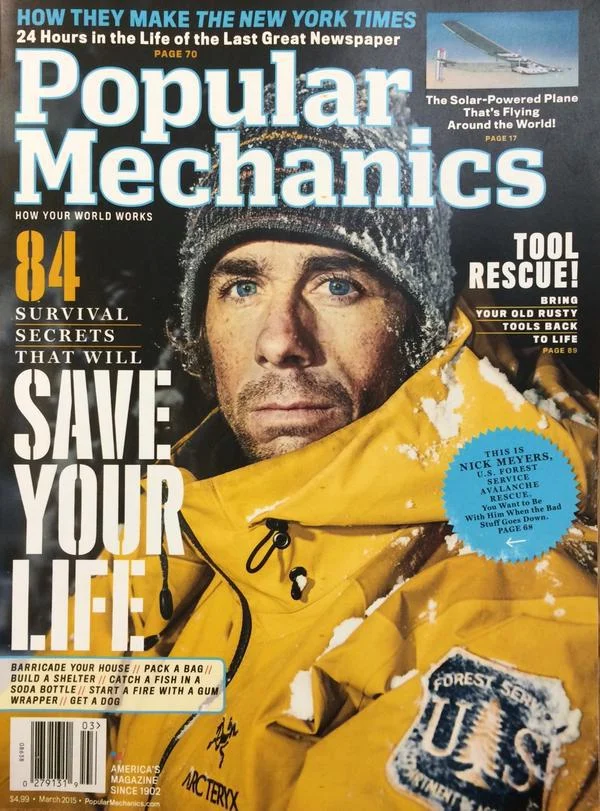
Nick Meyers, the Director of the Mount Shasta Avalanche Center and the Lead Climbing Ranger for the United States Forest Service on Mount Shasta, has received national recognition for his expertise in high-altitude safety and rescue operations by being featured on the cover of Popular Mechanics magazine. The profile highlights Meyers’ extensive experience navigating the treacherous terrain of one of California’s most prominent volcanic peaks, focusing specifically on the essential survival gear required for avalanche rescue and backcountry navigation. This mainstream media acknowledgment underscores the growing importance of avalanche awareness as backcountry recreation continues to see a surge in participation across the United States.
Meyers, who has served as a cornerstone of the Mount Shasta climbing community for over a decade, was selected by Popular Mechanics to provide a definitive guide on the "10 survival essentials" that professional rescuers rely upon in life-or-death situations. The feature serves as both a profile of Meyers’ professional life and an educational resource for the magazine’s global audience, bridging the gap between professional search-and-rescue (SAR) protocols and the needs of the average outdoor enthusiast.
Professional Background and the Mount Shasta Avalanche Center
Nick Meyers’ dual role as a Lead Climbing Ranger and the Director of the Mount Shasta Avalanche Center (MSAC) places him at the intersection of public safety, education, and emergency response. Mount Shasta, a 14,179-foot stratovolcano in the Cascade Range, attracts thousands of climbers, skiers, and hikers annually. Its unique geography, characterized by massive vertical relief and exposure to Pacific storm systems, creates complex snowpack conditions that require constant monitoring.
The Mount Shasta Avalanche Center was established to provide the public with critical information regarding snow stability and weather forecasts. Under Meyers’ leadership, the center has expanded its reach, utilizing digital platforms to provide real-time updates that are vital for decision-making in the backcountry. The center operates as a partnership between the U.S. Forest Service and the non-profit "Friends of the Mount Shasta Avalanche Center," a collaboration that ensures the facility remains funded and capable of providing daily advisories during the winter and spring months.
Meyers’ career has been defined by a commitment to "boots-on-the-ground" data collection. As a lead ranger, his duties involve not only administrative oversight but also active patrolling, conducting rescues, and performing snow pit analysis to determine the structural integrity of various snow layers. This hands-on expertise is what prompted Popular Mechanics to seek his insight for their "Survival Essentials" feature.
Chronology of Mount Shasta Safety Initiatives
The recognition of Nick Meyers by a major national publication is the culmination of a long-term effort to professionalize and publicize mountain safety on Mount Shasta.
- 1998-1999: The Mount Shasta Avalanche Center is formally established to address the increasing number of winter recreators and a series of high-profile accidents on the mountain.
- 2002: Nick Meyers begins his tenure with the U.S. Forest Service on Mount Shasta, initially working as a seasonal ranger before ascending to leadership roles.
- 2010-2015: The MSAC undergoes a digital transformation, improving the accuracy of its forecasting models and expanding its educational outreach programs to include "Avalanche Awareness" clinics for the local community.
- 2015: Popular Mechanics identifies Meyers as a leading voice in the field, culminating in the cover story and an in-depth digital feature regarding the logistics of mountain survival.
- Present Day: The MSAC continues to serve as a primary safety hub for the Shasta-Trinity National Forest, with Meyers remaining at the helm of both the forecasting and ranger divisions.
This timeline illustrates a steady progression from localized safety efforts to a nationally recognized standard of excellence in alpine management.
Supporting Data: The Rising Risks of Backcountry Recreation
The feature in Popular Mechanics comes at a time when avalanche safety data suggests a critical need for expert-led education. According to statistics from the Colorado Avalanche Information Center (CAIC), which tracks national trends, avalanche fatalities in the United States have averaged approximately 27 per year over the last decade. However, the number of "near misses" and non-fatal involvements is estimated to be significantly higher, often involving individuals who lack formal training or the necessary survival equipment.
Data from the Outdoor Industry Association indicates that participation in "human-powered" winter sports—such as alpine touring, split-boarding, and snowshoeing—has increased by over 20% in the last five years. This influx of new participants into uncontrolled mountain environments has placed a greater burden on agencies like the U.S. Forest Service. On Mount Shasta specifically, the ranger station issues thousands of summit passes annually, with peak weekends seeing hundreds of climbers attempting the ascent via Avalanche Gulch.
The gear highlighted by Meyers in his feature addresses the primary causes of death in avalanche incidents: asphyxiation and trauma. Statistical analysis of avalanche burials shows that victims found and extricated within 15 minutes have a survival rate of approximately 93%. That rate drops precipitously to 25% after 45 minutes. The "10 essentials" promoted by Meyers are designed to bridge this critical time gap.
The Ten Survival Essentials: A Professional Analysis
In the Popular Mechanics feature, Meyers breaks down the kit he carries during every mission. While the "Ten Essentials" is a concept that dates back to the 1930s, Meyers updates the list for the modern era, emphasizing technical tools that facilitate rapid rescue.
- Avalanche Transceiver (Beacon): The most critical tool for locating a buried partner. Meyers emphasizes the need for a three-antenna device for pinpoint accuracy.
- Collapsible Probe: Used to physically locate a victim beneath the snow once the beacon has narrowed the search area.
- Durable Shovel: A metal shovel is mandatory; plastic versions often fail in the debris of a "hard-slab" avalanche.
- Navigation Tools: While GPS is standard, Meyers advocates for the continued use of a physical map and compass, which do not rely on battery life or satellite signals.
- Emergency Communication: Devices such as the InReach or satellite phones are essential in the "dead zones" of the Shasta-Trinity National Forest where cellular service is non-existent.
- First Aid Kit: Specifically tailored for trauma and hypothermia management.
- Repair Kit and Tools: Including multi-tools and tape to fix broken bindings or skins, which can prevent a "stranded" scenario.
- Extra Layers and Insulation: Essential for surviving an unexpected night out in sub-zero temperatures.
- High-Calorie Nutrition and Hydration: Maintaining metabolic heat is a key component of survival.
- Emergency Shelter: A lightweight bivouac sack or "space blanket" to protect against wind chill and moisture.
Meyers’ analysis suggests that having the gear is only half the battle; the proficiency to use it under extreme stress is what ultimately saves lives.
Official Responses and Community Impact
The U.S. Forest Service (USFS) has expressed support for the feature, viewing it as an opportunity to amplify their safety messaging to a broader demographic. In a statement released via their official blog, the Shasta-Trinity National Forest noted that Meyers’ appearance in Popular Mechanics reflects the high caliber of personnel within the agency. "Nick represents the dedication and professional expertise required to manage our public lands safely," the statement noted. "His ability to communicate complex safety protocols to the general public is a vital service."
Local outdoor organizations, including the "Friends of the Mount Shasta Avalanche Center," have also lauded the coverage. They argue that national exposure helps secure the necessary funding and public interest to maintain the center’s operations. For the local community in the town of Mount Shasta, Meyers is a well-known figure whose visibility in a national magazine reinforces the town’s status as a premier—yet serious—mountaineering destination.
Broader Implications for Alpine Safety and Policy
The elevation of a Forest Service ranger to the cover of a major technology and mechanics magazine signals a shift in how the public perceives outdoor safety. It moves the conversation from "adventure" to "risk management." As climate change continues to alter snowpack patterns—leading to more frequent "extreme" weather events and unpredictable freeze-thaw cycles—the role of avalanche centers becomes even more critical.
Meyers’ feature also touches upon the "heuristic traps" that often lead to mountain accidents. These are psychological shortcuts—such as "social proof" or "familiarity"—that cause even experienced climbers to ignore physical warning signs in the snow. By focusing on gear and preparation, Meyers provides a framework for objective decision-making that can override dangerous subjective impulses.
Furthermore, the focus on technical gear in Popular Mechanics highlights the evolution of search-and-rescue technology. From the development of RECCO reflectors to the integration of AI in snowpack modeling, the field of avalanche science is becoming increasingly sophisticated. However, as Meyers demonstrates, the core of the work remains the same: a deep, physical understanding of the mountain and a disciplined approach to preparation.
Conclusion
The feature of Nick Meyers in Popular Mechanics serves as a testament to his years of service on Mount Shasta and his standing as a national authority on alpine survival. By detailing the essential tools of the trade, Meyers and the magazine provide a valuable service to the public, potentially reducing the number of preventable accidents in the backcountry. As the Director of the Mount Shasta Avalanche Center, Meyers continues to lead by example, ensuring that those who venture into the high country are as prepared as the professionals who stand ready to rescue them.
His message remains clear: the mountain offers immense beauty and challenge, but it demands respect, preparation, and the right equipment. The national spotlight on Meyers is not just a personal achievement but a significant moment for the entire search-and-rescue community, highlighting the quiet, essential work performed by those who patrol our nation’s most dangerous peaks.
