

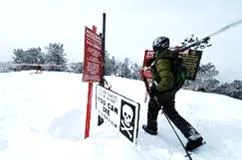
The term "sidecountry" has become a pervasive part of the modern skiing lexicon, describing out-of-bounds terrain that is accessed via the lift systems of established ski resorts. While the proximity to groomed runs and base-area amenities provides a veneer of safety, the reality of these areas is far more complex and dangerous. Unlike the managed slopes within a resort’s boundary, sidecountry terrain is essentially uncontrolled and unpatrolled backcountry. This distinction is critical for winter recreationists to understand, as the transition from a managed ski area to the sidecountry represents a total shift in responsibility, risk management, and emergency response protocols.
The Illusion of Managed Safety
Many of the premier ski destinations in the United States operate under special-use permits on United States Forest Service (USFS) land. These resorts are often adjacent to vast expanses of public wilderness. To accommodate the growing demand for "extreme" terrain, many resorts have installed "backcountry access gates." These gates serve as the legal and physical threshold between a controlled environment and the wild.
Within the resort boundaries, professional ski patrols perform extensive avalanche mitigation. This includes the use of explosives, hand charges, and "ski cutting" to trigger small, controlled slides before the public is allowed on the mountain. Furthermore, these areas are patrolled throughout the day to assist injured skiers and ensure compliance with safety regulations. However, once a rider passes through a boundary gate, these services vanish. The snowpack in the sidecountry is subject only to the whims of nature, and there is no guarantee that the slopes have been stabilized.
A Chronology of the Sidecountry Excursion
The transition from a safe resort environment to a high-risk backcountry scenario often happens within a matter of minutes, leading to a psychological phenomenon known as the "boundary mask." This occurs when skiers fail to recognize that the rules of the environment have changed.
Phase I: The Resort Approach
The day typically begins in the resort parking lot. At this stage, the environment feels entirely managed. Families arrive, children head to ski school, and the presence of lodge facilities and uniformed staff reinforces a sense of security. As noted by safety experts, parents often "wave goodbye" to their teenagers, assuming the day will be spent within the confines of the resort’s safety net.
Phase II: The Lift-Assisted Ascent
Skiers use high-speed quads or gondolas to reach the upper ridges of the mountain. This eliminates the physical exertion typically required for backcountry skiing, such as skinning or hiking for hours. This lack of physical effort often prevents skiers from observing the snowpack or noticing changing weather patterns, which are critical components of traditional backcountry preparation.
Phase III: The Gate Transition
At the summit or along a ridgeline, skiers encounter the access gate. These gates are usually adorned with warning signs stating that "Rescue is not guaranteed" and "You are entering uncontrolled terrain." Despite these warnings, the presence of tracks leading into the trees often provides "social proof," leading less-experienced riders to believe the area is safe simply because others have skied it.
Phase IV: The Incident and Response
If an avalanche occurs or a medical emergency arises in the sidecountry, the timeline for rescue shifts from minutes to hours or even days. Because ski patrols are not responsible for off-property incidents, the task falls to local Search and Rescue (SAR) teams, which are often composed of volunteers. These teams must be mobilized from the valley, travel to the resort, and then navigate to the victim’s location—a process that is significantly slower than an in-bounds response.
Supporting Data: The Rising Toll of Sidecountry Incidents
Statistical data from the Colorado Avalanche Information Center (CAIC) and the American Avalanche Association (A3) highlights a concerning trend regarding sidecountry fatalities. Over the last two decades, the percentage of avalanche deaths occurring in lift-accessed backcountry has seen a measurable uptick.
According to national records, approximately 90% of avalanche victims trigger the slide themselves or have it triggered by someone in their party. In the sidecountry, this risk is exacerbated by high skier density. Unlike remote backcountry peaks where a party might be the only group on the mountain, sidecountry "stashes" can attract dozens of people, increasing the likelihood of one group triggering a slide onto another group below.
Furthermore, data suggests a "gear gap" in sidecountry users. While traditional backcountry skiers almost universally carry an avalanche transceiver, probe, and shovel, a significant portion of sidecountry riders enter the terrain without these essential tools. A 2015 study indicated that nearly 40% of riders exiting resort gates lacked the basic safety equipment necessary for a companion rescue, relying instead on the false hope that ski patrol would be available to assist.
The "Rated R" Metaphor: Expert Perspectives
The phrase "Sidecountry: Rated R" was popularized by avalanche safety educators like Doug Chabot to emphasize that these areas are for "mature audiences only"—specifically, those with the education, gear, and experience to manage high-level risks.
"After a parent waves goodbye in the ski area parking lot, do they know what the kids are doing? Are they leaving the ski area for R-rated terrain?" Chabot asks. This question underscores a growing concern regarding the demographic of sidecountry users. Younger skiers, influenced by "free-ride" media and professional ski films, often seek out the steepest and most aggressive terrain without the foundational knowledge of snow science.
Professional ski patrollers have echoed these sentiments. Many report that their primary challenge is not managing the snow within the ropes, but managing the expectations of the public. "People see a rope line and think it’s a suggestion, not a life-saving boundary," noted one veteran patroller from the Intermountain West. "They don’t realize that three feet past that rope, the snowpack might be a ticking time bomb of faceted weak layers that we haven’t touched with explosives all season."
Official Responses and Regulatory Frameworks
The management of sidecountry terrain involves a complex intersection of federal law and private liability. Most ski resorts operate under the Skier Safety Act, which varies by state but generally protects resorts from liability regarding the "inherent risks" of skiing. However, these protections are most robust for incidents occurring within the permit area.
The USFS has maintained a policy of "open boundaries" at many resorts to respect public access to national forest lands. However, in response to the rising number of rescues, some forests have implemented "Special Closure Areas" where entering the backcountry is strictly prohibited during high-hazard periods.
Search and Rescue organizations have also become more vocal about the strain sidecountry incidents place on their resources. "Every time we have to go into the sidecountry for a rescue, we are putting our volunteers at risk in terrain that hasn’t been mitigated," stated a spokesperson for a mountain rescue association. This has led to debates in some jurisdictions about whether individuals rescued in the sidecountry should be held financially responsible for the cost of the mission, which can run into the tens of thousands of dollars.
Technical Analysis of Sidecountry Hazards
The primary technical hazard in the sidecountry is the "unconsolidated snowpack." In-bounds, the constant traffic of thousands of skiers acts as "boot packing," which helps to break down weak crystal structures in the snow and creates a more homogenous, stable base. Sidecountry terrain, by definition, lacks this constant compaction.
Consequently, the sidecountry often harbors "persistent weak layers"—types of snow crystals like depth hoar or surface hoar that can remain unstable for weeks or months. A single heavy snowfall or a period of high wind can load these weak layers to a breaking point. To an untrained eye, the surface may look like "hero powder," but the underlying structure may be incapable of supporting the weight of a skier.
Another significant factor is "terrain traps." Sidecountry areas often feature gullies, creek beds, and "pillows" that can funnel avalanche debris into a concentrated area. In these traps, even a relatively small slide can bury a person under several meters of snow, making survival nearly impossible even with a fast rescue.
Broader Impact and Implications for the Industry
The "sidecountry" phenomenon is forcing a reckoning within the ski industry and the winter sports community. There is a growing movement to rename these areas "lift-accessed backcountry" to remove the linguistic association with the "side" of the resort, which implies a secondary level of safety.
Educational organizations like the American Institute for Avalanche Research and Education (AIARE) have developed specific curriculum modules aimed at sidecountry users. These programs emphasize that the "gate" is a mental reset point. Before passing through, a group should perform a "beacon check," review the daily avalanche bulletin, and confirm that every member of the party is prepared for a self-rescue.
For the industry, the challenge lies in balancing the marketing of "extreme" experiences with the reality of mountain safety. As gear technology continues to advance, allowing more people to access difficult terrain with less effort, the responsibility for education falls increasingly on the shoulders of the users themselves.
The "Rated R" nature of the sidecountry serves as a stark reminder: the mountains do not know where the resort boundary ends, and they do not offer forgiveness for the unprepared. True safety in the sidecountry is not provided by a ski patrol vest or a lift ticket; it is earned through education, proper equipment, and the humility to turn back when the conditions demand it.
