

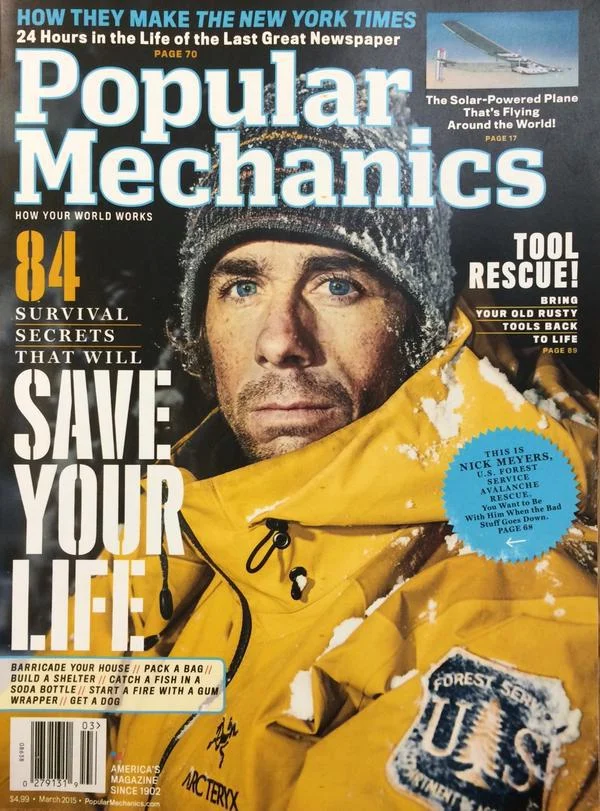
Nick Meyers, the Director of the Mount Shasta Avalanche Center (MSAC) and the Lead Climbing Ranger for the Mount Shasta-Trinity National Forest, has reached a significant milestone in public safety outreach by being featured on the cover of Popular Mechanics. The feature article, titled "10 Survival Essentials an Avalanche Rescue Expert Always Carries," positions Meyers as a primary authority on wilderness survival, gear selection, and high-altitude rescue operations. This recognition comes at a critical time for the outdoor recreation industry, as increasing numbers of enthusiasts venture into technical backcountry terrain, often without the requisite knowledge of snowpack dynamics or emergency preparedness.
The Popular Mechanics feature serves as more than a personal profile; it acts as a platform for the United States Forest Service (USFS) to disseminate life-saving information to a mainstream audience. Meyers, who has spent over a decade patrolling the slopes of Mount Shasta, provides a detailed breakdown of the tools and mindset required to survive the volatile conditions of one of California’s most prominent and dangerous peaks. The collaboration between a federal safety official and a major technology and mechanics publication highlights the evolving intersection of professional mountaineering, engineering, and public education.
The Professional Background of Nick Meyers
Nick Meyers’ ascent to the role of Director at the Mount Shasta Avalanche Center is the result of a career dedicated to the rigorous study of snow science and mountain safety. As the Lead Climbing Ranger, Meyers oversees the management of climbing activities on Mount Shasta, a 14,179-foot stratovolcano that attracts approximately 15,000 climbers and skiers annually. His responsibilities encompass a broad spectrum of duties, from performing technical high-angle rescues to conducting detailed snow stability tests that form the basis of daily avalanche advisories.
Under Meyers’ leadership, the Mount Shasta Avalanche Center has expanded its reach, providing critical data to the public regarding the "avalanche rose"—a graphical representation of aspect and elevation risks—and weather patterns specific to the Cascade Range. His dual role as a law enforcement officer for the Forest Service and a scientific researcher allows him to approach mountain safety from both a regulatory and an educational perspective. The Popular Mechanics cover story validates this multifaceted expertise, emphasizing that survival in the backcountry is as much about the "mechanics" of the gear as it is about the "mechanics" of the environment.
Mount Shasta: A High-Risk Alpine Environment
To understand the significance of Meyers’ survival advice, one must consider the unique challenges posed by Mount Shasta. Unlike many peaks in the Sierra Nevada, Mount Shasta stands in relative isolation, creating its own weather systems. The mountain is prone to high-velocity winds, rapid temperature fluctuations, and significant snowfall—factors that contribute to high avalanche danger.
Mount Shasta’s primary climbing routes, such as Avalanche Gulch, are subject to frequent rockfalls and "wet slide" avalanches during the spring and summer months. Data from the USFS indicates that while the mountain is accessible, it remains one of the most hazardous peaks in the continental United States for unprepared climbers. The MSAC records show that the majority of incidents on the mountain occur due to a combination of equipment failure and poor decision-making regarding weather windows. By featuring Meyers, Popular Mechanics addresses these specific risks, using his firsthand experience to illustrate the thin margin between a successful expedition and a catastrophic failure.
Analysis of the 10 Survival Essentials
The core of the Popular Mechanics feature revolves around the "10 Survival Essentials," a list curated by Meyers based on his years of rescue experience. While the concept of "ten essentials" has existed in scouting and mountaineering circles for decades, Meyers’ list is specifically tailored to the modern backcountry traveler. The items highlighted are not merely for comfort; they are technical assets designed to mitigate the specific physics of an avalanche or a high-altitude stranding.
- Avalanche Transceiver: A digital device used to locate buried individuals. Meyers emphasizes the shift from analog to multi-antenna digital signals for faster recovery.
- Probes and Shovels: Essential for the physical recovery of victims. Meyers notes that the density of avalanche debris can be comparable to concrete, requiring high-tensile strength aluminum shovels.
- Communication Devices: While cell phones are often unreliable in the Shasta-Trinity National Forest, Meyers advocates for satellite messengers (such as Garmin inReach) and two-way radios.
- Navigation Tools: High-accuracy GPS units and traditional topographic maps remain non-negotiable for whiteout conditions.
- Insulation: The use of technical layers to prevent hypothermia, which is the leading cause of death in mountain rescue delays.
- Illumination: High-lumen headlamps for night navigation and signaling.
- First Aid Supplies: Specifically geared toward trauma and high-altitude sickness.
- Fire Starters: Compact, waterproof tools for emergency warmth.
- Repair Kits and Tools: Multi-tools and tape to fix bindings or skins in the field.
- Nutrition and Hydration: High-calorie, stable food sources to maintain metabolic heat.
Meyers’ selection reflects a shift toward "proactive survival"—the idea that the right gear should help a climber avoid a crisis, rather than just surviving one once it has begun.
Chronology of Mount Shasta Safety Evolution
The recognition of Nick Meyers by a national publication is a milestone in a timeline of safety improvements on Mount Shasta that began in the late 20th century.
- 1998: The Mount Shasta Avalanche Center was officially founded to address the growing number of winter recreationists and the associated rise in avalanche-related fatalities.
- Early 2000s: The USFS began professionalizing the Climbing Ranger program, moving from a seasonal volunteer-based model to a year-round professional staff with specialized medical and technical training.
- 2010–2014: Under Meyers’ tenure, the MSAC integrated more advanced meteorological technology, allowing for real-time weather stations at high elevations (e.g., Old Ski Bowl at 7,600 ft and Grey Butte at 8,000 ft).
- 2015: The Popular Mechanics cover story brings national attention to the MSAC’s efforts, coinciding with a surge in "human-powered" backcountry skiing across North America.
This timeline illustrates a move away from "reactive" search and rescue toward a "preventative" education model. The Forest Service’s strategy is to use figures like Meyers to build a culture of safety that reduces the burden on local Search and Rescue (SAR) teams and Siskiyou County resources.
Supporting Data on Avalanche Safety and Public Impact
The impact of educational outreach, such as Meyers’ magazine feature, can be measured through national avalanche statistics. According to the Colorado Avalanche Information Center (CAIC), which tracks national data, there has been a notable trend over the last decade: while the number of people entering the backcountry has skyrocketed, the number of fatalities has remained relatively flat. Experts attribute this to better gear and, more importantly, better access to information provided by experts like Meyers.
On Mount Shasta specifically, the MSAC website and daily advisories receive tens of thousands of hits during the peak season. In seasons where education and outreach are high, the "incident-to-visitor" ratio tends to decrease. For example, during high-snowfall years where avalanche danger is "Extreme" or "High," the MSAC’s ability to communicate these risks directly affects the number of rescues performed by the Climbing Rangers. Meyers’ appearance in Popular Mechanics serves to reinforce these statistics by reaching the "casual" or "aspirational" adventurer who may not yet be a regular reader of specialized avalanche bulletins.
Official Responses and Broader Implications
While the Forest Service typically maintains a low-profile, administrative tone, the promotion of Meyers’ feature on the official USFS blog signals a strategic shift. By highlighting Meyers, the agency is humanizing the role of the Ranger and emphasizing the "expert" status of its personnel. This builds public trust, which is essential when Rangers must issue warnings or close certain areas due to hazardous conditions.
The broader implications of this media coverage extend to the outdoor industry at large. When a mainstream publication like Popular Mechanics focuses on survival gear through the lens of a professional ranger, it pressures manufacturers to prioritize durability and functionality over aesthetic trends. It also elevates the discourse on public lands management, reminding the public that National Forests are not just playgrounds, but managed environments that require respect and specialized knowledge.
Conclusion: The Legacy of Professional Stewardship
Nick Meyers’ feature on the cover of Popular Mechanics is a testament to his dedication to the Mount Shasta community and the broader field of mountain safety. By distilling years of life-and-death experience into accessible advice, he provides a roadmap for the next generation of climbers and skiers.
As the Director of the Mount Shasta Avalanche Center, Meyers continues to be a pivotal figure in the effort to balance the freedom of the hills with the realities of alpine risk. This national recognition serves as a reminder that the most important "mechanic" in any survival situation is a prepared and educated mind. Through his work on the mountain and his presence in the media, Meyers ensures that the "10 essentials" are not just items in a backpack, but a philosophy of respect for the power of the natural world.
