

The landscape of American winter recreation has undergone a seismic shift since the mid-1990s, transitioning from a niche pursuit for a dedicated few into a mainstream industry defined by high-tech equipment and massive public participation. During the winter of 1994/95, the infrastructure of avalanche safety was in its relative infancy. At that time, Knox Williams led the Denver-based Colorado Avalanche Information Center, Bruce Tremper managed operations in Utah, and Mark Moore headed the Northwest Avalanche Center in Seattle. Other regional hubs were similarly localized, with Jim Kanzler overseeing Jackson Hole and Brad Ray leading efforts at Mount Washington. In Bozeman, Montana, a fledgling avalanche center founded by researcher Karl Birkeland was only in its fifth season of operation. At this stage in history, centers did not yet exist in high-traffic areas such as the Chugach Range in Alaska, the Lake Tahoe region, or Mount Shasta.
The technological profile of the 1994/95 backcountry traveler was starkly different from today. The vast majority of backcountry skiers utilized telemark equipment, frequently pairing heavy skis with leather boots. Snowmobiles of the era lacked the power-to-weight ratios and specialized track designs that allow modern riders to navigate steep, technical terrain. Furthermore, the concept of "sidecountry"—resort-adjacent backcountry accessed via chairlifts—was not yet a recognized term, as most ski areas maintained strictly closed boundaries. Perhaps most significantly, the digital age had not yet arrived; the first avalanche advisories were only just beginning to appear on the nascent World Wide Web toward the conclusion of that season.
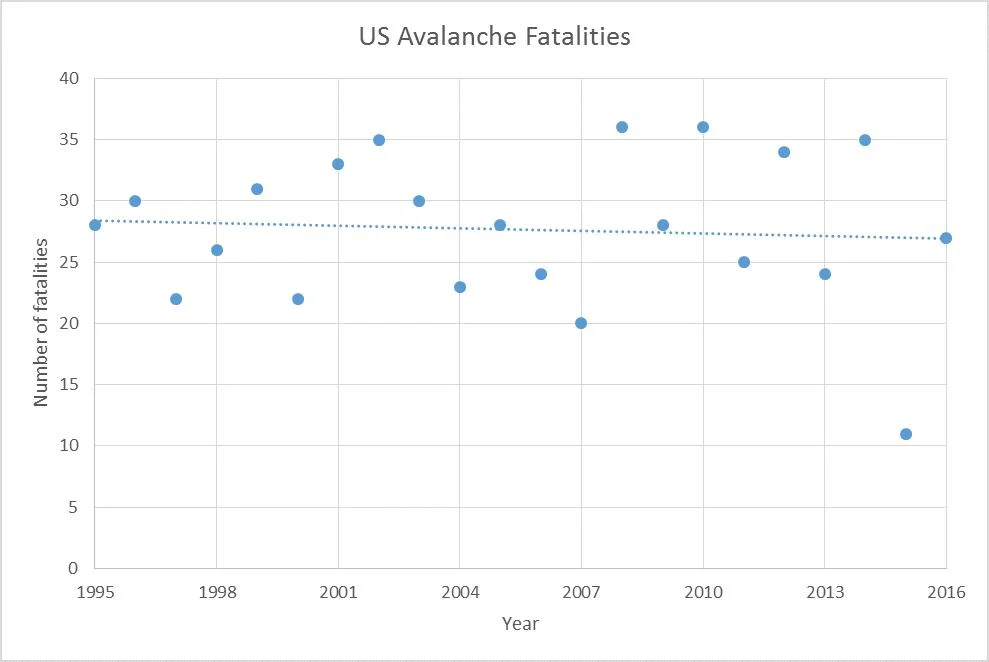
Despite these primitive beginnings and the subsequent "explosion" in backcountry usage over the following 22 seasons, a surprising statistical trend has emerged: the annual number of U.S. avalanche fatalities has not increased. Data compiled by the Colorado Avalanche Information Center (CAIC) and analyzed by experts such as Birkeland reveal that from the 1994/95 winter through the 2015/16 winter, the fatality rate remained remarkably steady. This period of stability occurred even as the mountain community transitioned through the eras of smartphones, social media, lightweight alpine touring (AT) gear, and high-performance mountain sleds.
Statistical Stability in a Changing Environment
The primary metric of concern for public safety officials is the total number of annual fatalities. According to Figure 1 of the CAIC data set, the trend line for U.S. avalanche fatalities over this 22-year span shows a slight decrease, though researchers note that this trend is not statistically significant (p = 0.7). In statistical terms, this indicates that there is no evidence of a definitive change in the number of deaths, despite the massive influx of people into avalanche terrain.
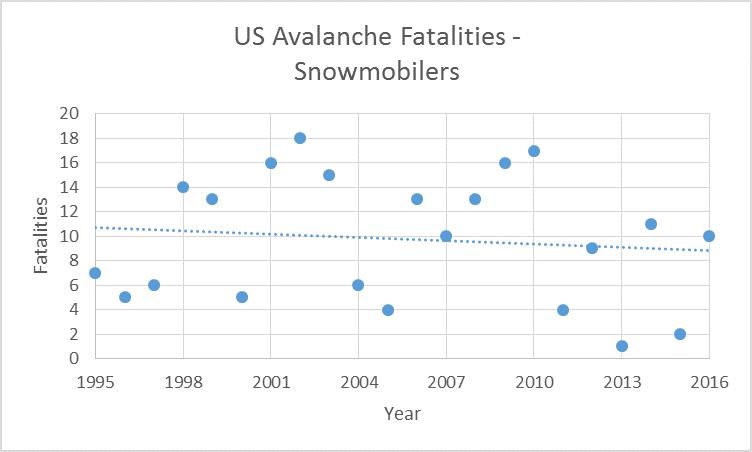
When the data is segmented by user group, the results remain consistent. Snowmobile-related fatalities have also remained flat over the same period (Figure 2), with a slightly decreasing trend line that lacks statistical significance (p = 0.6). There is, however, a marginal nuance regarding non-motorized users. Figure 3 indicates that the number of backcountry skier and snowboarder fatalities is also relatively flat, though there is a subtle statistical signal (p = 0.07) suggesting a potential slight increase. Nevertheless, when compared against the sheer volume of new participants in these sports, the overall trend remains a testament to effective safety interventions.
The Usage Proxy: Measuring the Backcountry Explosion
The significance of a flat fatality line is only fully understood when contrasted with the growth in backcountry participation. While obtaining precise figures for dispersed winter recreation is notoriously difficult due to the lack of centralized ticketing or entry points, researchers use avalanche advisory usage as a proxy for public engagement.
The data regarding advisory access reveals a staggering increase in public interest. Over the 22-season study period, the Utah Avalanche Center reported a 12-fold increase in the number of people accessing its forecasts. The Colorado Avalanche Information Center saw usage increase 17-fold, while the Gallatin National Forest Avalanche Center in Montana experienced a 36-fold increase. Most dramatically, the Northwest Avalanche Center in Seattle recorded a 60-fold increase in advisory usage.
While some of this growth can be attributed to the transition from phone-in "hotlines" to easily accessible mobile websites and apps, the magnitude of the change suggests a fundamental shift in user behavior. Even using a highly conservative estimate of an eight-fold increase in total backcountry use, the implications for public safety are profound. If the fatality rate (the number of deaths per user-day) had remained constant while use increased eight-fold, the United States could have reasonably expected upwards of 200 avalanche fatalities per winter. Instead, the number has stayed largely within the historical average of 25 to 30 deaths per year. This suggests that the fatality rate has dropped by at least a factor of eight, and likely more, over the past two decades.
A Multi-Front Success Story: Education and Technology
Experts attribute this dramatic decrease in the fatality rate to a combination of improved education, technological innovation, and a robust professional forecasting network. The "win" for public safety is shared across several sectors of the outdoor industry.
The Evolution of Education
Avalanche education has moved from a niche academic subject to a widely accessible public safety campaign. Programs like "Know Before You Go" (KBYG) have been instrumental in providing basic awareness to middle school and high school students, as well as casual weekend warriors. Simultaneously, professional organizations such as the American Institute for Avalanche Research and Education (AIARE) have standardized the curriculum for Level 1, 2, and 3 courses, ensuring that backcountry travelers receive consistent, high-quality instruction across the country.
Technological Advancements
The mid-1990s marked the beginning of a golden age for safety equipment. In 1994, avalanche transceivers were largely analog and required significant practice to master. Today, digital triple-antenna beacons have simplified the search process, making it faster and more intuitive for stressed rescuers. Other innovations have provided additional layers of defense:
- Avalanche Airbags: These packs, which use a large inflated balloon to keep the wearer near the surface of a slide, have become a standard piece of equipment for many.
- Avalungs: Devices designed to allow a buried victim to breathe under the snow for an extended period by diverting CO2 away from the face.
- Lightweight Helmets: Increased awareness of trauma-related deaths in avalanches has led to higher helmet adoption rates.
- Improved Gear: The transition from leather boots and telemark bindings to carbon-fiber AT boots and high-performance "tech" bindings has allowed users to move more efficiently and maintain better control in challenging conditions.
The Role of Regional Avalanche Centers
Central to this success is the U.S. regional avalanche center network. These organizations serve as the backbone of the safety community, providing daily advisories that translate complex snowpack science into actionable information for the public. The growth of these centers—expanding into regions like the Cascades, the Sierra Nevada, and the Chugach—has ensured that as users push further into the wilderness, they do so with a professional assessment of the risks involved.
The Colorado Avalanche Information Center, which provided the data for this analysis, serves as a primary repository for accident documentation. This meticulous record-keeping allows the community to learn from "near misses" and fatalities, constantly refining educational materials to address common human errors and heuristic traps.
Implications and Future Outlook
While the flat fatality trend is a cause for celebration among safety professionals, it also presents new challenges. The "sidecountry" phenomenon continues to blur the lines between managed resort terrain and the unmanaged backcountry, often attracting users who may not be fully equipped or educated. Furthermore, as technology allows users to access more remote and steeper terrain, the margin for error remains thin.
The statistical evidence suggests that the current model of public safety—relying on a mix of professional forecasting, high-tech rescue gear, and community-driven education—is working effectively. However, maintaining this flat line in the face of continued population growth in mountain corridors and the increasing popularity of winter sports will require sustained funding for avalanche centers and a continued emphasis on the "Know Before You Go" philosophy.
Ultimately, the data from 1994 to 2016 provides a powerful narrative of resilience. In an era where many aspects of mountain recreation have become more dangerous due to overcrowding and increased speed, the avalanche community has managed to significantly lower the per-capita risk. As Karl Birkeland and his colleagues at the CAIC note, this achievement is a testament to the collective efforts of educators, manufacturers, and the recreationists themselves, who have increasingly embraced a culture of safety and informed decision-making.
