

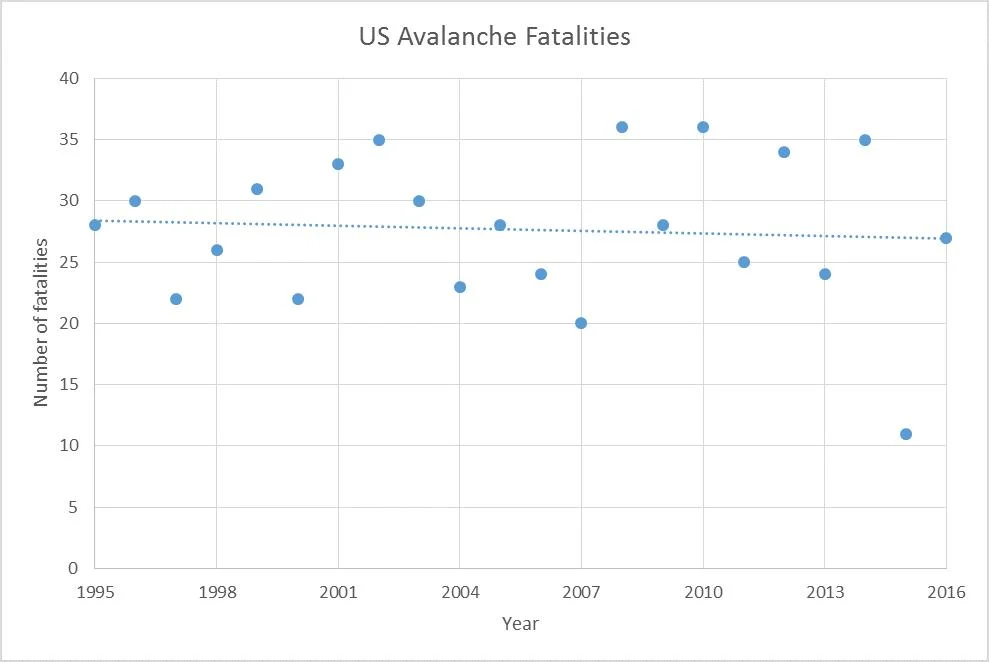
The landscape of backcountry recreation in the United States has undergone a seismic shift over the last quarter-century, transitioning from a niche pursuit involving specialized equipment to a mainstream winter activity supported by advanced technology and widespread digital infrastructure. According to data compiled by the Colorado Avalanche Information Center (CAIC) and analyzed by leading experts in the field, including Karl Birkeland of the National Avalanche Center, a surprising paradox has emerged: despite a massive explosion in the number of people entering avalanche-prone terrain, the annual number of fatalities has remained remarkably stable. This statistical plateau, spanning more than two decades, suggests a significant increase in the efficacy of avalanche education, forecasting, and rescue technology, effectively lowering the per-capita risk for backcountry travelers.
The Historical Context: The 1994/95 Baseline
To understand the current state of avalanche safety, one must look back to the mid-1990s, a period that served as a turning point for the industry. During the 1994/95 winter season, the infrastructure for avalanche awareness was in its infancy. In Denver, Utah, and Seattle, the three primary avalanche centers were led by pioneers Knox Williams, Bruce Tremper, and Mark Moore, respectively. Other regions, such as Jackson Hole and Mount Washington, maintained smaller operations, while now-essential centers in areas like the Chugach Mountains, Lake Tahoe, and Mount Shasta did not yet exist.
The equipment of the era also tells a story of limited accessibility and different physical demands. Telemark skiing was the dominant mode of backcountry travel, often performed in leather boots that provided minimal support compared to modern standards. Snowmobiles, while present, lacked the power-to-weight ratios and high-performance tracks that allow modern riders to navigate steep, technical, and high-elevation terrain. Furthermore, the concept of "sidecountry"—accessible backcountry terrain adjacent to ski resort boundaries—had not yet entered the popular lexicon. Most ski areas maintained strictly closed boundaries, and the internet was only beginning to emerge as a tool for public safety, with the first digital avalanche advisories appearing only at the conclusion of the 1995 season.
Statistical Analysis of Fatality Trends
A comprehensive review of U.S. avalanche fatalities from the 1994/95 season through the 2015/16 season reveals a trend line that is statistically flat. Despite the increasing popularity of winter sports, the average number of deaths per year has not seen a significant upward trajectory.
Data provided by the CAIC indicates that while there are year-to-year fluctuations based on snowpack stability and weather patterns, the long-term "least squares" trend line shows no statistically significant change. In statistical terms, the p-value for the overall fatality trend is approximately 0.7, well above the 0.05 threshold typically required to indicate a meaningful shift.
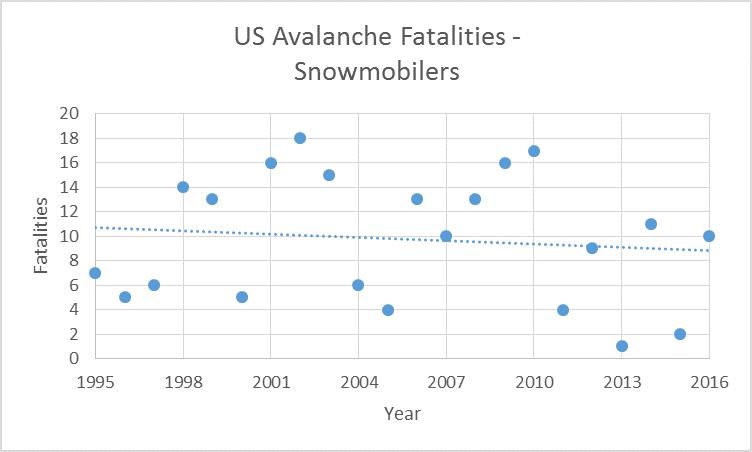
When the data is disaggregated by user group, the results remain consistent:
- Snowmobilers: The number of fatalities among motorized users has remained flat over the 22-season period. This is particularly notable given the technological leaps in snowmobile capability, which now allow riders to reach much more dangerous slopes than were accessible in the 1990s.
- Skiers and Snowboarders: There is some evidence of a slight increase in fatalities within this group, with a p-value of 0.07. While this suggests a potential upward trend, it remains statistically marginal and does not mirror the exponential growth in the number of participants.
Measuring the "Explosion" in Backcountry Use
Quantifying the exact number of backcountry users is notoriously difficult due to the dispersed nature of the activity. Unlike ski resorts, which track lift ticket sales, the backcountry has no turnstiles. However, avalanche centers use the consumption of their safety products—specifically avalanche advisories—as a proxy for participation levels.
The growth in advisory usage over the 22-year period studied is staggering:
- Utah Avalanche Center: Reported a 12-fold increase in advisory views.
- Colorado Avalanche Information Center: Reported a 17-fold increase.
- Gallatin National Forest Avalanche Center: Experienced a 36-fold increase.
- Northwest Avalanche Center: Saw a 60-fold increase in engagement.
While some of this growth can be attributed to the ease of accessing information via smartphones and social media, the magnitude of the increase points to a fundamental shift in how the public interacts with the mountains. Even using a conservative estimate that backcountry use has increased by a factor of eight, the fact that fatalities have remained flat implies that the fatality rate—the number of deaths per user day—has dropped by at least 800%. Experts suggest that if the fatality rate had remained constant while usage increased, the United States might now be seeing upwards of 200 avalanche-related deaths per winter, rather than the current average which typically fluctuates between 20 and 30.
Factors Contributing to the Decline in Fatality Rates
The dramatic improvement in safety outcomes can be attributed to a multi-faceted approach involving technology, institutional growth, and a cultural shift toward education.
Technological Advancements
The evolution of safety gear has provided users with better tools for both prevention and survival. In the mid-1990s, avalanche beacons (transceivers) were often analog and required significant practice to master. Modern digital beacons feature three antennas and sophisticated software that simplifies the search process, significantly reducing burial times.
Furthermore, the introduction and widespread adoption of avalanche airbag packs have been a "game-changer" for the industry. These packs, which use a large inflated bag to keep the wearer near the surface of a slide, have been shown to significantly increase survival rates in the event of an entanglement. Other tools, such as the Avalung (designed to extend the time a buried victim can breathe) and lightweight helmets, have also contributed to a reduction in trauma-related deaths.
The Role of Regional Avalanche Centers
The expansion of the regional avalanche center network has ensured that high-quality, localized weather and snowpack data are available to the public. These centers do more than just issue warnings; they provide the "ground truth" that allows recreators to make informed decisions before they ever leave their driveways. The transition from recorded telephone hotlines to sophisticated websites and mobile apps has made this information ubiquitous.
Education and Awareness Programs
The "Know Before You Go" (KBYG) program is frequently cited as a primary driver of the flat fatality trend. KBYG is a free avalanche awareness program that targets a broad audience, including middle and high school students, as well as casual weekend warriors. By focusing on five simple steps—Get the Gear, Get the Training, Get the Forecast, Get the Picture, and Get Out of Harm’s Way—the program has successfully lowered the barrier to entry for safety education. Professional guiding services and formalized Level 1 and Level 2 avalanche courses have also seen record enrollment, creating a more informed and risk-averse community of users.
Chronology of Safety Milestones (1994–2016)
- 1994/95: The baseline season. Internet usage for avalanche safety is virtually non-existent.
- Late 1990s: Digital transceivers begin to replace analog models, making search and rescue more accessible to novices.
- 2003/04: The term "sidecountry" begins to gain traction as resorts implement "open gate" policies, allowing skiers to access backcountry terrain from lifts.
- 2008/09: Smartphones begin to revolutionize the delivery of avalanche advisories, allowing users to check conditions in real-time at the trailhead.
- 2010–2015: Avalanche airbag technology becomes lighter and more affordable, leading to a surge in adoption among both motorized and non-motorized users.
- 2016: Analysis confirms that despite two decades of growth, the fatality line remains flat, marking a major success for the North American avalanche safety community.
Implications for the Future of Mountain Safety
The data suggests that the current model of public-private partnership in avalanche safety is working. The collaboration between government-funded avalanche centers (such as those run by the U.S. Forest Service), non-profit fundraising arms, and private equipment manufacturers has created a robust safety net.
However, experts warn against complacency. As backcountry use continues to grow, particularly in the "sidecountry" areas where users may have a false sense of security due to their proximity to ski resorts, the challenges for educators will evolve. The slight upward trend in skier and snowboarder fatalities, though not yet statistically definitive, suggests that the community must continue to innovate in how it reaches younger or less experienced demographics.
The "flat line" of U.S. avalanche fatalities is more than just a statistic; it is a testament to a massive, coordinated effort by educators, forecasters, and the users themselves. In an era where outdoor recreation is seeing unprecedented pressure, the ability to maintain a steady fatality rate amidst a sea of new participants is a rare and significant achievement in public safety. The goal for the next two decades remains clear: to continue the downward trend of the fatality rate and move the absolute number of annual deaths as close to zero as possible.
