

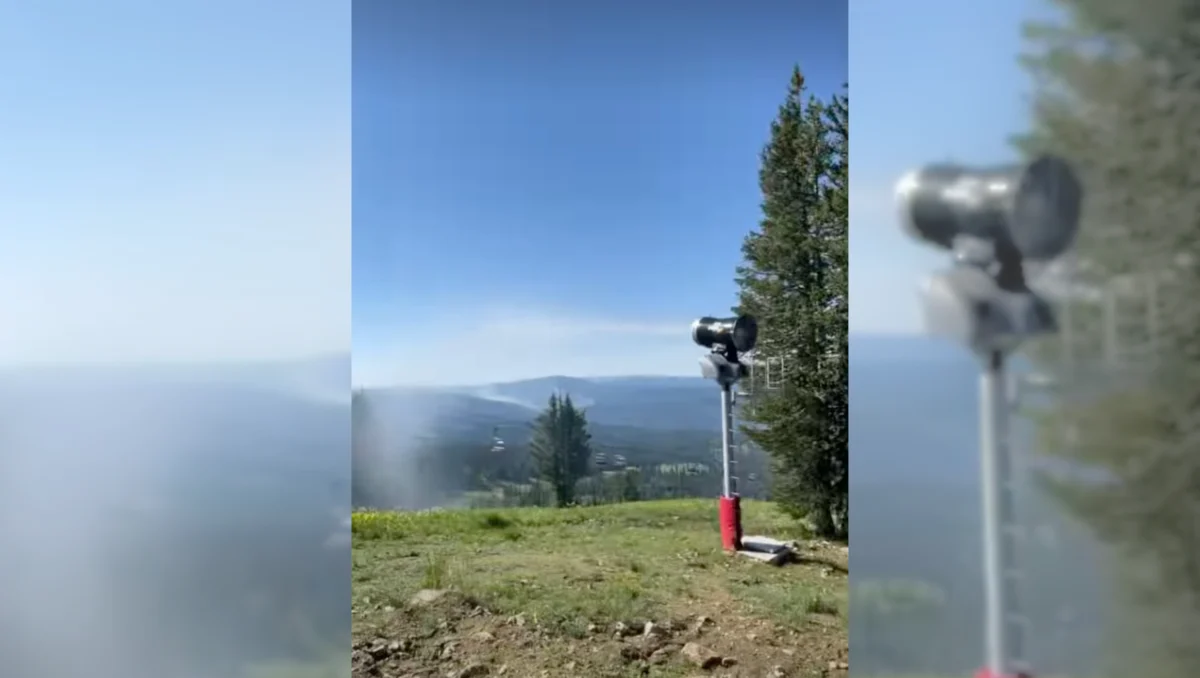
The familiar sight of snow guns, typically associated with the crisp air and burgeoning snowpack of early winter, has taken on a dramatically different, and far more urgent, purpose at Steamboat Resort in mid-July 2026. Rather than heralding the ski season, the powerful hiss of compressed air and the spray of water are now integral to the defensive measures against the burgeoning Fishhook Fire, a lightning-caused wildfire that ignited on Sunday, July 12, on national forest land southeast of the resort. This proactive deployment of ski area infrastructure underscores a growing trend among Western U.S. resorts adapting their operations to combat the escalating threat of wildfires, transforming snowmaking systems into vital tools for community and infrastructure protection during the increasingly volatile summer months.
The Unconventional Summer Blast: A Resort’s Proactive Stance
The activation of Steamboat’s sophisticated snowmaking apparatus in the Sunshine area, a popular sector of the mountain known for its wide-open runs, serves as a critical strategic maneuver. The objective is clear: to saturate the surrounding vegetation, creating a robust moisture barrier that can impede the fire’s advance towards essential resort infrastructure, including chairlifts, buildings, and other vital facilities. This seemingly paradoxical summer operation highlights the evolving role of modern ski resorts, which are increasingly compelled to serve as first lines of defense against natural disasters exacerbated by climate change. The sight of water cannons firing on sun-drenched slopes is a stark reminder of the unprecedented challenges facing mountain communities and the innovative solutions being developed to confront them. The resort’s swift action demonstrates a commitment to safeguarding both its extensive property and the broader community, working in tandem with emergency services to mitigate potential devastation.
The Fishhook Fire: Ignition, Spread, and Initial Response
The Fishhook Fire began its destructive trajectory on Sunday, July 12, 2026, sparked by a lightning strike during a period of dry thunderstorms, a common ignition source in the arid Western landscape. Igniting in the rugged, timbered terrain of national forest land southeast of Steamboat Springs, the fire quickly found ample fuel in the dense forest and dry undergrowth. The challenging topography, characterized by steep slopes and limited access, immediately complicated initial suppression efforts. Upon detection, an immediate and robust response was initiated by federal, state, and local firefighting agencies. Ground crews were deployed to establish fire lines and conduct assessments, while aerial resources, including helicopters and air tankers, were mobilized to conduct water and retardant drops, aiming to slow the fire’s progression and protect critical areas. By Monday, July 13, the fire had begun to exhibit moderate growth, prompting increased concern and the initiation of more comprehensive containment strategies. The rapid escalation of the fire in its initial stages underscored the inherent risks posed by the prevailing environmental conditions, setting the stage for Steamboat’s proactive intervention.
Steamboat’s Strategic Defense: Leveraging Infrastructure for Safety
By Tuesday, July 14, with the Fishhook Fire continuing to spread and exhibiting unpredictable behavior, Steamboat Resort management, in close consultation with incident commanders, made the decision to activate its snowmaking system. The Sunshine area, strategically located on the mountain and potentially in the path of the fire’s advance, became the focal point of this unconventional defense. The resort’s state-of-the-art snowmaking infrastructure, designed to cover vast expanses of terrain with precision-engineered snow, is uniquely capable of delivering significant volumes of water under high pressure. This network of pumps, hydrants, and extensive piping, typically used to ensure optimal ski conditions, was repurposed to drench vegetation, creating a "wet line" or defensible space. This deliberate soaking of foliage aims to increase its moisture content, making it less susceptible to ignition and slowing the fire’s spread if it reaches the resort boundary. The maneuver is not intended to extinguish the main blaze but rather to create a strategic buffer zone, buying valuable time for firefighters and reducing the immediate threat to the resort’s valuable assets. This strategic pivot highlights the versatility and adaptability required in an era of heightened wildfire risk.
The Dual Purpose of Snowmaking Infrastructure: A Growing Trend
Steamboat Resort is not an isolated case in this innovative application of ski technology. The integration of snowmaking systems into wildfire defense strategies represents a significant evolution in mountain resort management and an increasingly critical tool in the broader fight against wildfires across the Western United States. The underlying principle is simple yet effective: modern snowmaking systems are essentially highly efficient, large-scale water delivery networks. They possess powerful pumps, extensive pipelines, and strategically placed hydrants capable of distributing water over considerable distances and elevations. This inherent capability makes them ideal for pre-wetting fuel sources, establishing fire breaks, and even direct suppression in certain circumstances.
Several other prominent Western ski resorts have previously leveraged their snowmaking capabilities in similar emergencies. Angel Fire Resort in New Mexico, for instance, famously used its snow guns to protect its base area during a major wildfire threat. Sierra-at-Tahoe in California deployed its system to defend against the destructive Caldor Fire in 2021, successfully creating a crucial barrier that helped save portions of the resort. More recently, Mountain High Resort in California utilized its snowmaking guns in 2024 to combat a brush fire that threatened its perimeter. These instances demonstrate a compelling pattern: ski resorts, often situated in wildland-urban interface zones, are recognizing the inherent, year-round value of their winter infrastructure as a vital component of their comprehensive emergency preparedness plans. This trend is driven by necessity, as wildfire seasons lengthen and intensify, forcing resorts to rethink their operational paradigms beyond seasonal recreational offerings.
The Broader Wildfire Context in the Western United States
The Fishhook Fire and Steamboat’s response are symptomatic of a much larger, systemic challenge facing the American West: the escalating crisis of wildfires. Data from the National Interagency Fire Center (NIFC) consistently shows an upward trend in both the number and intensity of wildfires, as well as the total acreage burned annually. For example, in 2020, over 10.1 million acres burned across the U.S., a figure significantly higher than the 10-year average. While there are year-to-year fluctuations, the overall trajectory points towards more destructive and prolonged fire seasons.
Colorado, in particular, has experienced several record-breaking wildfire seasons in recent years, including the catastrophic Cameron Peak and East Troublesome Fires in 2020, which collectively burned hundreds of thousands of acres. These events are increasingly linked to long-term drought conditions, higher average temperatures, and earlier snowmelt—all hallmarks of a changing climate. The accumulation of dry fuel, coupled with extreme weather patterns such as high winds and dry lightning, creates an environment ripe for rapid fire ignition and spread. Scientific consensus points to anthropogenic climate change as a primary driver behind these trends, making proactive measures like those adopted by Steamboat Resort not just prudent, but essential for the resilience of mountain communities and economies. The economic toll of wildfires is also staggering, encompassing suppression costs, property damage, loss of natural resources, and impacts on tourism and public health.
Official Responses and Ongoing Operations
As of Wednesday, July 15, the Fishhook Fire remains an active and dynamic situation. Incident commanders from the U.S. Forest Service and other cooperating agencies are continuing to manage a multi-agency response, coordinating ground crews, specialized hotshot teams, and an array of aerial assets. Firefighters are facing challenging conditions, including steep, inaccessible terrain and variable winds, which can rapidly alter fire behavior. Containment efforts are focused on establishing and reinforcing fire lines, utilizing both natural barriers and constructed breaks.
Statements from Steamboat Resort officials, while not publicly detailed at the moment, would logically emphasize the paramount importance of safety for guests, staff, and the wider community. A spokesperson for the resort would likely affirm their commitment to supporting all firefighting efforts and highlight the collaborative spirit among local, state, and federal agencies. Adjustments to summer operations, such as temporary trail closures or restrictions on certain activities, would be announced as precautionary measures, underscoring the need for the public to heed warnings and avoid the immediate vicinity of the fire for safety and to allow emergency personnel unimpeded access. The Incident Command Team would issue regular updates on fire size, containment percentage, and any structural threats, maintaining transparency with the public and local stakeholders. The collective objective is to bring the fire under control while minimizing damage to both natural landscapes and human-made infrastructure.
Implications for Mountain Communities and Resort Management
The proactive defense strategy employed by Steamboat Resort carries significant implications for mountain communities and the broader ski industry. Firstly, it underscores the need for comprehensive, year-round risk management strategies that extend beyond traditional winter operations. Resorts, often major economic drivers in their regions, must invest in infrastructure and planning that addresses evolving threats like wildfires. This may involve further enhancements to snowmaking systems for dual-purpose use, creating defensible spaces around resort perimeters, and fostering closer collaboration with fire management agencies.
Secondly, the incident highlights the economic vulnerability of tourism-dependent communities. A major wildfire can devast devastate a resort and its surrounding town, leading to prolonged closures, property destruction, and a significant loss of revenue. Steamboat’s actions are a testament to the value of proactive investment in mitigation, which can potentially prevent far greater economic losses down the line. The long-term implications for the ski industry include potential shifts in insurance costs, increased pressure for sustainable land management practices, and a renewed focus on climate change adaptation strategies. Resorts may also become more vocal advocates for regional and national policies aimed at wildfire prevention and climate mitigation.
Finally, the incident reinforces the concept of resorts as integral community partners in disaster preparedness. Their specialized infrastructure, trained personnel, and deep knowledge of the local terrain can be invaluable assets during emergencies. This collaborative model, where private entities work hand-in-hand with public agencies, is becoming increasingly critical in building resilient communities in the face of growing environmental challenges.
Adapting to a Changing Climate: A New Paradigm
The scenes unfolding at Steamboat Resort are a powerful visual representation of how industries, particularly those deeply connected to natural environments, are compelled to adapt to the realities of a changing climate. What was once exclusively a tool for winter recreation is now a vital component of summer wildfire defense. This paradigm shift signals a broader recognition that climate impacts are not distant threats but immediate challenges requiring innovative and flexible responses. For ski resorts, this means embracing a multi-season approach to operations and risk management, where infrastructure investment considers year-round utility and environmental resilience. The Fishhook Fire, while a destructive force, has inadvertently provided another case study in the ingenuity and adaptability of mountain communities striving to protect their assets, livelihoods, and cherished landscapes against the increasingly severe consequences of a warming world. As information continues to emerge, the effectiveness of Steamboat’s strategic use of its snowmaking system will be closely monitored, potentially setting new benchmarks for wildfire defense within the resort industry.
