

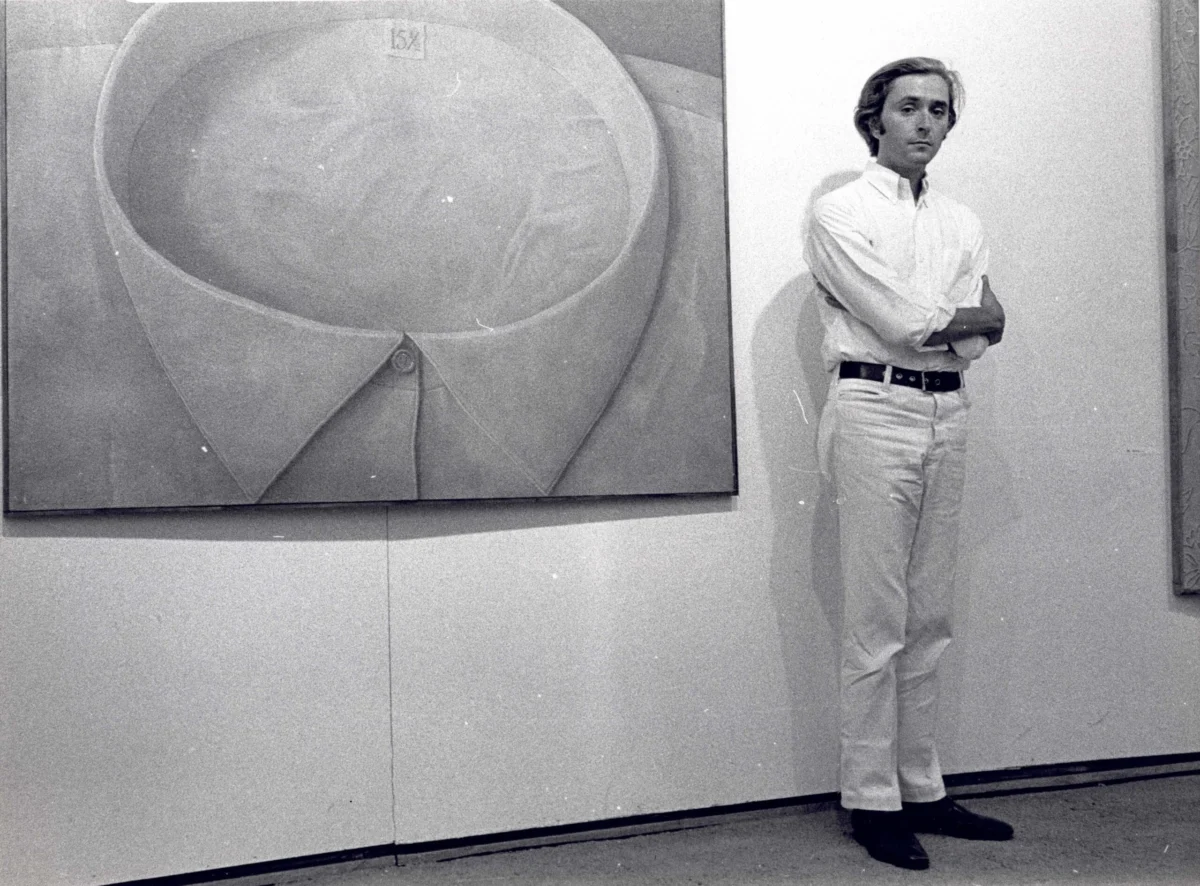
The imposing canvas, a striking cherry-red expanse measuring over five feet square, initially deceives the eye. Standing before Domenico Gnoli’s "Red Tie Knot" at Lévy Gorvy Dayan, one might mistake the subject for the back of an elegant woman’s dress. It is only upon stepping back several feet that the true subject—an ultra-cropped, almost abstracted depiction of a tie knot—reveals itself. Up close, the viewer is drawn into the meticulously rendered, rhythmic lines of the ribbed fabric. Under the hand of the late Italian artist, this seemingly mundane object transforms into a sculptural marvel, echoing the three-dimensional texture achieved by artists like Park Seo-Bo, who carved repeated pencil lines into still-wet surfaces. This masterful trompe-l’oeil effect is but one of many sophisticated techniques employed by Gnoli, as showcased in "The Adventure of Domenico Gnoli," the most extensive American exhibition of his oeuvre since 1969.
A Retrospective of a Singular Talent
The exhibition at Lévy Gorvy Dayan presents 17 exemplary paintings, alongside rarely seen drawings, etchings, notebooks, letters, and ephemera, all drawn from the peak of Gnoli’s prolific career between 1965 and 1969. The undertaking to assemble these works was significant, given that only an estimated 160 to 170 mature paintings by Gnoli exist, with the vast majority residing in private collections. This makes the exhibition a particularly rare and valuable opportunity for the public to engage with the artist’s work.

Domenico Gnoli, a Roman-born artist, lived a tragically short life, succumbing to cancer at the age of 36 in 1970. Despite his brief existence, his impact was profound. He achieved early success as an illustrator for prominent publications like Sports Illustrated and Life, and also made his mark as a costume and set designer. Ultimately, however, he is celebrated for his singular, timeless painting style, which fluidly evoked elements of Surrealism, Pop Art, and Arte Povera.
"Gnoli’s collectors are usually very reluctant to let his works go, even as loans," Amalia Dayan, co-director of Lévy Gorvy Dayan, shared with Vogue. "Many of his pieces either remain in their original owners’ hands or have been passed down through their families. There is a cult of Gnoli; once you delve in, and you understand his complex universe, it becomes an obsession." Dayan’s own fascination with Gnoli began over a decade ago, having previously organized exhibitions of his work in 2012 and 2018 with her former gallery, Luxembourg & Dayan.
The current exhibition required close collaboration with Gnoli’s estate, which encompasses the Domenico Gnoli Archives in Majorca, led by the artist’s widow, Yannick Vu, and her husband Ben Jakober (a fellow artist and close friend of Gnoli’s), and the Archivio Domenico Gnoli in Rome, overseen by Gnoli’s sister, Mimì Gnoli, and the Livia Polidoro-Gnoli Archive.
New York: A Crucible for Gnoli’s Career
.%2520Private%2520Collection%2C%2520courtesy%2520of%2520HomeArt.%2520courtesy%2520of%2520Le%25CC%2581vy%2520Gorvy%2520Dayan%2C%2520New%2520York%2520%25C2%25A9%25202026%2520Artists%2520Rights%2520Society%2520(ARS)%2C%2520New%2520York_SIAE%2C%2520Rome.jpg)
Yannick Vu, herself a distinguished artist and the daughter of the eminent Vietnamese painter Vu Cao Dam, emphasized the "vital" role New York played in Gnoli’s artistic journey. "It’s where he started his real career during the late 1950s and ended it," she stated, referring to his 1969 solo presentation at the Sidney Janis Gallery as a pivotal moment, a "consecration" for him. Despite his distinguished artistic lineage—his mother was a ceramicist, his father a renowned museum curator and art historian, and his grandfather a celebrated poet—Gnoli believed that New York and France were "the only places where one could develop as an artist."
His relocation to New York proved transformative, leading to a significant encounter with Diana Vreeland. The iconic former Met Costume Institute consultant and Vogue editor-in-chief became a close friend and an ardent collector of his work. "She was the most generous, extraordinary person," Vu recalled. In the summer of 1969, Vreeland visited Vu and Gnoli’s home in Majorca, where she witnessed the paintings Gnoli was preparing for the Janis exhibition. Several of these works are now featured in the Lévy Gorvy Dayan exhibition. Vreeland later documented the Janis opening in Vogue‘s January 15, 1970 issue, within her "People Are Talking About…" section, further cementing Gnoli’s presence in the American art scene.
Gnoli’s initial foray into New York’s artistic milieu was facilitated by his marriage to model Luisa Gilardenghi, who introduced him to a circle of creatives and intellectuals, including photographer Richard Avedon and editor Bob Silvers. Following a difficult divorce, Gnoli relocated to Paris in 1962, a move recommended by his friend Ben Jakober.
The Majorcan Muse and a Signature Technique

It was in France that Gnoli met and married Yannick Vu in 1965. The couple subsequently divided their time between France and Majorca, where several of their friends maintained residences. The Spanish island became a sanctuary for Gnoli, providing the space and inspiration for the creation of many of his most celebrated paintings. "Domenico found the freedom to really express himself there," Vu explained. Today, Jakober and Vu manage the Museum Sa Bassa Blanca in Majorca, a museum and archive dedicated to their collection, which includes a gallery specifically honoring Gnoli.
It was on Majorca that Gnoli developed his distinctive technique: mixing sand sourced from local beaches with vinyl glue and pigments. This innovative approach imbued his canvases with a rustic, fresco-like texture. This granular effect is particularly evident in "Il grand letto azzurro" (The Great Blue Bed) from 1965, a piece included in the Lévy Gorvy Dayan exhibition. Upon closer inspection, the seemingly uniform teal bedspread reveals an intricate tan floral pattern meticulously rendered using unpigmented sand.
An Unconventional Gaze on the Everyday
"He was always looking for his own path," observed Amalia Dayan. "What makes Gnoli’s work so singular is this isolation of the detail. That then touches on abstraction and minimalism because it’s so reduced and precise." This deliberate focus on isolated details of everyday objects, particularly clothing, elevated the mundane to the monumental. His subjects—zippers, buttons, collars, the backs of shoes—were rendered with an almost sacred gravitas.

Gnoli himself articulated his artistic philosophy: "My themes come from the world around me, familiar situations, everyday life; because I never actively mediate against the object, I experience the magic of its presence." Viewing a Gnoli painting is indeed a meditative experience, offering a chance to discover new nuances both by prolonged contemplation and by shifting physical distance from the canvas.
The exhibition prominently features Gnoli’s keen observations of quotidian life, beginning with works like "Striped Trousers" (1969) and "Curly Red Hair" (1969). While "Striped Trousers," with its tightly cropped sartorial focus, evokes comparisons to Issy Wood’s greyscale paintings, "Curly Red Hair" bears a striking resemblance to Anna Weyant’s portraits of young women with cascading locks.
Anna Weyant, who counts Gnoli among her favorite painters, shared her admiration: "I’m drawn to his restraint—everything feels clear and deliberate—and his simplified, sculpted forms with subtle distortions. He had a brilliant way of turning mundane and familiar objects and scenes into magnetic and psychologically charged images." Weyant also noted the inherent humor in Gnoli’s work, which is particularly evident in the upstairs room dedicated to his drawings. One such sketch features a depiction of a bosom where each breast is adorned with emotive visages, showcasing Gnoli’s playful and often unexpected approach.
Exploring Presence and Absence
.%2520Private%2520Collection%2C%2520courtesy%2520of%2520Le%25CC%2581vy%2520Gorvy%2520Dayan%2C%2520New%2520York%2520%25C2%25A9%25202026%2520Artists%2520Rights%2520Society%2520(ARS)%2C%2520New%2520York_SIAE%2C%2520Romejpg.jpg)
On the gallery’s first floor, a curated selection of Gnoli’s more conceptual works challenges viewers’ perceptions. These include a trompe-l’oeil depiction of the back of a painting, a yellow armchair, a brick-wall corner, and one of Dayan’s personal favorites, an apple. "It touches on the history of still life, Surrealism, femininity, and womanhood without having a figure of a woman. It’s got sexuality, it’s morbid—it has it all," Dayan commented on the apple painting, highlighting its layered symbolism.
A particularly evocative space within the exhibition is dedicated to Gnoli’s "bed paintings." Six of these works are displayed, most notably featuring empty beds, devoid of human figures. Amalia Dayan described the impact of this room as "spiritual," an adjective Yannick Vu also uses to characterize her late husband’s aura. "It’s very special because the whole cycle of life happens in the bed: you are born in bed, you die in the bed, and you make love in the bed," Dayan elaborated. The profound psychological resonance of these works is believed to have inspired Maurizio Cattelan’s 2007 installation "All," which comprises nine marble sculptures resembling shrouded corpses.
A Legacy of Elegance and Vision
The final section of the exhibition delves into Gnoli’s sustained preoccupation with clothing, a theme influenced by his background in costume design and his early exposure to his first wife’s fashionable circle. From the crisp geometry of a white collar to the rich, deep hue of "Purple Bust" (1969), Gnoli’s judicious color palette enhances the almost monastic quality of these paintings, which function as both studies of form and fabric.

"He was a very elegant person with a magnetic personality, and he liked to dress well," Vu observed. Rather than working from life, Gnoli relied on his "fabulous visual memory." Vu added, "He had incredible eyes and could see things that other people didn’t."
In 2021-2022, Milan’s Fondazione Prada presented a landmark retrospective of Gnoli’s work, featuring over 100 paintings and an equal number of drawings. This exhibition, supported by major collectors like Miuccia Prada and Patrizio Bertelli, underscored Gnoli’s enduring significance. Amalia Dayan expressed her hope that the current exhibition will further expand Gnoli’s legacy, advocating for a dedicated museum exhibition in America. Through the captivating presentation at Lévy Gorvy Dayan, Gnoli’s "cult" is poised to welcome a new wave of admirers in New York and beyond.
- "The Adventure of Domenico Gnoli" is on view at Lévy Gorvy Dayan through May 23.
