

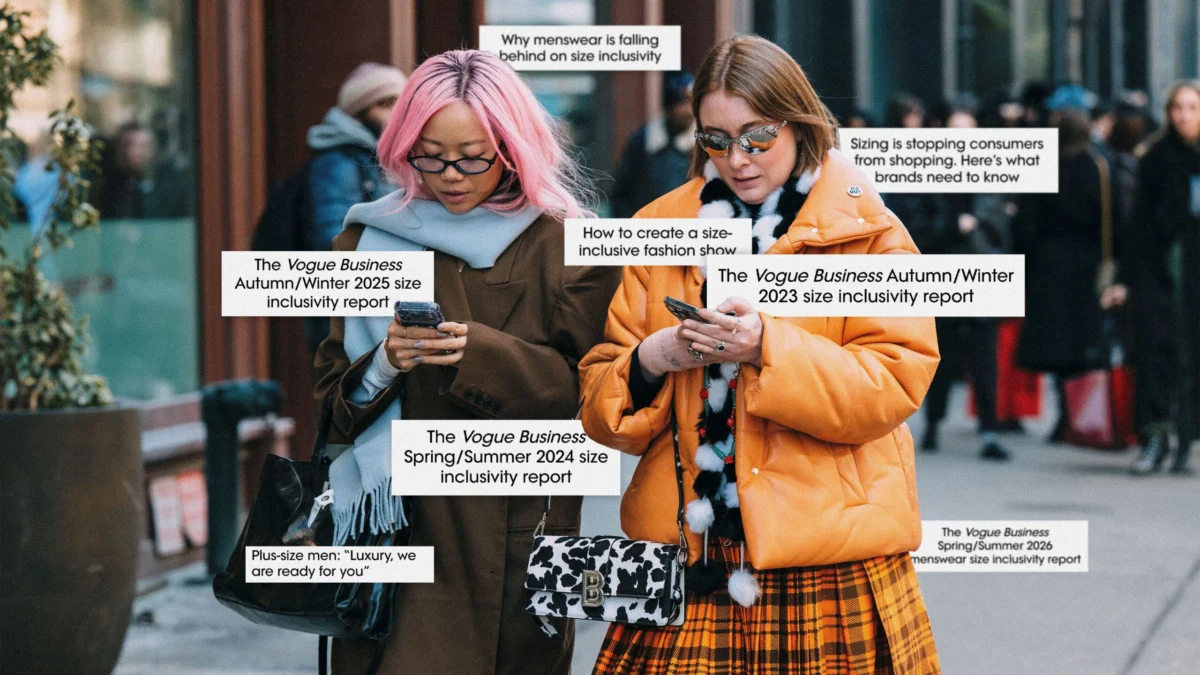
Three years ago, when Vogue Business launched its inaugural Size Inclusivity report, there was a palpable sense of optimism. The ambition was clear: to hold a mirror to the fashion industry and encourage brands to critically re-evaluate their narrow definition of beauty and design. The hope was that by highlighting and celebrating even the smallest steps toward inclusivity – the inclusion of a few curve models, for instance – brands would be motivated to expand their efforts. The expectation was that consistent reporting, backed by rigorous data analysis and industry interviews, would foster incremental yet significant improvements in size representation on the runway and beyond. However, a review of the data accumulated over the past three years reveals a disheartening reality: the initial optimism has been met with a stark regression, challenging the very notion of progress in this critical area.
The Unsettling Data: A Decline in Representation
The latest findings from the Vogue Business Size Inclusivity report paint a grim picture for womenswear on the runway. Contrary to initial hopes, the proportion of straight-size models (typically US sizes 0-4) has not only remained dominant but has actually increased. Across the seven seasons tracked, from Autumn/Winter 2023 (FW23) to Autumn/Winter 2026 (FW26), the representation of straight-size models on the runway has seen a two-percentage-point rise, climbing from 95.6% in FW23 to a staggering 97.6% in FW26. This trend indicates a tightening of aesthetic standards rather than an expansion.
Conversely, the representation of mid-size models (US sizes 6-12) has experienced a significant decline, falling from 3.8% in FW23 to a mere 2.1% in FW26. Even more concerning is the trajectory of plus-size representation (US size 14 and above). What was already a critically low figure has been halved over the same period, dropping from 0.6% in FW23 to a dismal 0.3% in FW26. The FW26 season, the most recent data point, saw plus-size representation return to its lowest ebb since the report’s inception, mirroring the figures from FW25.
Seasonal Aberrations and Sample Size Solutions
The report identifies two isolated seasons, Spring/Summer 2024 (SS24) and Spring/Summer 2025 (SS25), as brief deviations from this overarching trend, marked by a temporary uptick in mid-size and plus-size representation. However, these appear to be statistical anomalies rather than indicators of sustained progress. A key observation is that these peaks occurred during spring seasons, a phenomenon that can be attributed to the nature of garment design and sampling. Stretchy dresses, often suitable for warmer weather, are more amenable to being produced as a single sample size that can accommodate a range of body types. This contrasts with the more complex and varied garment constructions typically seen in other seasons, which require distinct mid- and plus-size samples to be developed. This suggests that the perceived inclusivity during these seasons might have been driven by logistical convenience rather than a genuine commitment to diverse sizing.

A Shifting Cultural Landscape and the Return to Extreme Thinness
The regression in size inclusivity does not exist in a vacuum. It is occurring against a backdrop of significant cultural and societal shifts that appear to have inadvertently or deliberately amplified the pressure towards extreme thinness. The rise of conservatism, the widespread adoption of GLP-1 medications (such as Ozempic) for weight loss, and a growing obsession with "looksmaxxing" – the pursuit of radical self-optimization in physical appearance – have collectively created an environment where many brands have seemingly abandoned any pretense of championing size inclusivity. Instead, there has been a pronounced pivot towards showcasing extreme thinness, with clothing designed to accentuate these very lean physiques. This shift is evident not only on the runway but also in major advertising campaigns. Recent seasons have witnessed audible gasps from audiences as exceptionally thin models pass by, and post-award ceremony media coverage has increasingly focused on the skeletal frames of celebrities rather than the fashion they wear.
The Deceptive Aesthetics of Inclusivity
The disconnect between industry claims and reality is further highlighted by the prevalence of superficial attempts at inclusivity. The report notes the appearance of digitally projected or padded "fake curves" on garments, designed to mimic fuller figures without actually accommodating them. Similarly, worryingly thin legs often emerge from voluminous suiting or plush faux fur, with models struggling on impossibly high heels. Brands, when prompted for the report, may describe their clothing as "mid-size," inadvertently referring to the garment’s fit rather than the intended wearer’s size. A significant number of brands, particularly those with no demonstrable size inclusivity, often fail to respond to requests for comment, further obscuring their practices.
The Personal Impact: A Mid-Size Perspective
The author, identifying as a US size 6-8, falls within the mid-size category according to the report’s runway-centric definitions. However, the average woman in the US wears a size 16-18, placing the average American consumer squarely in the plus-size bracket. While acknowledging the relative abundance of options available to someone of their size compared to those in the plus-size category, the author emphasizes the pervasive pressure to be thin within the fashion industry. As celebrities, models, and the general public increasingly shrink, and designers appear to feel liberated from considering how their creations might fit bodies beyond a size 0, a universal sense of pressure to conform to thinness pervades, regardless of one’s current size.
It is crucial to clarify that this critique is not about individual body types or the shaming of models who face immense pressure to maintain a certain physique for their careers. The intention is to address the systemic issue of reversed progress in size inclusivity and to acknowledge the limitations of a report in driving tangible change.
Beyond the Runway: The Disconnect with Consumer Availability
The Vogue Business Size Inclusivity report has also delved into the critical issue of sizing availability on e-commerce platforms and with major stockists. The findings suggest a significant chasm between what is presented on the runway and what is actually accessible to consumers. A recent survey of nearly 700 consumers revealed that a substantial 48% feel pressure to lose weight, with a higher proportion (63%) citing challenges with clothing sizing as the primary source of this pressure, surpassing runway shows (36%).

To investigate this discrepancy, the report undertook a physical investigation on London’s Bond Street. One prominent luxury brand, whose website indicated sizing up to a US 20, was found to stock a maximum of a US 12 in its flagship store. While sales assistants offered the possibility of special orders up to a size 20, particularly for clients ordering post-runway, this highlights a significant gap between online representation and in-store reality. Another label, advertising sizes up to a US 16 online, had its largest sizes sold out – a recurring theme in the research. In-store, however, the maximum available sizes were reported as US 12-14, with the caveat that "some things had a bigger fit," a vague and unhelpful descriptor for consumers seeking definitive sizing information.
Influencer Initiatives: Bridging the Gap
In contrast to the industry’s general reticence, individuals like creative director and content creator Abisola Omole, known as "Abi Marvel," are actively challenging these norms. Omole, who participated in a Vogue Business panel on size inclusivity at Copenhagen Fashion Week, has launched an Instagram series titled "Plus-Size and Passing." In this series, she visits luxury stores to physically try on garments as a US size 16-18, aiming to demonstrate that many brands do indeed cater to larger sizes, despite a perceived lack of runway representation and in-store availability. Omole recently showcased Jonathan Anderson’s debut collection for Dior, finding pieces that fit across both menswear and womenswear.
Currently, Omole is undertaking a similar evaluation of Matthieu Blazy’s first collection for Chanel, following the initial frenzy surrounding its release. "Chanel is a good example of a brand that does bigger sizes," Omole notes. "Obviously, they’re not perfect. But even just today, I was trying a lot of 50s and 52s [US 16-18], which I might not have expected." Her objective is to empower plus-size shoppers by illustrating the tangible possibilities of finding fashionable clothing in larger sizes.
Navigating the Retail Landscape: The ‘Hidden’ Inventory
Marvel’s research has uncovered a common practice where larger-sized garments, and the styles available in those sizes, are often relegated to the back of stores. This can create the impression for plus-size consumers that these sizes are simply not available. To counteract this, Marvel has adopted a proactive approach, now booking appointments at stores to ensure a better selection of pieces in her size is readily available upon her arrival.
The Road Ahead: Persistent Advocacy for True Inclusivity
The fashion industry’s representation problem extends far beyond the confines of the runway. Despite the apparent regression towards ’90s-style thinness and the persistent challenges in accurately reporting on size inclusivity, Vogue Business remains committed to its mission. The publication will continue to refine and enhance its data collection and analysis. The unwavering objective is to drive meaningful change, whether the industry chooses to listen or not. The pursuit of genuine size inclusivity demands sustained effort, rigorous investigation, and a refusal to accept superficial gestures as progress. The journey towards a fashion industry that truly reflects the diversity of its consumers is ongoing, and Vogue Business intends to remain at the forefront of this crucial conversation.
