

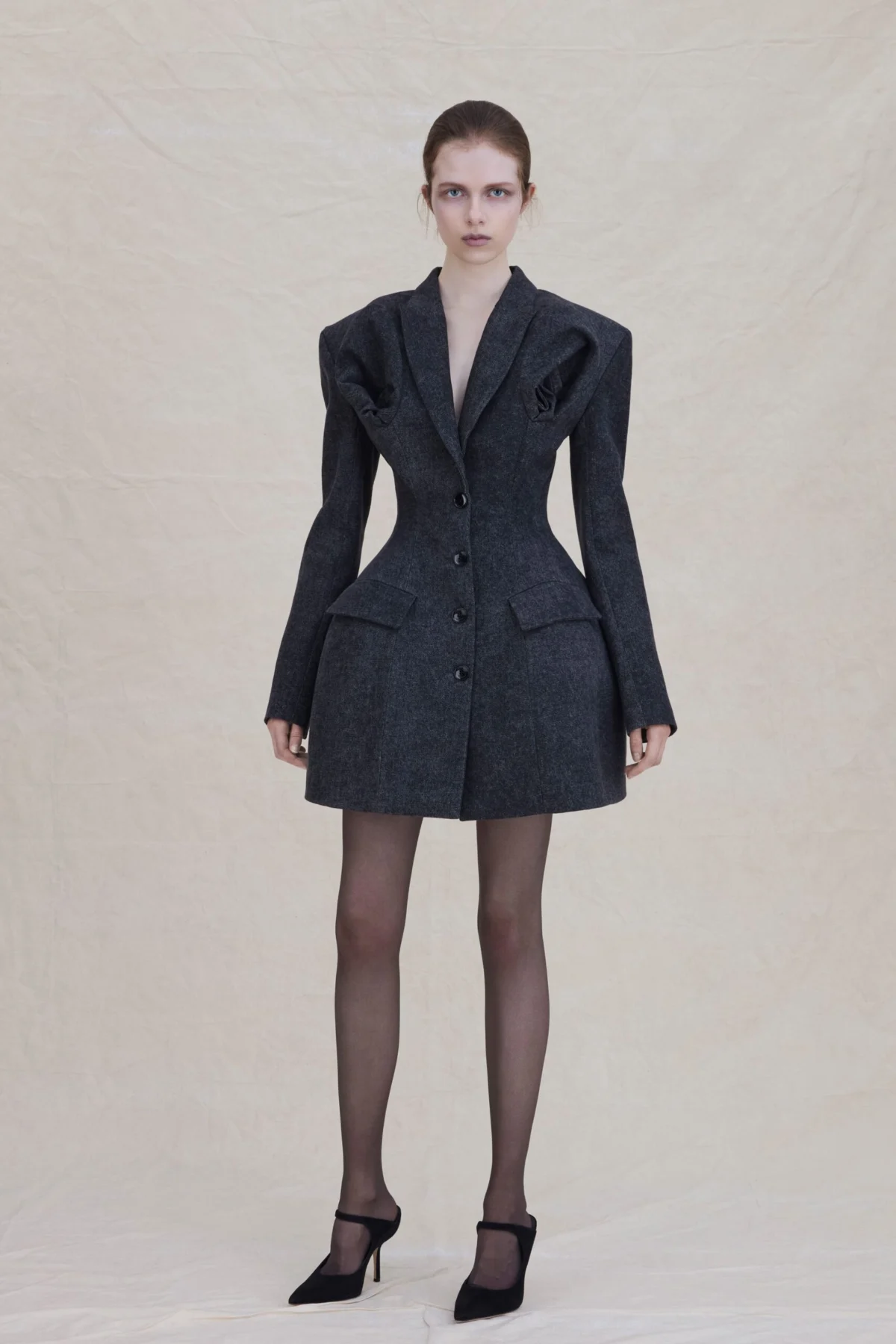
In times of global upheaval, designer Torishéju Dumi posits that a potent form of self-protection emerges through the act of dressing and the creation of clothing. This philosophy was vividly manifest in her recent collection, where garments were conceived as "loving armor," designed to impose order on chaos and offer a sanctuary of style. Dumi’s approach, deeply rooted in her understanding of costume history and her visceral connection to the contemporary socio-political landscape, presented a collection that balances the uncanny with the elegantly composed, a testament to her win of the LVMH Savoir-Faire Prize last year.
The Genesis of Protective Silhouettes
The collection opened with a striking piece that Dumi described as "almost like a cocoon, a cage," a clear homage to the iconic Dior Bar jacket. This initial silhouette immediately set the tone for a collection that explored themes of enclosure and transformation. The distinctive whorls adorning the shoulders of this opening look were interpreted by Dumi as "horns moved to the front of the jacket, like a cloak," suggesting a protective, almost mythical quality. However, she remained open to broader interpretations, even musing on their resemblance to black holes, inviting viewers to consider the profound, perhaps even existential, implications of such forms.
Dumi articulated her creative process as an inseparable link to her environment: "I can’t create a world without taking into account what’s going on around me. It happens viscerally, unconsciously." She emphasized that her work is not a mere negative reaction to external pressures but rather a considered response to the "weird, strange, Lynchian place we’re in right now." This perspective underpins her desire to explore the unknown, stating, "if it’s a black hole, I want to see what’s in there." This sentiment speaks to a designer confronting the anxieties of the present by creating garments that are both introspective and outward-looking, offering a visual exploration of contemporary human experience.
Materiality and Modernity: A Symphony of Textures
The architectural grace of the opening jacket was achieved through meticulous craftsmanship, utilizing denim worked on its reverse face, supported by traditional canvas and horsehair. This foundational technique was revisited across the collection in diverse materials, including boiled wool and shearling skirt suits. Dumi’s particular fondness for these layered ensembles stemmed from the practical yet stylish notion of "not needing a coat," highlighting a blend of functionality and fashion-forward thinking.
Further demonstrating this fusion of practicality and design, a suit crafted from black corduroy was presented alongside a crisp white funnel-neck shirt, a recurring element carried over from her debut collection. This continuity suggests a developing design language that prioritizes foundational pieces. A knitted, draped dress, fashioned from deadstock fabric, offered a nuanced take on the minimalist trend, incorporating a subtle twist at the back. This deconstructed aesthetic was echoed in a yellow mohair tartan dress, which featured an innovative spliced construction, hinting at a deliberate disruption of traditional patterns. Dumi’s stated objective was to "create pieces that had a sense of uncanny oddity, but at the same time elegance," a balance she masterfully achieved throughout the collection. The inclusion of a petticoat with a tartan skirt, a nod to her previous "Ship of Fools" collection from Spring 2025, further underscored her commitment to narrative continuity while assuring that these layered elements remained remarkably "light" in their execution.
Layering and Craftsmanship: The Art of Excess and Intimacy
In a season where trompe-l’oeil layering was a prevalent theme, Dumi’s pieces often featured an unexpected abundance of sleeves. A cardigan, for instance, boasted four distinct sets: the primary arm sleeves, complemented by additional sleeves designed to adjust around the neck, waist, and hem. This playful yet functional approach to garment construction extended to a corseted dress-coat bustier gown, where the sleeves acted as decorative flourishes, adaptable to be tied over the bust or fastened at the back.
Dumi’s dedication to artisanal techniques was further highlighted by a strikingly knotted silk top and skirt, a collaborative effort with her mother. This piece, described as a "shared labor of love," currently remains a unique creation, underscoring the personal and intimate dimension of her design process. This emphasis on handiwork, combined with the use of humble materials and bold volumes, directly contributed to her recognition with the LVMH Savoir-Faire Prize, a testament to her profound respect for traditional craftsmanship in contemporary fashion.
A Legacy of World-Building: From Stage to Studio
Dumi’s profound understanding of garment construction and theatricality is perhaps unsurprising, given her extensive background. Her formative years, from the age of eight to seventeen, were spent attending drama school. This experience laid a critical foundation for her later career, which included teaching a costume course at the London College of Fashion. This hands-on involvement with costume design provided her with an intimate knowledge of 18th- and 19th-century historical garments.
"It’s about world-building," Dumi explained, articulating the core of her creative philosophy. She elaborated on how dissecting historical garments and reinterpreting their layers imbues them with modernity, transforming them into something "special, real, and alive." This perspective reveals a designer who views clothing not merely as adornment but as a powerful tool for narrative and identity construction. "I think that’s why we create," she concluded, linking the act of creation to a fundamental human need for expression and meaning-making.
Context of the Collection: A Fashion Week Highlight
Torishéju Dumi’s presentation was a significant moment within the broader fashion calendar, likely showcased during a major fashion week event such as London Fashion Week or Paris Fashion Week, given the designer’s established profile and the calibre of her accolades. These events serve as crucial platforms for designers to present their seasonal visions to a global audience of buyers, press, and influencers. The timing of this collection, following her LVMH Savoir-Faire Prize win, would have amplified anticipation and critical attention, positioning her as a key emerging voice in the industry. The competitive landscape of these fashion weeks often sees designers grappling with economic pressures, supply chain challenges, and the increasing demand for sustainable practices, all of which Dumi appears to address through her use of deadstock fabrics and her focus on enduring craftsmanship.
Supporting Data and Industry Impact
The LVMH Savoir-Faire Prize, awarded to Dumi, recognizes exceptional craftsmanship and innovative techniques. This prize is not merely an accolade but a significant financial and strategic endorsement from one of the world’s largest luxury conglomerates, often providing mentorship and access to LVMH’s extensive network. The implications of this support can be profound, enabling designers to scale their operations, invest in research and development, and expand their global reach.
Dumi’s commitment to utilizing deadstock fabrics aligns with growing industry-wide efforts towards sustainability. According to the Ellen MacArthur Foundation, the fashion industry is responsible for significant environmental impact, including substantial water consumption and carbon emissions. By incorporating deadstock materials, Dumi actively contributes to reducing textile waste, a critical issue for the future of fashion. This approach resonates with a growing consumer demand for ethically produced and environmentally conscious clothing, potentially enhancing her market appeal and brand reputation.
Broader Implications and Future Trajectory
Torishéju Dumi’s collection offers a compelling narrative that transcends mere aesthetics. Her "loving armor" concept speaks to a collective yearning for resilience and self-expression in an increasingly complex world. By blending historical references with contemporary concerns, and by prioritizing artisanal skill alongside innovative material use, Dumi is carving out a unique space in the fashion landscape.
Her background in drama and costume design provides a distinct advantage, enabling her to imbue her garments with narrative depth and theatrical flair. This approach is particularly relevant in an era where brands are increasingly expected to offer more than just products, but experiences and stories. The success of her collection, particularly its critical reception and potential commercial performance following the LVMH recognition, will likely influence other designers to explore similar avenues of artistic expression and material innovation. Dumi’s trajectory suggests a future where fashion serves as a powerful medium for commentary, comfort, and courageous self-creation, offering a beacon of thoughtful design in turbulent times.
