

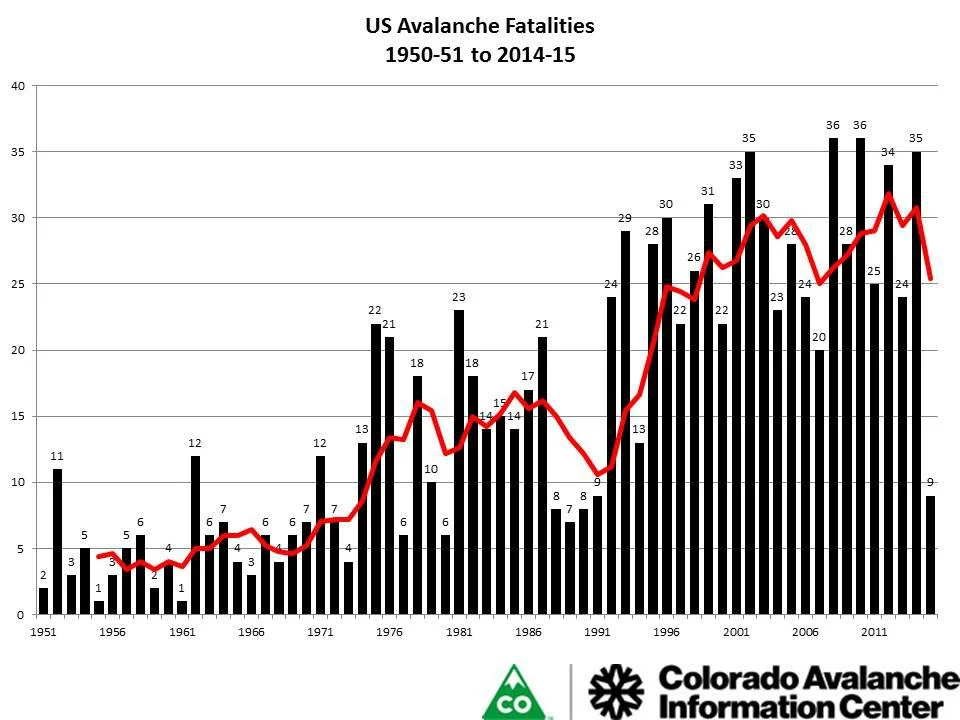
As the 2014-2015 winter season draws to a close this April 30, preliminary data from the Colorado Avalanche Information Center (CAIC) and the United States Forest Service avalanche centers indicate a historic downturn in mountain-related casualties. With only nine recorded avalanche fatalities across the United States, the current season marks the lowest death toll since the winter of 1991. This figure represents a significant departure from the five-year moving average, which typically fluctuates between 25 and 30 deaths per year. While safety experts and meteorologists caution that the avalanche season can extend into the late spring and early summer in high-altitude regions, the current statistics provide a rare moment of reprieve for the backcountry community and search-and-rescue organizations.
The decline in fatalities is attributed to a complex interplay of meteorological conditions and intensified public safety initiatives. Data suggests that a combination of uncharacteristically low snowfall along the West Coast and record-breaking warm temperatures across the Intermountain West contributed to a more stable, albeit thinner, snowpack for much of the season. However, experts also point to the success of aggressive educational campaigns and real-time information sharing as a primary driver in keeping enthusiasts safe despite a documented surge in backcountry participation.
Analyzing the 2014-2015 Statistical Anomalies
To understand the significance of the nine fatalities recorded this season, one must look at the broader historical context of avalanche accidents in North America. Since the early 1990s, the popularity of backcountry skiing, splitboarding, and snowmobiling has increased exponentially. Despite this growth in the number of people exposed to avalanche terrain, the 2014-2015 season bucked the trend of rising or stabilizing fatality rates.
According to Spencer Logan of the CAIC, who maintains the national avalanche accident database, the consistency of the five-year moving average—which has remained relatively flat over the last 15 years—is a testament to the efficacy of modern forecasting. However, dropping into single digits is an anomaly that has not been seen in nearly a quarter-century. For comparison, the 2013-2014 season saw 35 fatalities, and the 2007-2008 season reached a modern peak of 36 deaths. The drop to nine represents a nearly 75% decrease from the previous year’s total.
The geographical distribution of this year’s incidents also shifted. Typically, states like Colorado, Utah, and Montana lead the nation in fatalities due to their "continental" snowpacks, which are prone to persistent weak layers. This year, the lack of traditional winter storms in certain regions meant that the "avalanche problems" identified by forecasters were often less frequent or less severe than in a high-accumulation year.
The Role of Climatic Variations and Snowpack Development
The primary physical driver behind the low fatality count was the unique, and in many ways unfavorable, weather pattern of the 2014-2015 winter. Meteorologists characterized the season by a "Ridiculously Resilient Ridge" of high pressure over the northeastern Pacific, which diverted the jet stream and blocked moisture from reaching California, Oregon, and Washington.
In the Sierra Nevada and the Cascade Range, snowpack levels reached historic lows, with some monitoring stations reporting less than 10% of their average water content. In these regions, the avalanche danger was naturally suppressed because there was simply not enough snow to create significant slides. While this was a disaster for the ski industry and water resources, it resulted in a safer environment for those few who did venture into the high country.
Further inland, across the Rockies and the Tetons, the season was defined by unseasonably warm temperatures. In a typical year, early-season snow is followed by cold temperatures, which "facets" the snow, turning it into a weak, sugary foundation. When heavy mid-winter snow falls on top of this base, it creates a "persistent slab" condition—the deadliest type of avalanche. In 2014-2015, the warmth helped the snowpack settle and bond more quickly. The lack of deep, sustained cold meant that the "weak layers" were less prevalent, leading to a generally more "right-side-up" snowpack structure where the danger was often confined to new storm snow rather than deep-seated instabilities.
Advancements in Avalanche Education and Public Outreach
While the weather played a role, safety officials emphasize that the human element cannot be ignored. The Forest Service avalanche centers and the CAIC have spent the last decade refining how they communicate risk to the public. The 2014-2015 season saw an unprecedented level of engagement with digital forecasting tools and social media outreach.
The shift from technical jargon to "avalanche problems"—specifically identifying whether the threat is a wind slab, a persistent slab, or wet snow—has allowed backcountry users to make more nuanced decisions. Education providers, such as the American Institute for Avalanche Research and Education (AIARE), have reported record enrollment in Level 1 and Level 2 safety courses.
The widespread adoption of safety technology has also reached a critical mass. In the early 1990s, the use of avalanche transceivers, probes, and shovels was common among only a small subset of elite mountaineers. Today, these tools are considered mandatory "gate-entry" equipment for almost anyone leaving the boundaries of a ski resort. Furthermore, the 2014-2015 season saw an increased prevalence of avalanche airbags. While an airbag does not prevent an avalanche, it significantly increases the chances of staying on the surface of a slide, which has likely contributed to "near-miss" scenarios that did not result in fatalities.
Historical Context and Long-Term Fatality Trends
Looking back at the 1990-1991 season, which was the last time fatalities were this low, the backcountry landscape was unrecognizable. At that time, splitboarding was in its infancy, and high-performance snowmobiles capable of "high-marking" steep mountain slopes were not yet widely available. The fact that the US has returned to these low numbers in 2015, despite a massive increase in the number of skiers and snowmobilers, suggests a significant improvement in the "safety per capita" ratio.
The five-year moving average serves as a more reliable metric for gauging safety than any single year’s data. This average has remained between 25 and 30 for the past decade and a half. Experts argue that this stability in the face of rising participation rates is a "quiet success story." If the fatality rate had scaled linearly with the number of backcountry users, the US would likely be seeing 100 or more deaths per year. The 2014-2015 data point will pull this moving average downward, potentially signaling a new era of backcountry safety.
Regional Variations: From the Sierra Nevada to the Rockies
The 2014-2015 season was not uniform across the country. In Colorado, which historically accounts for the highest number of avalanche deaths due to its thin and fragile snowpack, the CAIC worked tirelessly to provide daily updates. The state saw fewer "deep slab" cycles than usual, which are the most difficult to predict and the most likely to kill.
In the Pacific Northwest, the season was almost non-existent in terms of traditional winter recreation. The lack of fatalities there was directly correlated to the lack of snow. Conversely, in regions like the Wasatch in Utah, the season was characterized by several close calls. Forecasters in Utah noted that even in a "low" year, the few storms that did arrive were often followed by rapid warming, leading to "wet slide" cycles that posed a different, yet still lethal, type of risk.
The nine fatalities that did occur were spread across different demographics, including snowmobilers and skiers. Each incident was meticulously documented by the CAIC to provide "lessons learned" for the community. These reports often highlighted that even in a low-fatality year, the "human factors"—such as group think, "summit fever," and the "expert halo"—remain the most dangerous elements in the backcountry.
Implications for Future Backcountry Safety and Management
The success of the 2014-2015 season poses a unique challenge for safety officials moving forward: the risk of complacency. With the lowest fatality rate in over 20 years, there is a concern that backcountry users may underestimate the danger in future seasons that return to more "normal" or high-snowfall patterns.
"The numbers for 2014/2015 are encouraging," the CAIC noted in its year-end summary. "While any fatality is too many, this season’s nine fatalities are the fewest since 1991." However, the agency and its partners at the Forest Service are already preparing for the possibility that the 2015-2016 season could see a return to more volatile conditions, especially if a strong El Niño pattern develops as some long-range forecasts suggest.
The 2014-2015 season also highlighted the need for stable funding for avalanche centers. These organizations operate on relatively small budgets, often relying on a mix of federal, state, and private donations. The data from this year provides a strong argument for the "return on investment" of avalanche forecasting. By providing the public with the information needed to avoid dangerous slopes, these centers likely saved dozens of lives and millions of dollars in potential search-and-rescue costs.
As the snow continues to melt and the mountain community transitions to summer activities, the 2014-2015 winter will be remembered by meteorologists for its warmth and drought, but by safety advocates as a year where the trend of mountain tragedies was successfully, if perhaps temporarily, arrested. The goal for the coming years will be to maintain these low numbers through continued education and technological innovation, even when the heavy snows inevitably return to the American West.
