

The 2026 Natural Selection Tour (NST) Ski competition concluded with a powerful demonstration of skill and adaptability, as athletes navigated a last-minute venue change that tested their ability to perform under pressure and pivot their strategies on the fly. Originally slated for a classic Alaskan spine face, the competition was relocated to a more rolling terrain outside Girdwood. This unexpected shift rendered pre-planned lines obsolete, transforming the event into a true test of quick thinking, on-the-spot problem-solving, and flawless execution. The final results underscore the importance of not just raw talent, but the mental fortitude to adjust to unforeseen circumstances, a hallmark of elite freeskiing.
Women’s Division: Manon Loschi Secures Dominant Back-to-Back Victory
In the women’s division, Manon Loschi of France cemented her status as a dominant force in freeskiing, successfully defending her Natural Selection Tour title with a performance characterized by precision and control. The tight competition saw the top three riders separated by a mere handful of points after the qualifying rounds, setting the stage for a thrilling finals showdown. Loschi, however, not only maintained her strong momentum but elevated her game, delivering a decisive second run that secured her victory.
Loschi’s winning performance featured a flawlessly executed double backflip off the primary feature, a testament to her technical prowess and nerve. This audacious opening trick was seamlessly integrated into a fluid and confident line through the remainder of the course. Her ability to combine high-amplitude aerials with smooth, flowing transitions through varied terrain highlighted her comprehensive skill set.
Astrid Cheylus of France provided a formidable challenge, also landing a double trick and showcasing an impressive overall performance that ultimately placed her in the second position. Elisabeth Gerritzen of Switzerland rounded out the podium, earning third place through consistent, well-executed runs that demonstrated her reliability and strategic approach throughout the competition.
The narrative of the women’s competition was not solely about the sheer scale of the tricks performed, but rather the intelligent application of skill and knowledge. Loschi’s win was a masterclass in understanding the nuances of the revised course and knowing precisely which features to attack and how to best link them together, proving that strategic execution often triumphs over brute force. The CREDO judging system, which evaluates Creativity, Risk, Execution, Difficulty, and Overall Flow, undoubtedly favored Loschi’s balanced and highly polished performance.

Men’s Division: Colby Stevenson Sets a New Standard with Explosive Performance
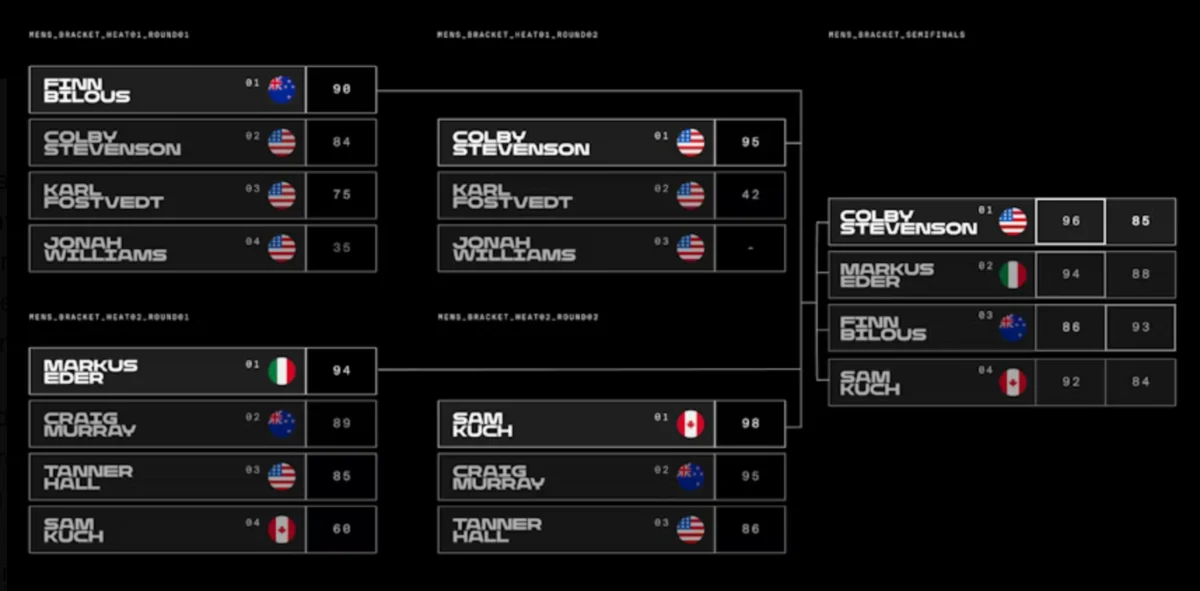
The men’s division witnessed a spectacular display of amplitude and confidence from Colby Stevenson of the United States, who effectively claimed victory with his opening run in the finals. Facing a course that still presented an evolving puzzle of the "best line," Stevenson opted for a high-risk, high-reward strategy, emphasizing speed, powerful airs, and bold maneuvers.
Stevenson’s standout run was characterized by its sheer commitment and the technical execution of a massive blunt 1080, a trick that commanded attention and set a high bar for his competitors. His ability to generate significant speed and maintain control through challenging sections of the course, culminating in this impressive aerial, underscored his mastery of the discipline. This run not only showcased his individual brilliance but also demonstrated a keen understanding of how to interpret and conquer the unique challenges presented by the new venue.
Markus Eder of Germany secured the second position with a run that was lauded for its creativity and technical intricacy. Eder’s approach included a nuanced nosebutter seven, a trick that requires exceptional balance and precision, coupled with a well-composed top-to-bottom line that impressed the judges, earning him a score of 94. His performance highlighted a different, yet equally effective, pathway to success, emphasizing technical innovation and stylistic fluidity.
Finn Bilous of New Zealand completed the podium in third place, delivering one of the most consistently strong performances across the entire event. Despite a minor setback on a cork 10 in the finals, Bilous’s overall consistency and the quality of his second run, which was particularly strong, ensured his place on the podium. His performance exemplified a balanced approach, blending solid trick selection with reliable execution.
The Decisive Factor: Embracing the Unforeseen
The significant venue shift for NST Ski 2026 served as a critical turning point, fundamentally altering the competition’s dynamics. The move away from the predictable, steep Alaskan spine faces forced athletes to recalibrate their expectations and strategies. Instead of executing meticulously planned lines, the competition became a race to decipher the optimal approach to a more varied and less defined terrain. This transition elevated the importance of adaptability, quick decision-making, and the capacity to improvise under pressure.
The judging criteria, centered on the CREDO system—Creativity, Risk, Execution, Difficulty, and Overall Flow—proved instrumental in evaluating performances on this new canvas. Athletes who could creatively interpret the terrain, take calculated risks, execute their chosen lines flawlessly, and maintain a cohesive flow throughout their runs were rewarded. The images captured from the event visually represent this shift, showcasing athletes navigating rolls, drops, and natural features in ways that might not have been possible or prioritized on the originally planned course. The contrast between the planned ruggedness of Alaska and the Girdwood area’s more undulating landscape highlights the adaptability demanded of these elite skiers.

Background and Chronology of NST Ski 2026
The Natural Selection Tour has established itself as a premier event in the freeskiing calendar, known for its commitment to showcasing athletes’ abilities in natural, challenging environments. The tour’s philosophy centers on bringing together the world’s best freeskiers to compete on natural terrain, judged on a comprehensive system that values more than just raw athleticism.
The 2026 iteration of NST Ski was initially slated to take place in a remote, iconic Alaskan location renowned for its steep, technical spine skiing. Preparations for this challenging environment typically involve extensive scouting, athlete planning, and course preparation, often taking months or even years to finalize. However, as the event drew closer, unforeseen environmental factors or logistical challenges, common in remote wilderness settings, necessitated a change. While specific details regarding the exact reasons for the venue shift were not immediately disclosed by the organizers, such decisions are usually made with athlete safety and competition integrity as paramount concerns.
The relocation to a site near Girdwood, Alaska, represented a significant pivot. Girdwood is known for its varied terrain, offering opportunities for both steep descents and more undulating, feature-rich areas. This change likely occurred within weeks or days of the competition, placing immense pressure on the athletes and organizing staff. The athletes, who had likely spent considerable time visualizing and preparing for the Alaskan spines, had to rapidly re-evaluate their trick selections and line choices based on the new terrain. This adaptability is a core tenet of freeskiing, but the compressed timeline for this adjustment amplified the challenge significantly.
The competition unfolded over several days, typically beginning with practice sessions where athletes familiarize themselves with the new venue. This is followed by qualifying rounds, where a larger field of competitors is narrowed down to a select group advancing to the finals. The finals then see the top athletes drop in for their ultimate runs, vying for the championship title. In the case of NST Ski 2026, the performance in the finals, particularly the crucial first runs for the men and second runs for the women, proved decisive, showcasing who best adapted to the altered circumstances.
Supporting Data and Judging Criteria
The CREDO judging system—Creativity, Risk, Execution, Difficulty, and Overall Flow—is central to the Natural Selection Tour’s scoring methodology. Unlike traditional slopestyle or halfpipe events, which often rely on more standardized courses and trick sets, NST emphasizes an athlete’s ability to interpret and interact with the natural mountain environment.
- Creativity: This element assesses the rider’s ability to find unique lines, innovative trick combinations, and personal style within the given terrain. It rewards riders who think outside the box and offer a fresh perspective on skiing.
- Risk: Judges evaluate the level of danger and commitment involved in a rider’s chosen line and tricks. This includes the consequence of failure and the boldness of decision-making.
- Execution: This is a fundamental aspect, measuring the precision, control, and cleanliness of the rider’s movements, both in the air and on the snow. Falls or significant mistakes detract heavily from this score.
- Difficulty: This pertains to the technical complexity of the tricks performed and the inherent challenge of the terrain navigated. Higher difficulty maneuvers, when executed well, contribute to a higher score.
- Overall Flow: This criterion evaluates the rider’s ability to link their chosen features and tricks seamlessly, creating a fluid and continuous line down the mountain. A smooth transition between elements and a sense of momentum are key.
While specific scores for each run are not detailed in the initial report, the context provided suggests that the winners excelled across these five pillars. Manon Loschi’s victory, for example, was not solely due to her double backflip (Difficulty/Execution) but also how that trick was integrated into her overall line (Flow) and how she chose to attack the features (Risk/Creativity) on the revised course. Similarly, Colby Stevenson’s winning run likely scored highly in Risk and Difficulty due to the magnitude of his blunt 1080, but also in Execution and Flow for its successful integration into his high-speed descent.

Broader Implications and Future Outlook
The outcome of NST Ski 2026 carries significant implications for the future of freeskiing competitions. It underscores that in the dynamic world of extreme sports, adaptability is not merely an advantage but a prerequisite for success. Athletes who can thrive amidst uncertainty, adjust their strategies instantaneously, and maintain peak performance under pressure are the ones who will consistently reach the podium.
This event serves as a valuable case study for organizers and athletes alike. For organizers, it highlights the importance of having contingency plans and the potential to leverage unexpected challenges into compelling narratives. The story of overcoming adversity often resonates more deeply with audiences than a perfectly executed, pre-ordained plan. For athletes, it reinforces the need for a comprehensive skill set that extends beyond mastering specific tricks to include adaptability, strategic thinking, and mental resilience.
The success of the revised venue also suggests that the Natural Selection Tour’s model is robust enough to accommodate a range of natural terrains. While the allure of Alaskan spines is undeniable, the Girdwood area provided an equally challenging and exciting platform for competition. This flexibility broadens the potential scope for future NST events, allowing the tour to explore diverse mountain environments and continue to push the boundaries of freeskiing.
Looking ahead, the performances at NST Ski 2026 will undoubtedly inspire a new generation of skiers. The champions, Manon Loschi and Colby Stevenson, have demonstrated not only exceptional talent but also the critical mindset required to excel in the evolving landscape of competitive freeskiing. Their victories are a testament to the fact that in the face of the unexpected, the most skilled and mentally prepared will ultimately prevail. The tour’s commitment to showcasing skiing in its most natural and challenging forms continues to captivate audiences and define the cutting edge of the sport. The 2026 season, with its dramatic venue shift, has only reinforced the Natural Selection Tour’s reputation for delivering authentic, high-stakes action that celebrates the true spirit of freeskiing.
