

The winter of 1994/95 marked a distinct era in North American winter recreation. For those venturing into the backcountry, the landscape of avalanche awareness and the gear they carried were vastly different from today. At that time, the infrastructure for avalanche forecasting was comparatively nascent. Prominent avalanche centers were led by figures such as Knox Williams in Denver, Bruce Tremper in Utah, and Mark Moore in Seattle. Jim Kanzler managed the center in Jackson Hole, while Brad Ray spearheaded operations at Mount Washington. A nascent avalanche center, established by the author, was entering its fifth year in Bozeman. Crucially, major avalanche centers in regions like the Chugach, Tahoe, and Mt. Shasta had yet to be established.
The technology employed by backcountry enthusiasts was also rudimentary by contemporary standards. The vast majority of backcountry skiers relied on telemark gear, with many, including seasoned individuals, still using leather boots. Snowmobiles, the primary motorized access for some, were significantly less powerful, less mobile, and considerably heavier than their modern counterparts. Ski resorts generally operated with strict in-bounds policies, and the term "sidecountry," denoting the accessible terrain just outside resort boundaries, was not yet a common descriptor in the lexicon of winter sports. Furthermore, the internet was in its infancy, with the first avalanche advisories only beginning to appear online at the close of that winter season.
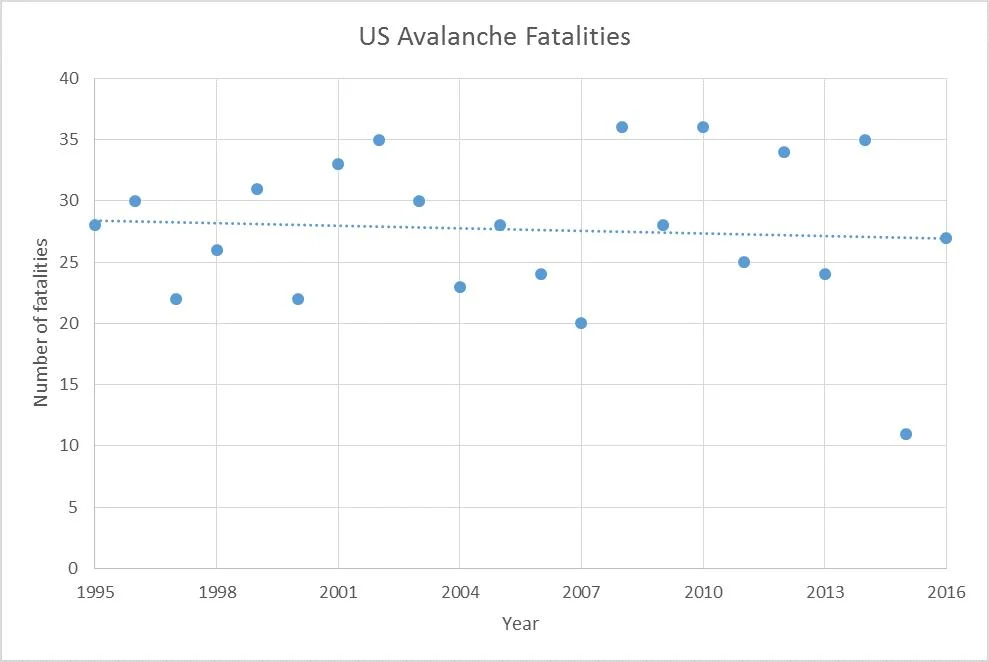
Given this historical context, a surprising statistic emerges: since the winter of 1994/95, the annual number of avalanche fatalities in the United States has remained remarkably stable. This observation is particularly striking when juxtaposed with the dramatic transformations in backcountry recreation over the subsequent 22 seasons. During this period, the U.S. has witnessed the widespread adoption of smartphones, the ubiquity of social media, the evolution of lightweight randonee (AT) gear, the development of powerful and agile snowmobiles, and an unprecedented surge in the popularity of backcountry skiing, snowboarding, and snowmobiling. Despite these profound shifts and the exponential increase in human presence in avalanche terrain, the total number of U.S. avalanche fatalities has shown no statistically significant upward trend.
Data Trends: Stability in the Face of Growth
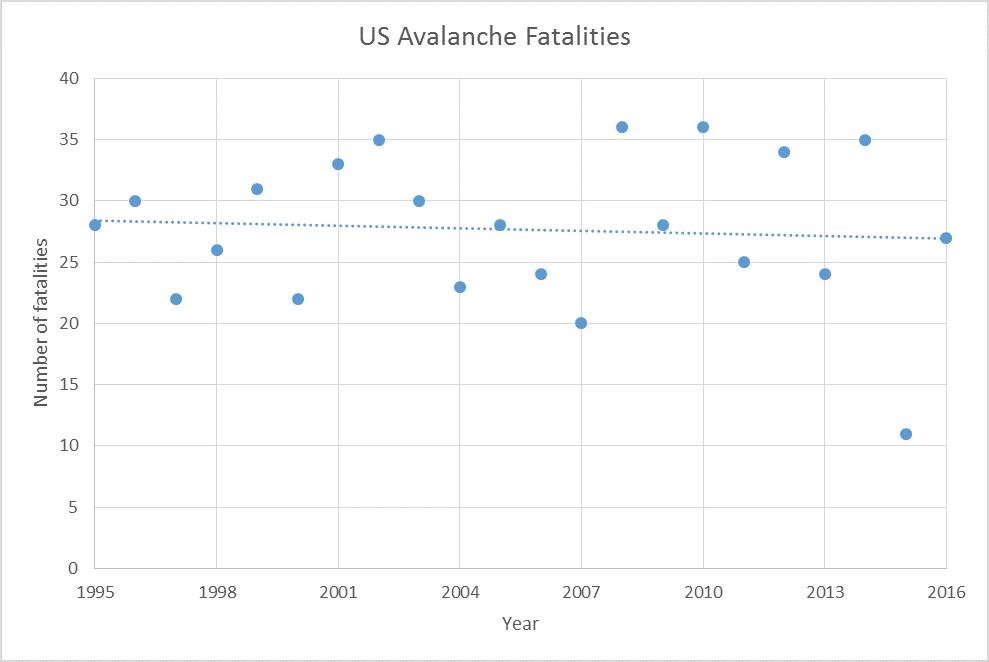
Analysis of fatality data from the 1994/95 winter through the 2015/16 winter reveals this consistent pattern. Figure 1 illustrates the annual U.S. avalanche fatalities over this 22-year span. A statistical analysis, employing a least squares regression trend line, shows a slight decrease, but this trend is not statistically significant (p = 0.7). This indicates that, on a national level, there is no discernible statistical evidence of an increase in avalanche deaths despite the manifold changes in recreational habits and technology.
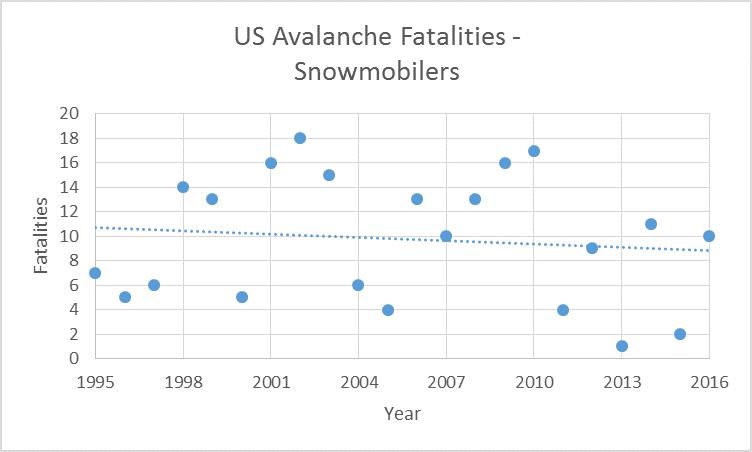
Interestingly, a similar stability is observed in snowmobile-related avalanche fatalities. Figure 2 presents the data for snowmobile avalanche fatalities over the same period. Like the overall fatality rate, the number of snowmobile avalanche deaths has remained relatively flat. The slightly decreasing trend line here is also not statistically significant (p = 0.6), suggesting that advancements in snowmobile technology and their increased prevalence have not translated into a rise in fatalities within avalanche environments.
However, a nuanced observation emerges when examining backcountry skier and snowboarder fatalities separately. Figure 3 displays the trend for fatalities among these groups. While the overall trend remains relatively flat, there is some statistical evidence (p = 0.07) suggesting a slight increase in the number of avalanche fatalities specifically among backcountry skiers and snowboarders. This marginal uptick, though not definitively conclusive, warrants further consideration within the broader context of backcountry safety.
The Unseen Surge: Backcountry Use Skyrockets
The stability in absolute fatality numbers would be less remarkable if backcountry usage had remained static. However, anecdotal evidence and indirect data overwhelmingly indicate a dramatic escalation in the number of individuals venturing into avalanche terrain. While precise, comprehensive statistics on dispersed winter recreation are inherently challenging to obtain, the usage of avalanche advisory services can serve as a valuable, albeit imperfect, proxy for this growth.
Over the past 22 seasons, the Utah Avalanche Center has reported a staggering 12-fold increase in avalanche advisory usage. The Colorado Avalanche Information Center (CAIC) has experienced a 17-fold surge in advisory access. The Gallatin National Forest Avalanche Center has seen an impressive 36-fold increase in its user base, and the Northwest Avalanche Center has recorded an extraordinary 60-fold expansion in advisory engagement.
While a portion of these dramatic increases can be attributed to the enhanced accessibility and ease with which individuals can now obtain avalanche information—thanks to the internet and mobile technology—the overall trend undeniably points to a significantly larger population participating in backcountry activities. This widespread access to information is a positive development, empowering more people to make informed decisions.
A Drastic Reduction in Fatality Rate
When this substantial increase in backcountry use is factored into the equation, the implications for the fatality rate become profound. Assuming a conservative estimate that backcountry use has increased by at least eightfold, and combining this with the observed flat trend in absolute fatalities, the fatality rate per backcountry user day has experienced a dramatic decline. This suggests that the risk of dying in an avalanche for an individual backcountry user has dropped by at least a factor of eight, and likely more, over the past two decades.
To put this into perspective, if the fatality rate had remained constant while user numbers eightfold, the U.S. could have potentially seen over 200 avalanche fatalities per winter. The fact that this grim scenario has been averted is a testament to a multitude of factors contributing to improved safety.
A Collective Win for Avalanche Safety
The stability in avalanche fatalities, particularly in light of the exponential growth in backcountry participation, represents a significant achievement for the entire avalanche safety community. This success is not attributable to a single entity but rather to a synergistic effort involving various stakeholders.
Avalanche Educators: The dedication of avalanche educators at all levels has been paramount. From those providing comprehensive professional courses to instructors delivering vital "Know Before You Go" awareness presentations in schools and community settings, their efforts have instilled a greater understanding of avalanche hazards and safe practices.
Guiding and Resort Operations: Professional backcountry guides and ski area operations that extend their safety protocols beyond resort boundaries play a crucial role. Their commitment to educating and protecting clients in the backcountry environment contributes directly to mitigating risk.
Equipment Manufacturers: The innovation and development in avalanche safety equipment have been transformative. Manufacturers have introduced a range of advanced tools, including significantly improved avalanche transceivers (beacons) with enhanced search capabilities, Avalungs that can extend a buried victim’s breathing time, lightweight and protective helmets, and increasingly sophisticated airbag packs designed to deploy and help a skier stay on the surface of an avalanche.
Regional Avalanche Centers: The network of regional avalanche centers across the United States has been instrumental in providing the public with critical, up-to-date information. These centers offer both educational resources and detailed avalanche forecasts for specific recreational areas, enabling users to make informed decisions about when, where, and how to travel safely in the backcountry.
The sustained flat trend in U.S. avalanche fatalities, during a period of such explosive growth in backcountry activity, powerfully demonstrates the efficacy of these collective efforts. It signifies that the strategies, education, and technologies being employed are working. This achievement should instill a sense of pride and accomplishment within the entire winter recreation community.
Looking Ahead: The Pursuit of Zero Fatalities
While celebrating this success, the avalanche safety community remains committed to the ultimate goal of reducing avalanche fatalities to zero. The current data, while encouraging, also highlight areas for continued focus. The slight upward trend in skier and snowboarder fatalities, even if marginal, suggests that ongoing education and risk management strategies need to be continually refined to address the evolving demographics and behaviors of backcountry users.
The increased accessibility of information, while a boon for safety, also necessitates vigilance against complacency. As more individuals enter avalanche terrain, the importance of thorough education, responsible decision-making, and adherence to safety protocols cannot be overstated.
Acknowledgements and Data Sources
This analysis and its findings are made possible through the diligent data collection and reporting efforts of numerous individuals and organizations. The Colorado Avalanche Information Center (CAIC) has been a crucial provider of the data underpinning this report. The entire avalanche community owes a profound debt of gratitude to the CAIC, its dedicated personnel who meticulously compile accident data, and the countless individuals who report and document avalanche incidents. Their contributions are invaluable, allowing for critical lessons to be learned and disseminated, ultimately benefiting the safety of all who venture into avalanche terrain.
Further constructive reviews and feedback were provided by Simon Trautman, Doug Chabot, and Spencer Logan, whose expertise has helped to shape the understanding and presentation of these important findings. The ongoing collaboration and commitment of these individuals and their respective organizations are vital to the continued advancement of avalanche safety in the United States. The data presented here, while comprehensive, represents a snapshot in time, and ongoing research and data collection will be essential to monitor future trends and adapt safety strategies accordingly. The commitment to continuous improvement remains at the forefront of the avalanche safety mission.
