

The winter of 1994/95, a period marked by a nascent avalanche safety infrastructure and a significantly less crowded backcountry, saw a specific number of avalanche fatalities in the United States. Fast forward twenty-two seasons, and despite a dramatic surge in backcountry participation, the annual toll of avalanche-related deaths has remained remarkably consistent. This surprising equilibrium, revealed through data analysis, suggests a profound success in avalanche education, technology, and advisory systems, even as the very nature of winter recreation has transformed.
The Landscape of 1994/95: A Different Era of Backcountry Exploration
To fully appreciate the current situation, one must recall the winter of 1994/95. The network of dedicated avalanche centers, the backbone of modern avalanche forecasting, was considerably smaller. Prominent figures like Knox Williams helmed the Denver Avalanche Center, Bruce Tremper led the Utah Avalanche Center, and Mark Moore managed operations in Seattle. In Jackson Hole, Jim Kanzler directed the local center, while Brad Ray was at the helm of the Mount Washington Avalanche Center. A nascent center, established by the author in Bozeman, was only in its fifth year of operation. Crucially, major avalanche forecasting hubs in regions like the Chugach Mountains of Alaska, the Lake Tahoe area, and Mount Shasta were yet to be established or were in their infancy.
The equipment used by backcountry enthusiasts also paints a picture of a different era. Telemark skiing was the predominant mode of backcountry travel, with many participants, including the author, relying on traditional leather boots. Snowmobiles, while present, were significantly less powerful, less mobile, and considerably heavier than their modern counterparts. Ski resorts generally maintained strict in-bounds policies, with the concept of "sidecountry" – terrain accessible from resort boundaries but outside of ski patrol jurisdiction – not yet a widely adopted term, and its popularization would be delayed by over a decade. The internet, a ubiquitous tool for information dissemination today, was in its nascent stages. The first avalanche advisories were only beginning to be posted online at the conclusion of that 1994/95 winter season.
The Unchanging Fatality Rate: A Statistical Anomaly
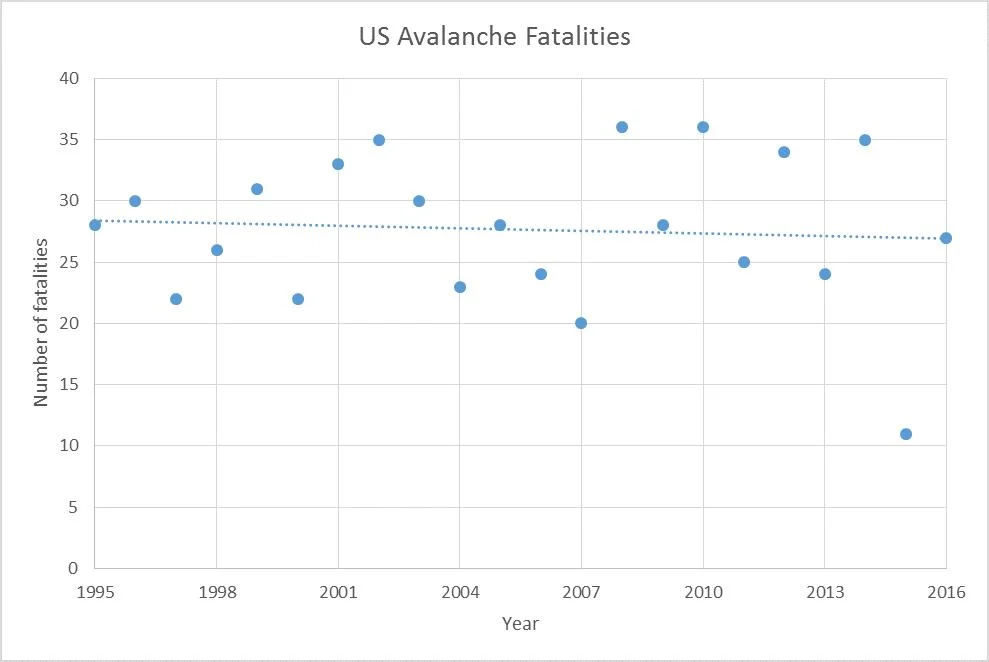
Against this backdrop of a developing safety net and a more specialized user base, the data reveals a striking trend: the annual number of avalanche fatalities in the U.S. has not increased over the subsequent twenty-two seasons, from 1994/95 through the 2015/16 winter. This stagnation is particularly noteworthy given the transformative shifts in winter recreation during this period. The advent of smartphones and social media has made accessing information, including avalanche forecasts, more immediate than ever. Lightweight and highly effective alpine touring (AT) gear has democratized backcountry access for skiers and snowboarders. Snowmobile technology has advanced dramatically, offering greater power and range, leading to exploration of previously inaccessible terrain. Most significantly, there has been an explosion in the popularity of backcountry skiing, snowboarding, and snowmobiling.
Figure 1: U.S. Avalanche Fatalities (1994/95 – 2015/16)
A statistical analysis of U.S. avalanche fatalities from the 1994/95 winter through the 2015/16 winter (Figure 1) shows a remarkably flat trend line. A slightly decreasing least squares trend line calculated for this period is not statistically significant (p = 0.7), indicating no discernible statistical evidence of a change in the overall number of avalanche fatalities over these twenty-two seasons. This suggests that despite a vastly increased number of people venturing into avalanche terrain, the absolute number of deaths has not risen.
Snowmobile Fatalities Mirror the Trend
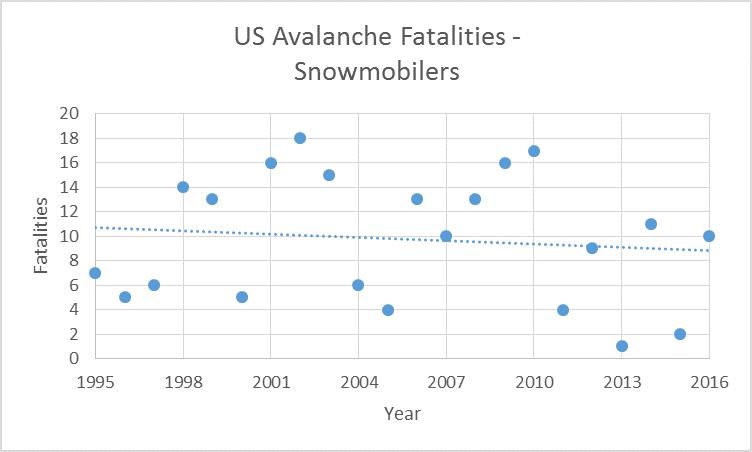
Interestingly, the trend observed in avalanche fatalities extends to snowmobile-related incidents. Figure 2 illustrates the number of snowmobile avalanche fatalities over the same twenty-two-season period. Similar to the overall avalanche fatality rate, the number of snowmobile avalanche deaths has remained relatively constant. The slightly decreasing trend line in this data is also not statistically significant (p = 0.6), reinforcing the notion that despite advancements in snowmobile capabilities and increased use, the absolute number of snowmobile avalanche fatalities has not trended upwards.
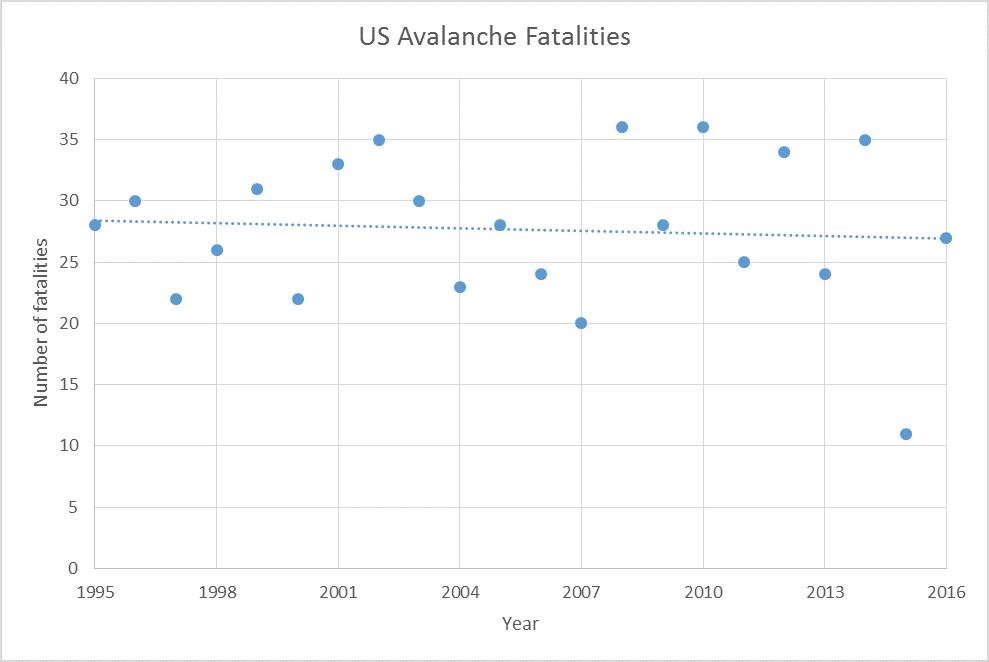
Figure 2: Snowmobile Avalanche Fatalities (1994/95 – 2015/16)
A Subtle Shift for Skier and Snowboarder Fatalities
While the overall numbers remain stable, a closer examination of specific user groups reveals a nuanced picture. Figure 3 presents data on backcountry skier and snowboarder avalanche fatalities. This data, while still largely flat, exhibits some statistical evidence (p = 0.07) of a slight increase over the twenty-two-year period. This suggests that while the absolute number of deaths is not significantly rising, the proportion of fatalities among skiers and snowboarders might be subtly increasing relative to other user groups. This could be attributed to the aforementioned surge in popularity of backcountry skiing and snowboarding, leading to more individuals venturing into avalanche terrain with varying levels of experience.
Figure 3: Backcountry Skier and Snowboarder Avalanche Fatalities (1994/95 – 2015/16)
The Exploding Backcountry: Quantifying the Growth
The stability in absolute fatality numbers would be less remarkable if backcountry use had also remained static. However, anecdotal evidence and available data paint a starkly different picture: a dramatic and sustained increase in winter backcountry recreation. While precise, universally accepted figures for dispersed winter recreation are notoriously difficult to obtain, the usage of avalanche advisories serves as a powerful, albeit imperfect, proxy for this growth.
Over the past two decades, the Utah Avalanche Center has reported a staggering twelve-fold increase in advisory usage. The Colorado Avalanche Information Center (CAIC) has witnessed a seventeen-fold increase, while the Gallatin National Forest Avalanche Center has experienced a remarkable thirty-six-fold surge. The Northwest Avalanche Center (NWAC) has seen its advisory usage escalate by a factor of sixty. While the increased accessibility of online advisories undoubtedly contributes to some of this growth, the magnitude of these increases strongly indicates a substantial rise in the number of individuals venturing into avalanche-prone areas.
Implications: A Dramatic Drop in Fatality Rate
This confluence of a flat fatality trend and skyrocketing backcountry use leads to a profound conclusion: the fatality rate, defined as avalanche fatalities per backcountry user day, has plummeted dramatically. Even with a conservative estimate that backcountry use has increased eightfold over the past twenty-two years, combined with the stable fatality trend, the fatality rate has decreased by at least a factor of eight. If the fatality rate had remained constant while use increased, the U.S. could have potentially witnessed over 200 avalanche fatalities per winter. This signifies a monumental success in mitigating risk in an increasingly popular recreational domain.
The Pillars of Success: Education, Technology, and Information
The consistent number of avalanche fatalities in the face of exponential growth in backcountry use is not a matter of chance. It is a testament to the collective efforts of various stakeholders within the avalanche safety community.
-
Avalanche Education: The foundational role of avalanche education cannot be overstated. Professionals offering certified avalanche courses, along with organizations providing awareness programs like "Know Before You Go," have equipped a growing number of individuals with essential knowledge for mitigating risk. This widespread dissemination of critical safety information has empowered backcountry users to make more informed decisions.
-
Technological Advancements: Equipment manufacturers have played a crucial role in enhancing safety. The development of sophisticated avalanche beacons, the integration of features like the Avalung, the widespread adoption of lightweight helmets, and the innovation of airbag packs have all contributed to improved survival rates in avalanche incidents. These technological advancements offer better chances of detection, rescue, and survival.
-
Avalanche Information Networks: The robust network of regional avalanche centers across the United States has been instrumental in providing timely and accurate information to the public. These centers, often staffed by dedicated professionals, not only disseminate daily avalanche forecasts but also actively engage in public outreach and education. Their work in compiling and analyzing avalanche incident data further informs their forecasting and educational efforts, creating a virtuous cycle of safety improvement.
-
Industry and Guiding Operations: Backcountry guiding services and ski area operations that manage and educate their clients have also contributed significantly. Their commitment to safety protocols and client education further reinforces the importance of responsible backcountry practices.
Looking Ahead: The Pursuit of Zero Fatalities
While the current trend is a cause for celebration and pride within the avalanche community, the pursuit of eliminating fatalities entirely remains the ultimate goal. Continuous improvement in forecasting accuracy, further refinement of educational curricula, ongoing technological innovation, and sustained public engagement are all critical for pushing the number of fatalities closer to zero.
The data from the past quarter-century offers a powerful validation of the current strategies employed in avalanche safety. It demonstrates that with concerted effort, collaboration, and a commitment to education and technological advancement, it is possible to significantly reduce the inherent risks associated with winter backcountry recreation, even as more people embrace its allure.
Acknowledgements
This analysis draws heavily on data compiled by the Colorado Avalanche Information Center (CAIC). The entire U.S. avalanche community owes a profound debt of gratitude to the CAIC, its dedicated personnel who meticulously gather and analyze accident data, and the numerous individuals who report and document avalanche incidents. This collective effort allows for invaluable lessons to be learned and shared, ultimately contributing to the safety of all who venture into avalanche terrain. Constructive reviews and feedback from Simon Trautman, Doug Chabot, and Spencer Logan were also instrumental in shaping this report.
