

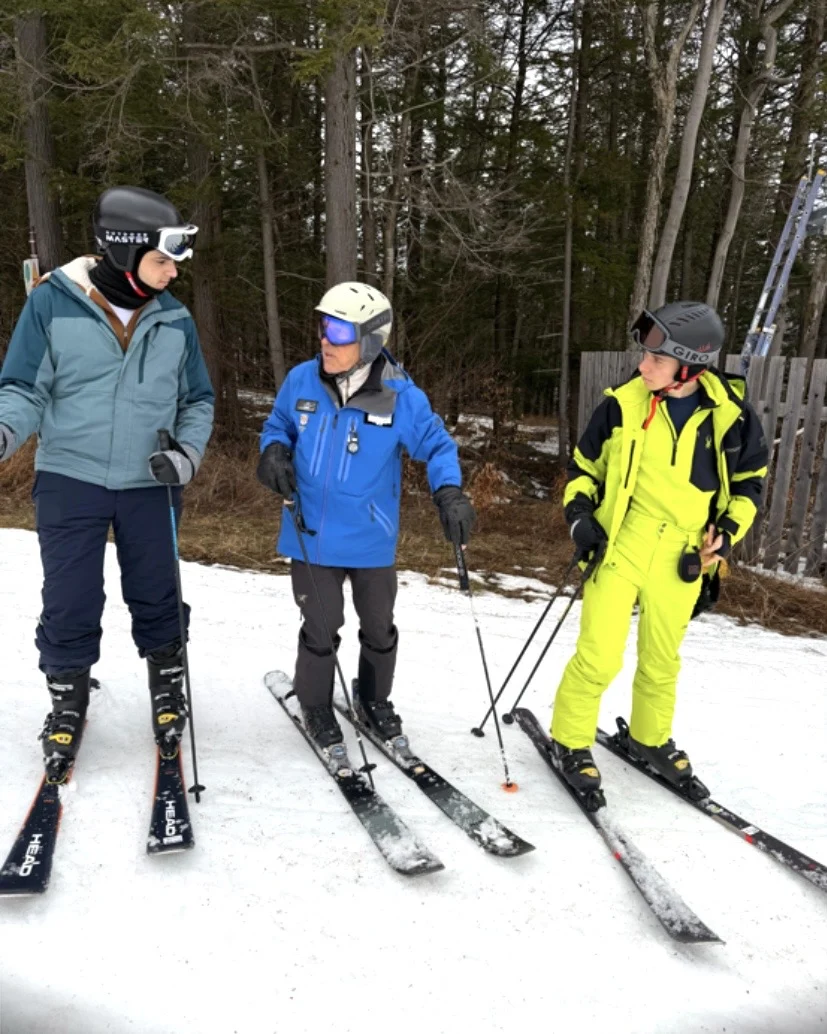
A piercing shot of wind swirled the snow with a formidable intensity as the chairlift crested the Otis Quad’s unloading ramp at New York’s Hunter Mountain. The thermometer on Leslie Surprenant’s jacket, an Alpine Level II and Children’s Specialist 1 instructor, registered a bone-chilling -5°F, but the relentless biting wind made the ambient temperature feel closer to a brutal -30°F. Skis squeaked in protest against the cold, dry snow as a small group glided down the ramp, coming to a stop near Ralph Perlberger and three other hardy souls. On a day when most guests wisely sought refuge in the warmth of the lodge, some jockeying for a prime spot near the crackling fireplace, Ralph Perlberger was not among them. Instead, he stood ready to embrace the mountain, a testament to his unwavering spirit. Surprenant, proud of Ralph and his sheer grit, introduced him to the women from the weekly clinic she was coaching, offering them an immediate, tangible example of inspiration.
It was Ralph Perlberger’s 95th birthday, and true to his deeply ingrained philosophy of skiing in every snow condition and weather imaginable, he and his wife, Carol, alongside two fellow ski instructor friends, David Raindorf and Steve Cohen, were meticulously readying for their next descent. Their camaraderie and respect for Ralph were palpable. "When I grow up, I want to be Ralph," David Raindorf had once confided to Surprenant, encapsulating the admiration many feel. Steve Cohen echoed this sentiment, adding, "Ralph is my idol." Surprenant announced the special occasion, and Ralph, a wide grin spreading across his face despite the frigid air, received a heartfelt rendition of "Happy Birthday," their voices muffled by frozen face masks. He graciously thanked them, then, without hesitation, led the way down West Side Glide, an intermediate trail that gracefully wound its way among towering pines and resilient hemlocks. His fluid movements and confident posture belied his advanced age, serving as a powerful demonstration of the profound connection between an active life and enduring vitality.
The Enduring Spirit on the Slopes: A Beacon at Hunter Mountain
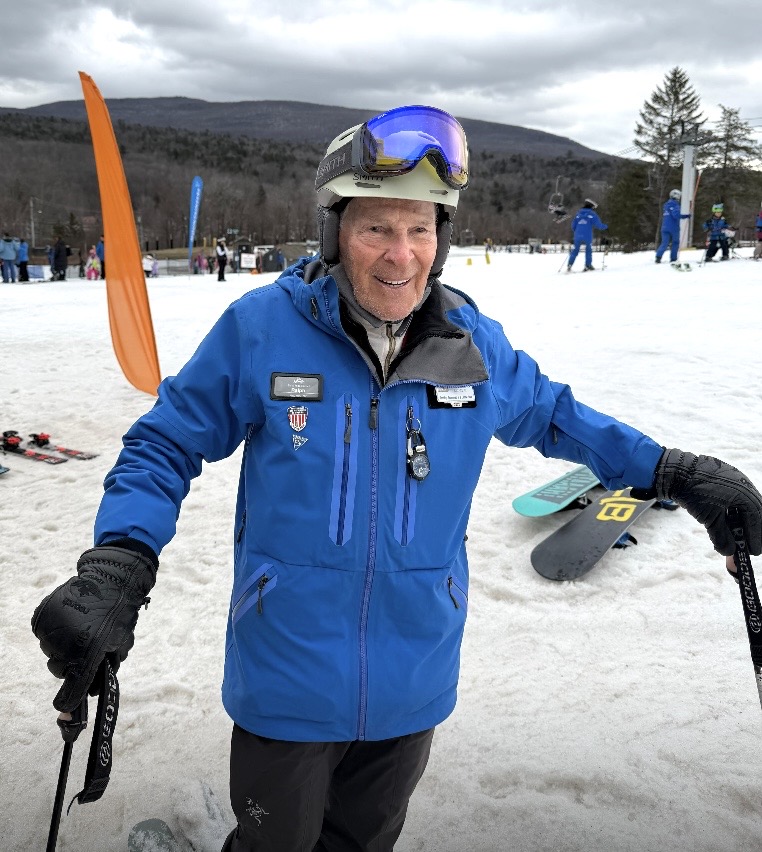
Ralph Perlberger’s presence at Hunter Mountain is more than just a remarkable personal achievement; it is a profound inspiration for the entire ski community. Hunter Mountain, a prominent ski resort in the Catskill Mountains, is known for its diverse terrain and vibrant atmosphere. Yet, even in its bustling environment, Ralph stands out. Victoria Mercado, the Senior Manager of Hunter Mountain’s Ski and Ride School, articulated the collective awe: "Ralph is an inspiration. He’s not only skiing, but teaching! Skiing and riding keep you young. When I watch Ralph ski, I can’t believe he’s 95. His energy, skill, and passion on the mountain defy his age. It’s an absolute pleasure to work alongside him." Her words underscore a sentiment widely shared among staff and guests alike – Ralph is a living legend, a testament to the idea that age is merely a number when passion fuels the spirit.
The commitment shown by individuals like Ralph Perlberger resonates deeply within the Professional Ski Instructors of America (PSIA) Eastern/Education Foundation, the official publication of which, The SnowPro, featured this very story in its Spring 2026 issue. The PSIA promotes excellence in snow sports instruction, and Ralph, a Level II Alpine instructor, embodies the lifelong dedication to learning and teaching that the organization champions. His continued activity on the slopes highlights the significant benefits of physical engagement throughout life. Studies have consistently shown that regular physical activity, such as skiing, contributes significantly to maintaining cognitive function, bone density, muscle strength, and cardiovascular health in older adults. For many seniors, skiing offers not just physical exercise but also a crucial social outlet and a connection to nature, factors that are vital for mental well-being and combating isolation. Ralph’s ability to not only ski but actively teach at 95 challenges conventional notions of aging, providing a powerful counter-narrative to the often-negative stereotypes associated with later life. He serves as a role model, demonstrating that with determination and a love for what one does, the possibilities remain limitless, regardless of chronological age.
A Chronicle of Resilience: From Bergen-Belsen to the Black Diamond
Ralph Perlberger’s life story is not merely one of sporting longevity but also a harrowing narrative of survival, resilience, and hope against unimaginable adversity. Born in Amsterdam, Netherlands, his early childhood was tragically interrupted by the outbreak of World War II. In 1940, Ralph’s father, anticipating the growing threat of Nazi Germany, courageously left for New York City to arrange for his family’s immigration to the United States. He arrived on May 10, 1940, the very day Nazi forces launched their devastating invasion of the Netherlands, trapping his family in a country rapidly falling under brutal occupation.
The following year, the Perlberger family’s worst fears were realized. In 1941, 9-year-old Ralph, his mother, and his two older brothers were forcibly taken from their home in Amsterdam. They were first imprisoned in Westerbork transit camp in the northeastern Netherlands. Westerbork, initially a refugee camp, was repurposed by the Nazis into a transit camp for Jews, Roma, and resistance fighters destined for extermination camps in Eastern Europe. Conditions were harsh, but it was merely a temporary stop. In February 1944, the family was subjected to the horrific experience of being transferred by railroad cattle car to the Bergen-Belsen concentration camp in Germany. Bergen-Belsen became infamous for its horrific conditions, rampant disease, and staggering death toll, claiming the lives of tens of thousands, including Anne Frank, who perished there just weeks before its liberation.
Despite enduring the unspeakable suffering and contracting both typhus and typhoid fever, Ralph maintained an unshakeable belief that he and his family would survive. He attributes this profound sense of confidence, security, and hope to the unwavering strength and optimism instilled in him by his parents. In a remarkable testament to childhood resilience, he even harbored the thought that he would have quite a story to share with friends once the war finally ended. During these agonizing years, Ralph’s father in New York City lived with the crushing uncertainty of his family’s fate, having no knowledge if they had survived the atrocities.
At the war’s end, a glimmer of hope emerged. His father learned that his family had miraculously survived and were located in the Russian-occupied village of Tröbitz, Germany. They had arrived there on the infamous "Lost Transport" train, one of three trains on which the Nazis sent approximately 7,500 Jewish prisoners from Bergen-Belsen. These prisoners were intended to be exchanged for German prisoners, a desperate, last-ditch effort by the Nazi regime. However, the "Lost Transport" never reached its intended destination. For two agonizing weeks, the train traveled erratically, constantly stopping and rerouting due to widespread destruction of railway tracks by Allied bombing. It finally came to a halt on a destroyed bridge over the Elster River, just outside Tröbitz. On April 23, 1945, Russian troops liberated the train’s emaciated and traumatized prisoners. Hundreds had already succumbed to typhus and hunger during the torturous journey. During the five months that the family’s visa applications were pending for entry into the United States, Ralph’s father, through the Red Cross, diligently sent them packages filled with essential food and hygiene products, a lifeline across a war-torn continent.
In February 1946, Ralph, his two brothers, and his mother finally immigrated to the United States, reuniting with their father and making their new home in New York City. The transition was immense. Ralph, demonstrating incredible adaptability, quickly learned to speak English and excelled in school, while his father painstakingly got to know his family again after years of forced separation and unimaginable trauma. This period marked not just a new chapter but a complete rebirth, laying the foundation for a life defined by perseverance and an unwavering embrace of new experiences.
The Path to the Pistes: A Lifelong Passion for Skiing
Ralph Perlberger’s love affair with skiing began years later, during his time studying economics at Stanford University. During a winter break, his father, perhaps recognizing the need for joy and new experiences after their past hardships, sent Ralph and his two older brothers to Sun Valley, Idaho. Sun Valley, established in 1936, was one of America’s first destination ski resorts, known for its pristine slopes and glamorous clientele. It was here, amidst the stunning Idaho mountains, that Ralph was irrevocably "hooked." The exhilaration of gliding down snowy slopes captured his imagination, igniting a passion that would endure for decades. He seized every opportunity to ski, even while pursuing his demanding law degree at Harvard University, a testament to his ability to balance intense academic rigor with his burgeoning athletic pursuit.
After decades of honing his skills on various slopes, including renowned resorts in Taos, New Mexico, throughout Europe, and locally at Hunter Mountain, an advertisement caught Ralph’s discerning eye in 2002. For what seemed a modest sum of $85, he could participate in a weekend of instructor training and candidate selection at Hunter. The incentive was clear: if selected as an instructor candidate, an additional weekend of training and final selection would be free. At 71 years old, an age when many contemplate retirement from physically demanding activities, Ralph embraced the challenge. He was among those chosen to become instructors, a testament to his inherent skill and palpable enthusiasm. Yet, he humbly realized that despite his years of experience, he still had much to learn about the art of teaching the sport he loved.
Today, Ralph stands as a PSIA Level II Alpine instructor, a designation that requires significant technical proficiency, teaching expertise, and a deep understanding of ski mechanics. He insists that some of the best advice he ever received came from a fellow ski instructor and PSIA alpine examiner, Charlie Knopp: "Lift your inside hip!" This seemingly simple instruction is, in fact, a fundamental concept in advanced skiing, crucial for effective edge control, rotational dynamics, and maintaining balance throughout a turn, especially on challenging terrain.
Ralph is profoundly beloved by the Hunter Mountain ski and ride school community, where his colleagues express both awe and deep appreciation for the profound impact he has on them. Luca Arrigoni, a member of the Eastern Alpine Development Team, shared his admiration: "Ralph has a special place in my heart. I shadowed him as a new instructor and was inspired by his patient, gentle, and knowledgeable way with beginners. He still proudly wears the Hunter uniform, which shows his love for, and dedication to, the sport and teaching." This sentiment reflects not just professional respect but genuine affection for a man who embodies the best of the skiing spirit.
Ralph particularly enjoys helping adult intermediate skiers, a group often struggling with plateaus in their development. He typically begins by asking students to describe how they make their skis turn. "I don’t know," most respond, "I just turn." Ralph observes that many of these skiers tend to turn using primarily leg rotation on flat skis, a technique that is inefficient and limits progression. He believes that many intermediates lack the foundational understanding of maintaining their center of mass (CM) over their base of support (stance), effectively directing pressure to their outside skis, and controlling precise edge angles. To address these issues, he coaches skiers to consciously feel their shins against the tongue of their boots throughout all phases of a turn, promoting a more forward and balanced stance. When he notices skiers leaning back, a common intermediate fault leading to fatigue and loss of control, he asks them to stop and notice how their quadriceps feel. Most instantly recognize the "tired" or "burning" sensation. He then directs them to notice where their bodies are in relation to their feet, gently reminding them to maintain consistent shin contact with the front of their boots. In the end, Ralph says, every student improves, has fun, and leaves with gratitude, a testament to his effective and empathetic teaching style.
Hunter Mountain and the PSIA Eastern Division: A Community of Support and Inspiration
The ski instructors at Hunter Mountain span an impressive eight decades in age, creating a unique intergenerational learning and teaching environment. Ralph Perlberger’s wisdom and experience are particularly invaluable to the youngest instructors entering the profession. His advice to them is simple yet profound: "Keep at it and don’t give up! Don’t let anything stop you. Ski in all conditions and all weather." This philosophy, forged in the crucible of his early life, transcends skiing, offering a universal lesson in perseverance.
Having recently completed his 24th season of instructing, Ralph Perlberger has no plans to stop doing what he loves. His continued presence on the slopes is a source of wonder and inspiration. "Maybe someone above is watching over me," he muses, acknowledging the fortunate turn his life has taken. He adds that he has always drawn inspiration from the legendary Baseball Hall of Famer Satchel Paige, who famously advised, "Don’t look back; something might be gaining on you." For the skiers at Hunter Mountain, that "something" isn’t a threat, but rather the enduring, inspiring force of Ralph Perlberger, a man whose life story is a powerful testament to human resilience, the joy of lifelong learning, and the profound ability of the human spirit to find passion and purpose, even after experiencing the darkest chapters of history. His legacy is not just in the turns he makes, but in the countless lives he touches and the profound inspiration he imparts, proving that true vitality knows no age.
