

The winter of 1994/95 marked a different era for winter backcountry enthusiasts and avalanche safety professionals in the United States. Back then, the landscape of avalanche awareness and risk management was considerably less developed than it is today. Leading the charge at three major avalanche centers were Knox Williams in Denver, Bruce Tremper in Utah, and Mark Moore in Seattle. Jim Kanzler managed the center in Jackson Hole, Brad Ray directed operations at Mount Washington, and a nascent avalanche center in Bozeman, initiated by the author, was just entering its fifth season. Notably, dedicated avalanche centers were yet to be established in significant recreation hubs like the Chugach mountain range in Alaska, the Lake Tahoe region, and Mount Shasta.
The equipment and technology available to backcountry adventurers in that period stand in stark contrast to the present day. The vast majority of backcountry skiers relied on telemark gear, often with cumbersome leather boots. Snowmobiles, a significant factor in backcountry accidents, were considerably less powerful, less mobile, and heavier than their modern counterparts. Ski resorts typically operated with strict, closed boundaries, and the concept of "sidecountry" – terrain accessible from a resort but outside its managed boundaries – had not yet entered mainstream vernacular, with its widespread adoption more than a decade away. Furthermore, the internet was in its infancy, with the first avalanche advisories appearing online only at the close of that 1994/95 winter season.
A Surprising Stability in Fatalities
Against this backdrop of limited resources and burgeoning interest, a remarkable trend has emerged over the past 22 seasons: the annual number of avalanche fatalities in the United States has remained remarkably stable. This stability persists even as the backcountry landscape has transformed dramatically. The advent of smartphones and social media has revolutionized information dissemination, while lightweight alpine touring (AT) gear has made backcountry access easier. Snowmobile technology has advanced exponentially in power and agility, and there has been a literal explosion in the number of people venturing into the backcountry for recreation.
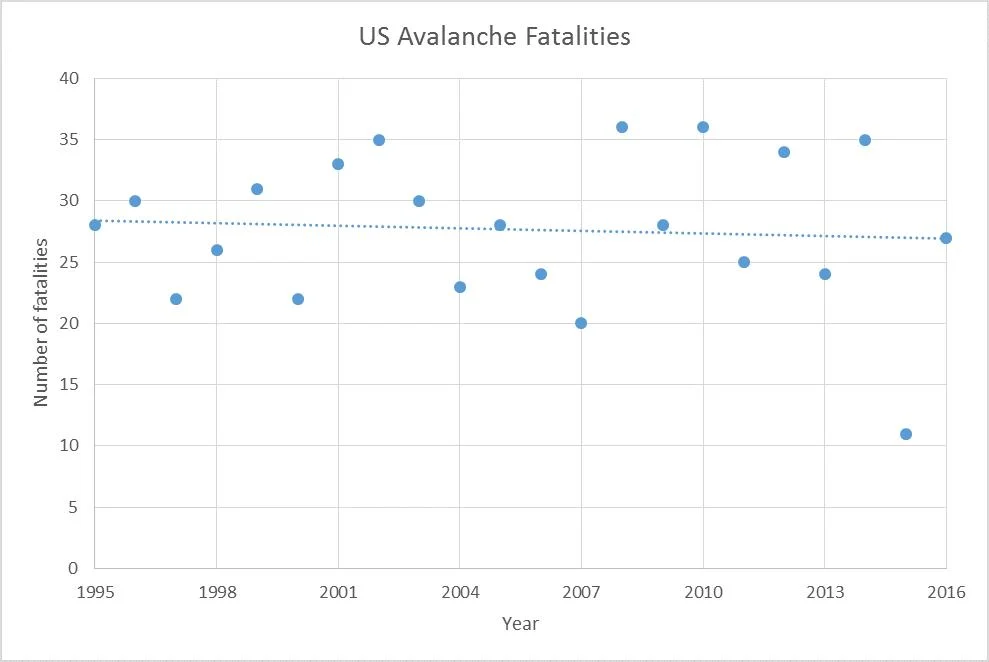
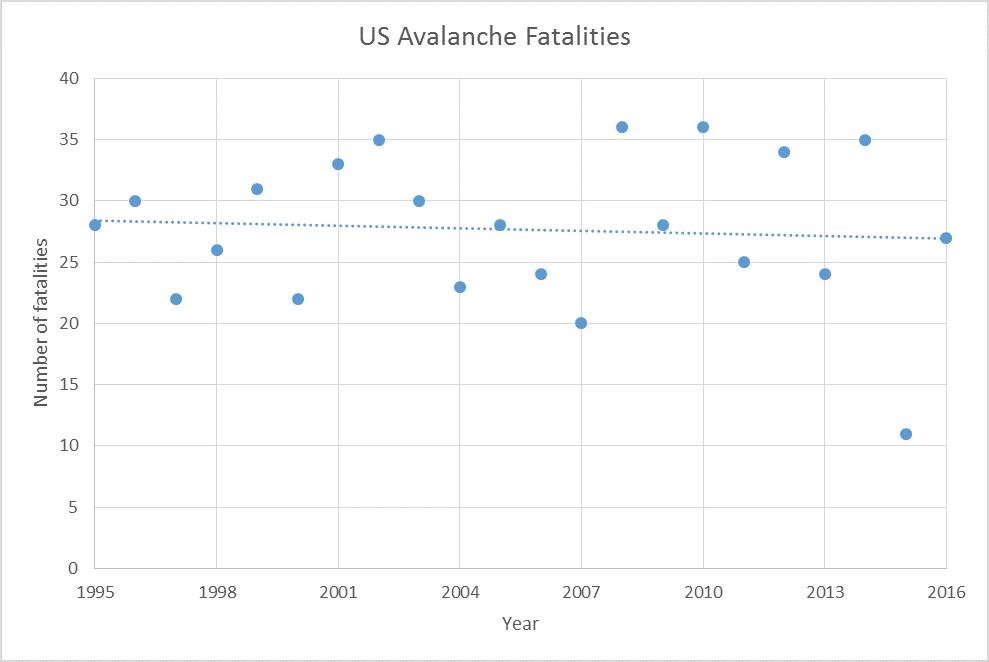
Despite these significant shifts, which intuitively might suggest an increase in fatalities, data compiled by avalanche centers across the nation reveals a different story. Figure 1, illustrating U.S. avalanche fatalities from the 1994/95 winter through the 2015/16 winter, shows a nearly flat trend line. Statistical analysis of this data indicates that a slightly decreasing least squares trend line is not statistically significant (p = 0.7), meaning there is no compelling statistical evidence to suggest a change in the overall number of avalanche fatalities during this period.
Differentiating Risk Across User Groups
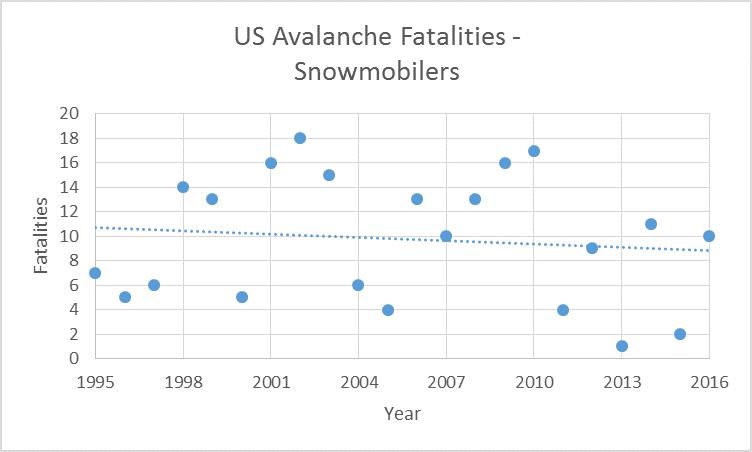
While the overall avalanche fatality count has remained steady, a closer examination of specific user groups reveals some nuances. Figure 2, which tracks snowmobile avalanche fatalities over the same 22-season span, also shows a flat trend. The slightly decreasing trend line here is also not statistically significant (p = 0.6), mirroring the overall stability.
However, Figure 3, focusing on backcountry skier and snowboarder fatalities, presents a slightly different picture. While this graph also appears relatively flat, there is some statistical evidence (p = 0.07) suggesting a potential, albeit slight, increase in fatalities within this specific demographic over the observed time period. This observation warrants further investigation and may point to evolving behaviors or increased exposure within this user group.
The Unprecedented Surge in Backcountry Use
The stability in overall avalanche fatalities becomes even more striking when juxtaposed with the dramatic increase in backcountry recreational use. While precise, comprehensive data on dispersed winter recreation is inherently challenging to collect, avalanche advisory usage serves as a valuable, albeit imperfect, proxy for this growth. The trend is undeniable and profound.
Over the past two decades, the Utah Avalanche Center has reported a staggering twelve-fold increase in advisory usage. The Colorado Avalanche Information Center (CAIC) has witnessed a seventeen-fold surge, while the Gallatin National Forest Avalanche Center has experienced an extraordinary thirty-six-fold increase. The Northwest Avalanche Center (NWAC) has seen an even more dramatic sixty-fold rise in usage. While some of this amplified usage can be attributed to the increased accessibility of avalanche information through online platforms and mobile applications, it unequivocally signifies a substantially larger number of individuals venturing into avalanche-prone terrain.
A Dramatic Decline in Fatality Rate
To put this into perspective, let us consider the implications of this phenomenon. Assuming a conservative estimate that backcountry use has increased by a factor of eight over the past 22 years, and combining this with the observed flat trend in fatalities, the fatality rate per backcountry user day has plummeted. This suggests that the avalanche fatality rate has decreased by at least a factor of eight, and likely more, over the past two decades. Had the fatality rate remained constant while usage surged, the United States could have potentially seen over 200 avalanche fatalities per winter season during this period. This dramatic reduction in risk per user is a testament to the collective efforts of the avalanche community.
A Triumph for Avalanche Education and Safety Initiatives
The sustained stability in U.S. avalanche fatalities, especially in the face of exponential growth in backcountry participation, represents a significant success story for avalanche education and safety initiatives. This achievement is not attributable to a single factor but is the result of a multi-faceted approach involving numerous stakeholders.
Avalanche Educators: From professionals offering comprehensive avalanche courses to volunteers conducting "Know Before You Go" awareness presentations, educators have played a pivotal role. Their tireless efforts in disseminating crucial knowledge about snowpack assessment, terrain evaluation, and safe travel practices have equipped countless individuals with the skills to make informed decisions in the backcountry. The consistent messaging and increasing reach of these educational programs have undoubtedly contributed to safer practices.
Backcountry Guiding and Ski Area Operations: Professional guiding services and ski areas that extend their operations into or adjacent to backcountry terrain have also been instrumental. By prioritizing client safety, providing essential training, and implementing rigorous operational protocols, these entities have created safer environments and fostered a culture of responsibility among their clientele. Their commitment to safety often extends beyond resort boundaries, influencing the behavior of those who venture further afield.
Equipment Manufacturers: The innovation in avalanche safety equipment has been nothing short of revolutionary. Manufacturers have developed and refined a suite of critical tools that significantly enhance a backcountry user’s ability to survive an avalanche incident. This includes vastly improved avalanche beacons, which are more sensitive and user-friendly; Avalungs, which provide a crucial air supply in buried scenarios; lightweight yet highly protective helmets; and the increasingly popular airbag packs, which can significantly increase a buried person’s chances of remaining near the surface. The availability and adoption of this advanced gear have undoubtedly contributed to the reduced fatality rate.
Regional Avalanche Center Network: The robust and expanding network of regional avalanche centers across the United States has been a cornerstone of this success. These centers provide the public with up-to-date, localized avalanche forecasts and advisories, enabling users to make critical decisions about where and when to travel. Beyond advisories, many centers offer extensive educational resources, workshops, and public outreach programs. Their consistent provision of reliable information and their deep engagement with the backcountry community have been vital in mitigating risks.
Looking Ahead: The Pursuit of Zero Fatalities
While the current trend is cause for celebration and pride within the avalanche community, the ultimate goal remains zero fatalities. The data clearly demonstrates that the existing strategies are effective, but continued vigilance and adaptation are necessary.
The slight upward statistical suggestion in skier and snowboarder fatalities, though not yet definitively conclusive, warrants attention. Further research may be needed to understand the contributing factors. This could involve analyzing accident reports for commonalities in decision-making, route selection, or equipment usage among this demographic. It might also highlight areas where targeted educational interventions could be most impactful.
The continuous evolution of backcountry access and technology also necessitates ongoing adaptation of safety protocols. As new forms of winter recreation emerge or existing ones gain further traction, avalanche safety messaging and educational materials must evolve to meet these new challenges. The increasing complexity of terrain accessed and the speed at which information travels in the digital age require a dynamic approach to risk management.
A Collective Achievement and a Foundation for the Future
The stable U.S. avalanche fatality rate over the past 22 seasons, despite a massive surge in backcountry use, is a profound testament to the dedication and effectiveness of the avalanche safety community. It underscores the value of investment in education, the impact of technological advancements, and the critical role of reliable information dissemination. This trend is not merely a statistical anomaly; it is a tangible outcome of years of concerted effort and collaboration.
The data, primarily compiled and analyzed by institutions like the Colorado Avalanche Information Center (CAIC), highlights the crucial work of data collection and analysis in understanding avalanche risk. The CAIC, along with numerous other centers and individuals within the avalanche community, deserves immense gratitude for their ongoing commitment to public safety. The meticulous documentation of avalanche accidents and near misses by various individuals and organizations provides invaluable lessons that inform and refine safety strategies.
In conclusion, the narrative of U.S. avalanche safety over the past two decades is one of remarkable progress. The unseen victory of a stable fatality rate amidst unprecedented growth is a source of collective pride and a strong foundation upon which to continue the vital work of bringing avalanche fatalities toward zero. It validates the current approaches while also providing crucial insights for future endeavors in safeguarding those who seek adventure in the winter backcountry.
Acknowledgements: The data presented in this analysis was primarily provided by the Colorado Avalanche Information Center (CAIC). The entire avalanche community owes a profound debt of gratitude to the CAIC, its dedicated personnel who meticulously compile this vital data, and the many individuals who report and document avalanche accidents, thereby enabling continuous learning and improvement across the field. Special thanks are extended to Simon Trautman, Doug Chabot, and Spencer Logan for their constructive reviews and valuable feedback on this information.
