

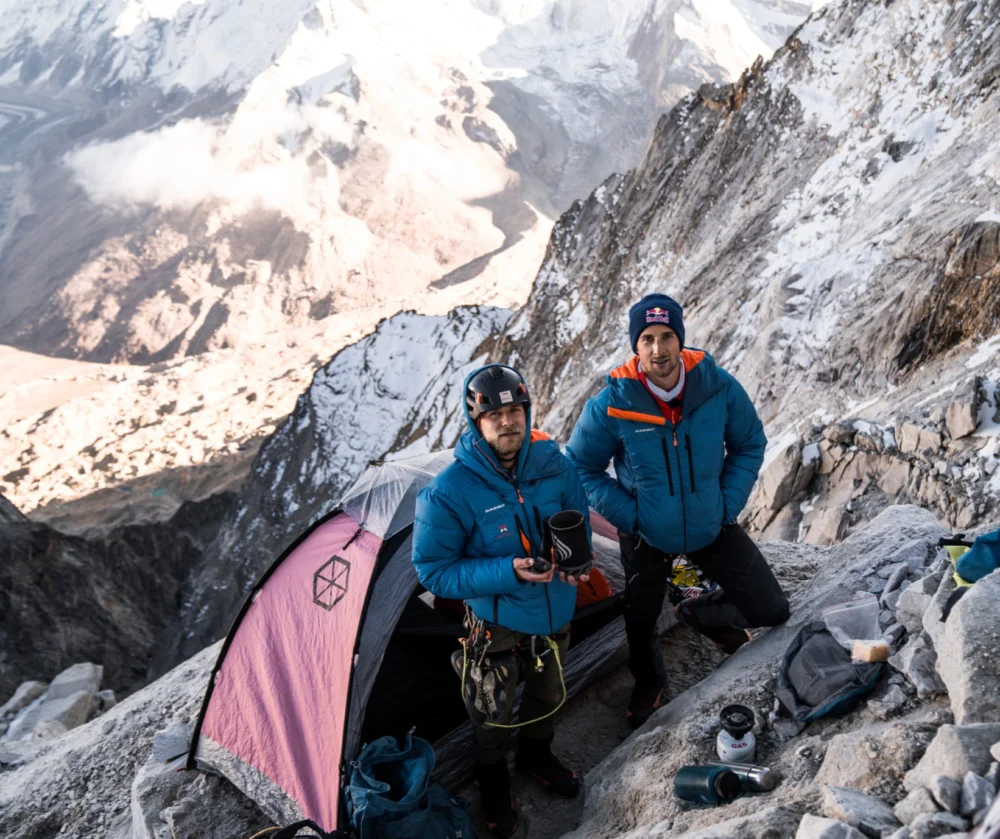
Born and raised amidst the majestic landscapes of Spiez, Switzerland, Nicolas Hojac’s journey into the high mountains began not with a predetermined destiny, but with a profound sense of curiosity. What initially sparked during a language immersion stay in the Lower Valais quickly evolved into a sophisticated pursuit: the art of moving efficiently and safely through some of the world’s most formidable terrain. For Hojac, this pursuit is a complex interplay where raw speed, meticulous preparation, and refined intuition converge, crafting a distinctive path in the demanding world of alpinism.
Hojac’s ascent in the climbing world was remarkably swift. By the tender age of 18, he had already conquered the Eiger’s iconic North Face, a route synonymous with alpine legend and formidable challenge. Within just two short years, he cemented his early prowess by completing the coveted North Face Trilogy, adding ascents of the Matterhorn and the Grandes Jorasses to his impressive resume. This early foundation set the stage for a career characterized by ambitious link-ups and landmark speed ascents, predominantly across his native Alps, but also extending to far-flung expeditions.
One of Hojac’s most notable achievements unfolded in May of last year, when he and his Austrian climbing partner, Philipp Brugger, executed a breathtaking full link-up of the north faces of the Eiger, Mönch, and Jungfrau. They completed this monumental traverse in an astonishing 15 hours and 30 minutes, decisively shattering the previous record established in 2004. This feat not only underscored their exceptional physical and technical capabilities but also highlighted Hojac’s innovative approach to modern alpinism.

From Childhood Fascination to Alpine Mastery
Hojac’s early life in Spiez, a town nestled on the shores of Lake Thun with panoramic views of the Bernese Alps, provided a constant backdrop of towering peaks. Yet, unlike many alpinists who inherit a climbing legacy, Hojac’s family was not steeped in mountaineering tradition. His initial connection to the outdoors was nurtured through literature, as he describes devouring books by legendary adventurers such as Ernest Shackleton and Mike Horn. These narratives of exploration and endurance fueled a nascent longing for adventure.
His pivotal moment arrived during a language stay in the Valais region, home to some of Switzerland’s most dramatic peaks. It was there that Hojac realized the profound truth that adventure didn’t require traveling to the ends of the earth; the same exhilarating sense of discovery, albeit on a different scale, could be found right in his own backyard. This realization ignited a passion that, he asserts, continues to burn brightly, propelling him deeper into the mountains. This foundational experience shaped his understanding of mountaineering as a personal journey of exploration and self-discovery, rather than mere conquest.
The Allure of the Eiger and the North Face Trilogy

The Eiger, with its towering 1,800-meter North Face, has consistently served as a powerful magnet throughout Hojac’s career. Its sheer scale and profound, often tragic, history cast a unique spell over climbers. The North Face, often referred to as "Mordwand" (murder wall) due to its historical dangers, is not merely a rock and ice climb; it’s a living museum of alpinism. The Heckmair Route, in particular, traverses sections steeped in legend, where the echoes of past dramas resonate deeply. Hojac speaks of these historical narratives almost palpably, recalling the cries for help of Toni Kurz, one of the route’s early and ill-fated pioneers, as if they were still present within the very rock and ice. This deep respect for the mountain’s history adds a layer of reverence to his ascents, grounding his speed in an appreciation for those who came before.
His early completion of the North Face Trilogy—the Eiger, Matterhorn, and Grandes Jorasses—marked him as a prodigious talent. These three faces are considered the ultimate test pieces of classical alpinism, demanding a blend of technical skill, endurance, and mental fortitude. Conquering them by age 20 placed Hojac firmly among an elite group of mountaineers, signaling his arrival as a serious force in the alpine world.
The Record-Breaking Eiger-Mönch-Jungfrau Link-Up
The monumental link-up of the Eiger, Mönch, and Jungfrau north faces in 2023 stands as a testament to Hojac’s evolving craft. These three iconic peaks, forming the majestic "Triple Threat" of the Bernese Alps, present a colossal challenge individually, let alone in a continuous traverse. The previous record for linking their north faces, set nearly two decades prior, was considered a benchmark of speed and endurance. Hojac and Philipp Brugger’s achievement of completing this traverse in a blistering 15 hours and 30 minutes was a masterclass in strategy, physical conditioning, and seamless teamwork.

The challenge involved not just climbing three distinct and highly technical north faces, but also navigating the treacherous terrain between them, often requiring complex glacier travel, rock climbing, and ice climbing, all while maintaining an unrelenting pace. This type of "link-up" represents the cutting edge of modern alpinism, where the goal extends beyond merely ascending a single peak to crafting innovative and demanding traverses that redefine what’s possible in a single push. The record was a clear demonstration of their superior preparation, intimate knowledge of the terrain, and an almost telepathic understanding between the climbing partners.
The Legacy of Ueli Steck: A Mentor’s Profound Impact
A significant chapter in Hojac’s development was his collaboration with the late, legendary Swiss alpinist Ueli Steck, often dubbed the "Swiss Machine" for his unparalleled speed and efficiency in the mountains. Hojac recounts a particularly iconic speed ascent of the Eiger with Steck, emphasizing that the record itself was an unplanned byproduct of a simple objective: to get Steck back to Bern for a 6:00 PM meeting. This anecdote powerfully illustrates Steck’s philosophy of efficiency and Hojac’s own burgeoning understanding of it.
For Hojac, the true value of that day was not the broken record, but the profound lesson imparted by Steck. "He showed me that I am capable of much more than I think," Hojac reflects. Steck, known for pushing the boundaries of human endurance and speed in the high mountains, became more than a role model; he was a mentor and a close friend. This relationship taught Hojac the immense potential that lies beyond perceived limits, fostering a mindset of continuous self-improvement and challenging internal barriers, while always emphasizing safety and calculated risk.

Global Expeditions and the Appreciation of Home
While Hojac is celebrated for his groundbreaking ascents in the Alps, his mountaineering endeavors are far from confined to his home range. His resume includes challenging expeditions to remote and demanding regions like Patagonia, China, and Norway. These global adventures, characterized by their unique logistical complexities, extreme weather, and often unexplored terrain, have broadened his perspective and honed his skills in diverse alpine environments.
Returning from such grand expeditions, Hojac finds a renewed appreciation for the accessibility and grandeur of the Alps. The familiar peaks, though smaller in scale compared to some Himalayan giants or Patagonian spires, regain their charm. Distances seem shorter, logistics simpler. However, this return also brings a stark contrast: the relative crowds of the popular Alpine routes. After the solitude of remote ranges, the presence of many others on the mountain can be a minor point of contention, highlighting the rare and cherished experience of having a mountain entirely to oneself.
The Philosophy of Speed: Strategy, Safety, and Flow

Speed climbing often garners misunderstanding, frequently misconstrued as reckless or overly competitive. Hojac vehemently challenges this perception. For him, moving fast in the mountains is not primarily about setting records but about "solving a puzzle." It involves an immense amount of strategic thinking, detailed planning, and precise execution to achieve a goal as efficiently as possible, all while operating strictly within a safe framework. He clarifies that his focus is not on individual peak speed records, but on ambitious "link-ups" – connecting multiple summits, faces, or disciplines – where speed becomes an indispensable tool to achieve the larger objective.
He articulates that speed, rather than being an end in itself, is a "means to an end." It enables him and his partners to embark on longer, more complex adventures within a viable timeframe, fostering a state of "flow" – a deep, immersive engagement with the present moment. Paradoxically, speed can enhance safety. By minimizing exposure time to objective hazards like rockfall, avalanches, or rapidly changing weather, a swift ascent can reduce overall risk. This demands an exceptional level of physical conditioning, allowing for sustained effort, and highly refined technical skills, ensuring precision even under pressure. Without this robust foundation, attempting speed would indeed become reckless.
Navigating Risk and the Wisdom of Retreat
In the unforgiving realm of alpinism, knowing when to push and, more importantly, when to retreat, is paramount. Hojac openly acknowledges moments where "respect told [him] to slow down, or walk away, even when everything looked possible." In his younger years, these decisions often stemmed from a lack of experience or an underestimation of a route during planning. Standing at the base of a climb, confronted by an overwhelming sense of respect for the mountain’s power, he wisely chose to turn back.

Even with his extensive experience, such situations still arise if planning has been overly optimistic. Hojac views these moments not as failures, but as integral to the process of growth. He emphasizes that there is nothing wrong with retreating, as long as one avoids putting oneself in danger. These calculated withdrawals are crucial for learning, for understanding one’s true limits, and for ensuring longevity in a sport where consequences can be fatal. This measured approach underscores the saying, "Only an old alpinist is a good alpinist," a maxim Hojac holds dear as his ultimate definition of success.
Humility in the Heights: Rejecting the "Hero" Narrative
Despite his extraordinary accomplishments, Nicolas Hojac actively shies away from being labeled a "hero." He views mountaineering as inherently "useless and selfish," echoing Lionel Terray’s famous quote, "Conquistadors of the Useless." This perspective grounds his achievements in a profound sense of humility. He sees himself as an ordinary person striving for excellence, just like anyone else in their chosen field, finding no reason for arrogance.
While his public profile might seem to contradict his natural inclination to avoid the spotlight, Hojac made a conscious decision to share his projects. This choice stems from a desire to inspire, acknowledging that by sharing his experiences and lessons, he can encourage others to pursue their own goals, whether in sports, career, or personal life. This vulnerability, he understands, also opens him to criticism, yet he embraces it for the broader impact it can have.

Ego Management in a Sport of Extremes
In a sport that frequently celebrates extremes and individual achievement, the management of ego is a critical factor for long-term survival and genuine progression. Hojac attributes his grounded approach to what he describes as a "quite small" ego. He emphasizes that his motivation is not to measure himself against others, but rather against his own potential. This internal drive allows him to genuinely celebrate the successes of fellow climbers without feeling diminished or competitive.
He explicitly states, "I don’t want to be ‘the best’; I just want to follow my own path and realize cool projects." This philosophy allows him to accept that constant escalation – "faster, higher, further" – is not sustainable in alpinism and can lead to fatal consequences. After a major undertaking, such as the Eiger, Mönch, and Jungfrau trilogy, he consciously takes time to "come back down to earth and ground myself," a crucial practice for maintaining mental and emotional equilibrium.
The Evolving Definition of Progression

Hojac’s definition of progression has matured significantly over his career. Initially, like many young alpinists, it was synonymous with "faster, further, higher, and harder." Today, it encompasses a more holistic development of both body and mind, and a relentless pursuit of new facets within the sport. He is no longer driven by the marginal improvement of an existing record by a few minutes; instead, he seeks to apply creativity to conceptualize and execute entirely novel challenges.
A prime example of this evolved progression is his summer 2024 traverse of the majority of the Bernese Panorama. This unprecedented feat involved a non-stop, 37-hour push across 11 peaks, covering 65 kilometers and ascending 7,000 meters of vertical gain. This imaginative link-up, a line so "obvious" once seen but never before attempted, perfectly encapsulates his current philosophy: to innovate and explore new dimensions of possibility within the mountains.
Dispelling Misconceptions and Inspiring Others
Hojac recognizes that those outside the alpinism community often misunderstand speed climbing. He addresses the common perception of climbers as "gamblers," asserting that they risk only their own lives, not others’. He likens the perceived "meaningfulness" of speed climbing to kicking a ball into a goal, emphasizing that its value is often subjective. He stresses that the occasional use of a stopwatch for specific projects does not diminish his profound enjoyment and appreciation for the mountains on other days. He still finds immense joy in observing wildlife or simply soaking in a view, demonstrating that his dedication to speed is a specialized aspect of a broader, deeply felt connection to nature.

He also acknowledges the changing landscape of alpinism. The "Golden Age" of first ascents in the Alps is long past; every peak has been summited, every major face has a route. This reality necessitates evolution within the sport, where "link-ups" and "speed" offer new frontiers for exploration and achievement. While he admits a wistful desire to have been among the first to climb the Eiger North Face, he embraces the current era’s challenges.
Ultimately, Hojac finds the most profound meaning in his "job" through his ability to inspire. By transparently sharing his experiences, his triumphs, and his lessons learned, he hopes to encourage individuals from all walks of life to identify their own goals and pursue them with dedication, step by step. His pursuit, distilled into a single word, is simply "Passion."
What resonates most deeply about Nicolas Hojac is not merely the sheer scale of his accomplishments—the broken records, the audacious link-ups, the mastery of daunting faces—but the measured and remarkably understated manner in which he articulates his journey. His perspective is one profoundly grounded in process rather than outcome, defined by meticulous preparation, strategic ingenuity, and an unwavering commitment to humility.
As his projects continue to expand across diverse faces, mountain ranges, and alpine disciplines, Hojac’s core emphasis remains steadfast: a focus on precise execution over mere spectacle, a commitment to longevity in the sport over fleeting immediacy, and a steadfast dedication to making deliberate, well-considered decisions within terrain that consistently demands the utmost respect. He stands as a thoughtful leader in modern alpinism, demonstrating that true progression is an internal journey, far richer and more complex than any time on a clock.
