

For nearly a quarter of a century, the landscape of American winter recreation has undergone a transformation so profound it is nearly unrecognizable to those who stood on the ridgelines of the mid-1990s. In the winter of 1994/95, the technological and institutional framework of avalanche safety was in its infancy. High-speed mobile internet did not exist, avalanche beacons were analog devices with limited range, and the "sidecountry"—the easily accessible backcountry terrain adjacent to ski resorts—was a concept yet to be named. During this era, leadership in the field was concentrated among a small group of pioneers: Knox Williams in Denver, Bruce Tremper in Utah, and Mark Moore in Seattle. While a few other centers existed, such as the one in Jackson Hole led by Jim Kanzler or the Mount Washington center under Brad Ray, vast swaths of the American West, including the Chugach Range in Alaska, Tahoe, and Mount Shasta, lacked formal regional avalanche forecasting.
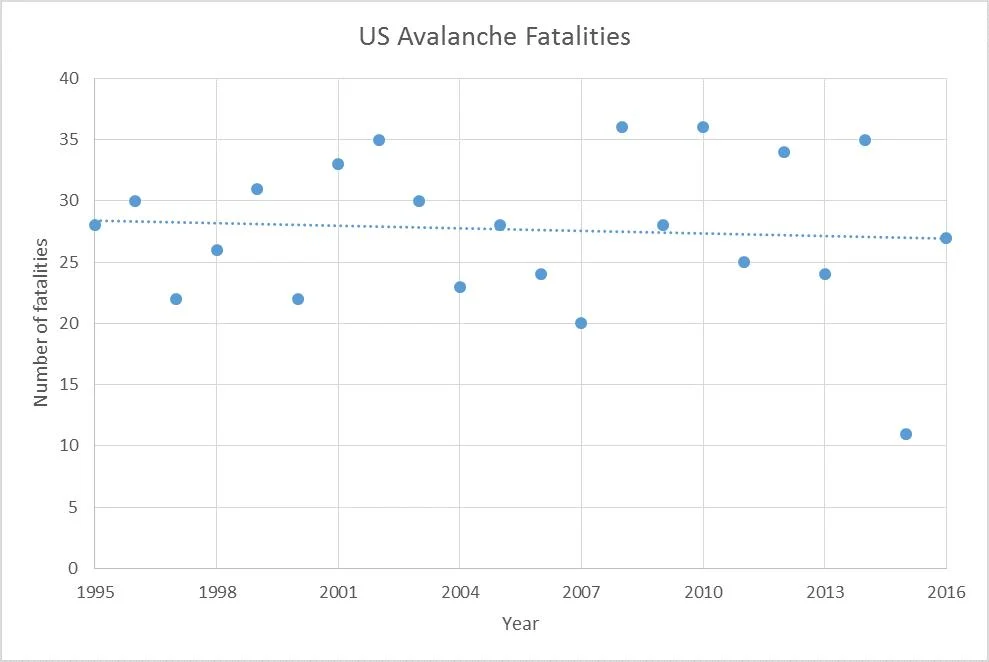
Despite a massive surge in the number of people venturing into the mountains over the following 22 seasons, a startling statistical trend has emerged. Data compiled by the Colorado Avalanche Information Center (CAIC) and analyzed by Karl Birkeland of the National Avalanche Center reveals that the annual number of U.S. avalanche fatalities has remained remarkably steady since 1995. This stability persists despite a revolution in gear, a literal explosion in backcountry usage, and the advent of high-powered snowmobiles capable of reaching terrain that was once the exclusive domain of professional mountaineers.
A Comparative Chronology of Backcountry Evolution
To understand the significance of the flat fatality trend, one must first examine the technological and cultural shifts that occurred between the 1994/95 season and the 2015/16 season. In the mid-90s, the backcountry was a niche environment. Skier equipment largely consisted of telemark gear, often paired with leather boots that offered minimal support. Alpine Touring (AT) equipment was heavy, cumbersome, and rare. Snowmobiles of the era were heavy, underpowered machines by modern standards, lacking the track technology and power-to-weight ratios that allow today’s riders to "high-mark" steep, avalanche-prone slopes with ease.
Communication and information sharing were similarly primitive. In 1995, the first avalanche advisories were only beginning to appear on the nascent World Wide Web. Most recreationists relied on recorded phone lines or physical bulletin boards at trailheads to receive weather and snowpack updates. By 2016, this landscape had shifted to a world of smartphones, real-time social media updates, and high-definition helmet cameras that encouraged "hero shots" in extreme terrain. Furthermore, the boundary policies of many ski areas changed during this period. In the 1990s, crossing a resort boundary was often a prohibited act; today, many resorts provide "open gate" policies that funnel thousands of skiers into unmitigated backcountry terrain every weekend.
Statistical Analysis of Fatality Trends
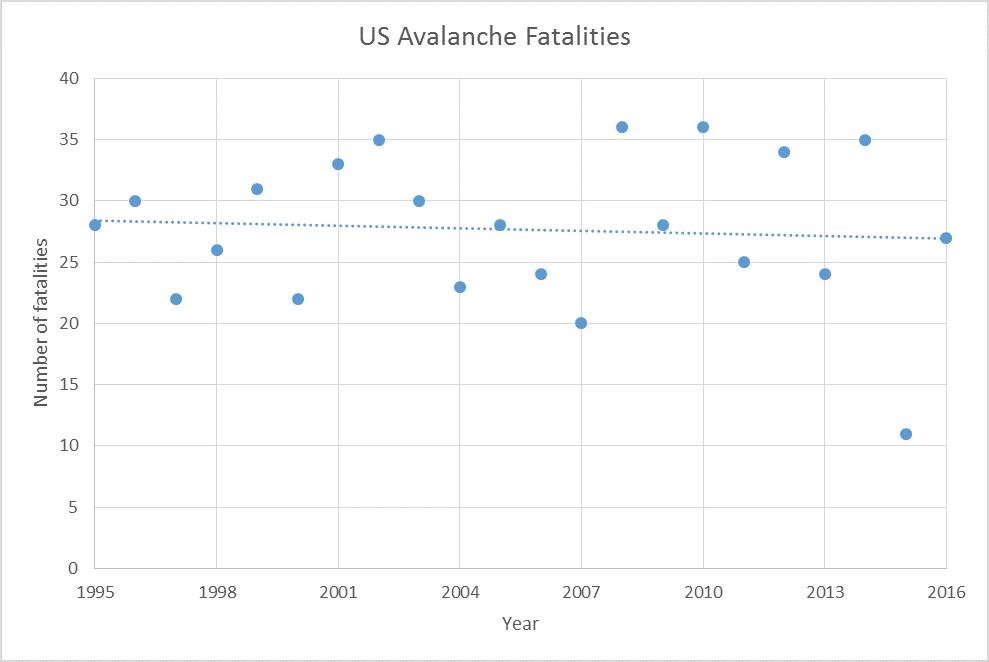
The data spanning from 1994 to 2016 provides a clear picture of the phenomenon. When plotting total U.S. avalanche fatalities over these 22 seasons, the trend line is nearly horizontal. A "least squares" statistical analysis of the data shows a p-value of 0.7, indicating that any slight downward tilt in the line is not statistically significant. In simpler terms, there is no evidence of a meaningful change in the number of people dying in avalanches each year, despite the massive influx of new participants.
Specific demographics within the backcountry community show slightly different, though largely consistent, trends:
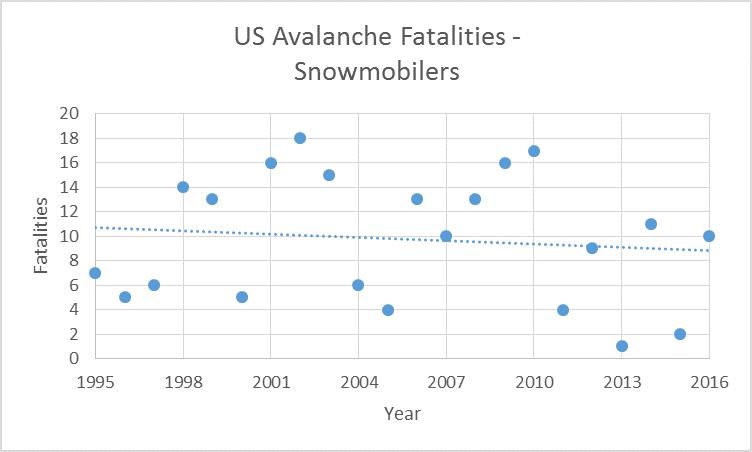
- Snowmobile Fatalities: Despite the rapid advancement in snowmobile technology and the increased ability of riders to access complex terrain, the number of motorized avalanche fatalities has remained flat. The statistical trend line for this group shows a p-value of 0.6, confirming a lack of significant change over the 22-year period.
- Skier and Snowboarder Fatalities: This group shows a slight potential increase in fatalities, with a p-value of 0.07. While this suggests a more noticeable upward trend than the motorized or overall categories, it still does not represent the exponential spike that might be expected given the growth in the sport.
The Growth Factor: Utilizing Proxies for Backcountry Use
The true significance of the flat fatality line is revealed when it is weighed against the growth of backcountry recreation. Measuring the exact number of people in the backcountry is notoriously difficult, as there are no turnstiles at trailheads and much of the use is dispersed across public lands. However, researchers have used "avalanche advisory usage"—the number of times people access professional forecasts—as a proxy for participation.
The growth in these numbers is staggering. Between 1994 and 2016, the Utah Avalanche Center recorded a 12-fold increase in advisory hits. The Colorado Avalanche Information Center saw a 17-fold increase, while the Gallatin National Forest Avalanche Center in Montana experienced a 36-fold increase. Most dramatically, the Northwest Avalanche Center in Seattle reported a 60-fold increase in the number of people seeking avalanche information.
While some of this increase can be attributed to the transition from phone-in recordings to the ease of web-based clicks, the sheer magnitude of the rise points to a massive increase in the number of individuals entering the mountains in winter. Even using a highly conservative estimate—assuming that actual backcountry use increased by a factor of eight over the 22-year period—the implications are profound.
The Drastic Decline in Fatality Rates
If the number of fatalities remains the same while the number of users increases eightfold, the "fatality rate"—the number of deaths per backcountry user day—has dropped by at least 800 percent. Statistical modeling suggests that if the fatality rate had remained the same as it was in the mid-1990s, the United States would be witnessing upwards of 200 avalanche deaths per winter by the mid-2010s, rather than the average of 25 to 30 that is currently observed.
This dramatic reduction in risk is considered a major success for the avalanche safety community. Experts attribute this "win" to a multi-pronged approach involving education, technology, and information dissemination.
The Role of Education and Awareness
The standardization of avalanche education has played a pivotal role. Organizations such as the American Institute for Avalanche Research and Education (AIARE) and the American Avalanche Association (A3) have developed rigorous curriculum standards that have moved from niche mountaineering circles into the mainstream. Programs like "Know Before You Go," a free awareness program, have reached hundreds of thousands of students and casual recreationists, instilling the basics of checking the forecast and carrying the proper gear.
Technological Advancements in Safety Gear
While gear allows people to go deeper into the mountains, it has also provided a more robust safety net. Modern digital transceivers are significantly faster and more intuitive than the analog beacons of the 1990s. The introduction and widespread adoption of avalanche airbag packs have significantly increased the chances of a victim staying on the surface of a slide. Other innovations, such as the Avalung (designed to provide an air pocket under the snow) and lightweight carbon-fiber probes and shovels, have improved the efficiency of companion rescue.
The Expansion of the Avalanche Center Network
The growth of regional avalanche centers has been perhaps the most critical factor. These centers provide daily, high-resolution forecasts that allow users to make informed decisions before they even leave their homes. The expansion of these centers into regions like Alaska and Northern California has closed significant gaps in public safety coverage that existed in the 1990s.
Professional and Institutional Responses
The findings presented by Karl Birkeland have been met with a sense of cautious pride within the professional avalanche community. While the goal remains "zero fatalities," the data suggests that current strategies are working effectively to mitigate the risks associated with a booming outdoor recreation economy.
Analysts suggest that the collaboration between government agencies (like the U.S. Forest Service), non-profit partners, and private equipment manufacturers has created a unique safety ecosystem. This "community of practice" ensures that lessons learned from accidents are quickly integrated into educational curricula and equipment design. The Colorado Avalanche Information Center, which provided the data for this study, remains a central hub for this information, meticulously documenting accidents to ensure the community can benefit from forensic analysis of past tragedies.
Broader Impact and Future Challenges
The flat fatality trend is a testament to the resilience and adaptability of the avalanche safety community. However, the future presents new challenges that may test the limits of current mitigation strategies. Climate change is altering snowpack patterns, leading to more frequent "unusual" weather events and potentially more volatile avalanche conditions in some regions. Furthermore, as backcountry gear becomes even more accessible and "easy" to use, the barrier to entry continues to lower, potentially drawing in users who lack the traditional mentorship and experience of previous generations.
The transition from the "analog" era of 1994 to the "digital" era of 2016 has proven that information is the most powerful tool in avalanche safety. The fact that the fatality rate has plummeted by a factor of eight or more is a landmark achievement in public safety. It demonstrates that through a combination of professional forecasting, public education, and technological innovation, it is possible to manage the inherent risks of the mountains even as the number of people seeking adventure in high-alpine environments continues to grow.
As the backcountry community looks toward the next 20 years, the focus will likely remain on maintaining this "flat line" in the face of ever-increasing use. The success of the past two decades serves as a roadmap: continue to invest in regional centers, refine education for a digital audience, and foster a culture of safety that keeps pace with the technology of the day. For now, the data stands as a clear indicator that the efforts of avalanche professionals and educators are saving hundreds of lives every winter.
