

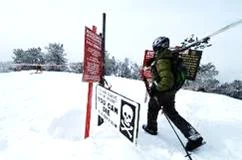
The modern skiing landscape is defined by a paradoxical relationship between the controlled environments of commercial ski resorts and the raw, unmanaged wilderness that often lies just a few feet beyond their boundaries. Across the United States, dozens of major ski areas operate on or adjacent to public lands managed by the U.S. Forest Service, creating a seamless but dangerous transition for winter recreationists. This proximity has birthed the term "sidecountry," a colloquialism used to describe backcountry terrain accessed via a ski lift. However, avalanche safety experts and mountain professionals are increasingly warning that the term itself creates a deadly illusion of safety, masking the reality that once a skier or snowboarder passes through a boundary gate, they have entered an "R-rated" environment where the rules of the resort no longer apply.
The fundamental danger of sidecountry terrain lies in the absence of traditional resort infrastructure. Within the ropes of a ski area, professional ski patrols perform daily avalanche mitigation using explosives, hand charges, and "ski cutting" to stabilize the snowpack. They monitor weather patterns and slope stability to ensure that open runs are safe for public use. Furthermore, if an injury occurs, a patrolled response is typically minutes away. Beyond the boundary line, none of these protections exist. These areas are uncontrolled, unpatrolled, and entirely susceptible to the same natural hazards as the most remote wilderness peaks. In the event of an accident or an avalanche burial, the responsibility for rescue falls entirely on the individual and their partners, as official search and rescue (SAR) operations can take hours or even days to mobilize.
The Psychological Trap of the Boundary Gate
The proximity of lift-accessed backcountry creates a psychological phenomenon known as the "halo effect." When a skier can see the lift towers, the lodge, or the groomed runs of a resort, they often subconsciously believe they are still within a safety net. This sense of security is frequently reinforced by the presence of a "gate"—a physical opening in the boundary fence that implies a sanctioned path.
However, experts like Doug Chabot, a veteran avalanche forecaster, point out that these gates do not signify safety; they signify a transition into high-stakes terrain. The metaphor of "Rated R" terrain is used to highlight the maturity, experience, and equipment required to navigate these areas. For many young skiers and snowboarders, the lure of untracked powder outweighs the recognition of risk. This leads to a disconnect between the perception of the terrain and the reality of its volatility. As Chabot notes, parents often wave goodbye to their children in the parking lot, unaware that their teenagers may be transitioning from the "G-rated" environment of a groomed blue run to "R-rated" slopes where a single mistake can be fatal.
Statistical Trends in Sidecountry Fatalities
Data from the Colorado Avalanche Information Center (CAIC) and the American Avalanche Association (A3) illustrate a troubling trend in backcountry and sidecountry accidents. Over the last two decades, as equipment has become more advanced and easier to use, the number of people venturing out of bounds has increased exponentially. This surge in participation has been mirrored by a shift in fatality statistics.
In the mid-20th century, avalanche victims were often highway workers or professionals working in the mountains. Today, the vast majority are recreational users. Specifically, "sidecountry" users—those who access the backcountry via lifts—represent a significant portion of these incidents. According to historical data, roughly 25 to 30 people die in avalanches annually in the United States. A recurring theme in these tragedies is the lack of proper safety equipment. Studies have shown that a significant percentage of sidecountry skiers do not carry the "Big Three" essential tools: a transceiving beacon, a collapsible probe, and a metal shovel. Without these tools, and the knowledge of how to use them, the chances of surviving a burial are nearly zero.
The 2011-2012 winter season served as a watershed moment for the industry, particularly following the Tunnel Creek avalanche at Stevens Pass, Washington. That incident, which claimed the lives of three highly experienced skiers just outside the resort boundary, highlighted that even those with significant knowledge can be caught in the complex terrain typical of the sidecountry.
The Evolution of Equipment and Accessibility
The rise of sidecountry skiing is inextricably linked to the evolution of alpine equipment. The development of "frame" and "tech" bindings, which allow a skier to lift their heel for uphill travel while maintaining downhill performance, has blurred the lines between resort and backcountry gear. Furthermore, the trend toward wider, "rockered" skis has made deep powder more accessible to intermediate skiers who previously lacked the technique to navigate such conditions.
This technological advancement has outpaced the growth of avalanche education. While a skier may have the equipment to reach the top of a remote ridge, they may lack the "mountain sense" to recognize "red flag" indicators such as recent loading from wind-drifted snow, "whumpfing" sounds, or shooting cracks in the snowpack. The ease of access provided by high-speed quad lifts means that a skier can reach a dangerous, high-alpine environment in minutes, often without breaking a sweat or having the time to observe the changing snow conditions that a traditional backcountry hiker would notice during a long ascent.
Jurisdictional Limits and the Role of Ski Patrol
A common misconception among the general public is that ski patrol is legally or operationally required to perform rescues outside of resort boundaries. While many patrols do assist in out-of-bounds rescues as a matter of humanitarian concern, they are not obligated to do so, nor are they always equipped for long-range wilderness extraction.
Most U.S. ski resorts operate under "Special Use Permits" from the U.S. Forest Service. These permits define the "Operational Boundary" of the resort. Within this boundary, the resort assumes a degree of liability and responsibility for hazard mitigation. Outside of it, the land is typically "open" to the public, but the resort’s authority and responsibility end. When an emergency occurs in the sidecountry, it becomes the jurisdiction of the local County Sheriff and volunteer search and rescue teams.
The financial and human cost of these rescues is substantial. SAR operations often involve dozens of volunteers, helicopters, and specialized equipment, often funded by taxpayers or donations. In some states, such as Colorado and New Hampshire, authorities have the legal right to bill rescued parties for the cost of the operation if they are found to have acted with extreme negligence or entered closed areas.
The Social Media Factor and Youth Culture
The "Rated R" nature of sidecountry terrain is further complicated by the influence of social media. The "GoPro effect"—the desire to capture high-intensity footage for platforms like Instagram and YouTube—can lead to "heuristic traps." These are mental shortcuts that cloud judgment, such as "social proof" (the belief that if others are skiing a slope, it must be safe) or "scarcity" (the urge to ski a slope before someone else gets the fresh tracks).
Younger demographics are particularly susceptible to these pressures. The culture of "sending it" and seeking "extreme" terrain is often at odds with the cautious, methodical approach required for safe backcountry travel. Professional mountain guides and educators are now focusing on "human factors"—the psychological reasons why people make poor decisions in the mountains—as much as they focus on the science of snow crystals.
Industry Response and Education Initiatives
In response to the growing number of sidecountry incidents, the ski industry has launched several major initiatives. The "Know Before You Go" program, a collaborative effort between various avalanche centers and brands, provides a free, introductory curriculum aimed at middle and high school students. The goal is to instill a basic understanding of avalanche risk before they ever step through a boundary gate.
Resorts have also changed how they communicate boundary policies. Many have replaced simple "Closed" signs with more descriptive warnings that state: "You are leaving the ski area. This terrain is not patrolled. You are responsible for your own safety." Some resorts, such as Jackson Hole in Wyoming and Silverton Mountain in Colorado, have implemented stricter gate policies or require certain equipment for access to specific zones.
The American Institute for Avalanche Research and Education (AIARE) has also seen record enrollment in its Level 1 and Level 2 certification courses. These courses teach participants how to read a regional avalanche forecast, how to identify terrain traps (such as gullies or trees where snow can pile up deeply), and how to perform a companion rescue.
Broader Implications and the Future of Mountain Access
The debate over "sidecountry" access touches on broader issues of land use and personal freedom. In the United States, the right to access public lands is a cherished principle, and many argue that the government should not "close" the backcountry regardless of the danger. However, as the volume of users grows, so does the strain on public resources and the potential for tragedy.
Climate change is also playing a role in the stability of these areas. Unpredictable weather patterns, including more frequent "rain-on-snow" events and extreme temperature swings, are creating more complex and volatile snowpacks. This makes the "R-rated" terrain even more unpredictable, requiring a higher level of expertise to navigate safely.
Ultimately, the term "sidecountry" may eventually be phased out of the professional lexicon in favor of "lift-accessed backcountry." This shift in terminology is intended to remind the public that there is no middle ground: you are either in a controlled environment or you are in the wilderness. For those who choose to pass through the gate, the requirement is clear: carry the proper gear, seek out professional education, and respect the fact that the mountains do not offer a "safety" setting. The "Rated R" landscape demands a mature, calculated approach where the consequences of an error are final.
