

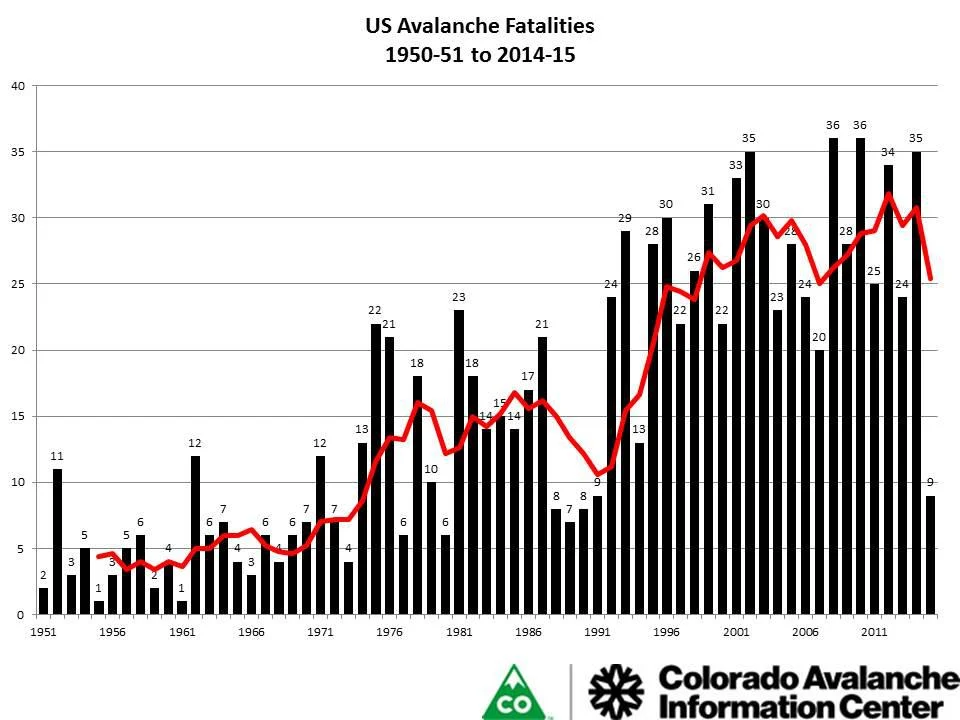
As the 2014-2015 winter recreation season draws to a close on April 30, preliminary data from the Colorado Avalanche Information Center and the United States Forest Service indicates a historic decline in avalanche-related fatalities. With only nine deaths recorded across the country, this season marks the lowest number of avalanche fatalities in the United States since 1991. This statistical anomaly arrives during a period when backcountry recreation—including backcountry skiing, snowboarding, and snowmobiling—has seen an unprecedented surge in participation. While every loss of life is regarded as a tragedy by the outdoor community, the sharp decrease from the five-year moving average of 25 to 30 deaths per year suggests a confluence of favorable meteorological conditions and increasingly effective public safety initiatives.
The data, compiled by Spencer Logan and the Colorado Avalanche Information Center (CAIC), which maintains the national database for avalanche accidents, highlights a significant departure from recent trends. For over a decade, safety experts have expressed concern that the rising popularity of "human-powered" winter sports would lead to a linear increase in accidents. However, the 2014-2015 figures provide a moment of cautious optimism for snow safety professionals and land managers.
Meteorological Drivers of the 2014-2015 Season
The primary factor contributing to the reduced fatality count is widely attributed to the unique and often erratic weather patterns observed across the North American continent over the past six months. The winter of 2014-2015 was characterized by a stark dichotomy between the Eastern and Western United States, with the latter experiencing one of the least productive snow years in recent memory.
Along the West Coast, particularly in the Sierra Nevada of California and the Cascade Range of Washington and Oregon, a persistent high-pressure system—often referred to by meteorologists as the "Ridiculously Resilient Ridge"—blocked the traditional path of Pacific storms. This resulted in record-low snowpack levels and, in many areas, temperatures that were too high to sustain a seasonal alpine snowpack. Because avalanches require a sufficient volume of snow to create "slabs" and "trigger points," the lack of depth in the maritime snowpack naturally limited the frequency and scale of slide activity. In many regions that typically see high volumes of backcountry traffic, the "avalanche season" never truly materialized in a traditional sense.
Further inland, across the Intermountain West—including the Rocky Mountains of Colorado, Utah, and Montana—the season was defined by unseasonably warm temperatures. While these regions did receive snow, the warmth helped to "heal" the snowpack more quickly than in colder, more traditional winters. In a typical Rocky Mountain winter, cold temperatures often create "facets" or weak, sugary layers of snow near the ground that remain unstable for months. In 2014-2015, the warmth allowed the snowpack to settle and gain strength more rapidly, thereby reducing the window of high avalanche danger following storm cycles.
Historical Context and the 1991 Benchmark
To find a comparable year with fewer than ten fatalities, researchers must look back nearly a quarter of a century to the 1990-1991 season. The early 1990s represented a very different era for backcountry travel. During that period, the equipment available to skiers and snowmobilers was significantly less advanced, and the number of people venturing beyond the boundaries of established ski resorts was a fraction of today’s figures.
Since 1991, the "sidecountry" and "backcountry" revolutions have transformed the winter landscape. The development of lightweight touring bindings, high-traction climbing skins, and powerful mountain-climbing snowmobiles has granted the general public access to terrain that was once the exclusive domain of elite mountaineers. Despite this massive increase in exposure—the number of people physically standing in avalanche-prone terrain—the fatality rate has not kept pace with participation. The fact that 2014-2015 returned to 1991 levels is seen by many experts as a testament to the success of modern forecasting, even when accounting for the poor snow year.
The Role of Education and Public Information
While weather played a decisive role, the efforts of the U.S. Forest Service avalanche centers and the CAIC cannot be overlooked. Over the last decade, these organizations have shifted their focus from purely scientific observation to a more sophisticated model of public communication and behavioral psychology.
The CAIC, which serves as a central hub for avalanche information in the United States, has utilized social media, mobile applications, and localized "Know Before You Go" programs to reach a broader audience. By providing daily, easy-to-understand danger ratings and detailed descriptions of "avalanche problems" (such as wind slabs or persistent weak layers), forecasters have empowered recreationists to make more informed decisions.
Inferred reactions from the professional community suggest that while they welcome the low numbers, there is a concern regarding "complacency." Safety officials emphasize that a low-snow year does not mean a "no-risk" year. In fact, thin snowpacks can often be more temperamental and harder to predict than deep ones. The stability of the 5-year moving average—remaining between 25 and 30 deaths despite the explosion in use—indicates that education is working, but it also highlights the inherent risks that remain even in "good" years.
Analysis of the 5-Year Moving Average
One of the most encouraging data points provided in the 2014-2015 summary is the stability of the 5-year moving average. In statistical analysis, the moving average is used to smooth out short-term fluctuations and highlight longer-term trends.
In the late 1990s and early 2000s, as backcountry gear became more accessible, there was a noticeable upward trend in fatalities. However, for the past 15 years, that trend line has largely flattened. This "plateau" in fatalities, occurring simultaneously with a "skyrocketing" increase in users, suggests a significant decrease in the per-capita risk of dying in an avalanche.
Several factors contribute to this stabilization:
- Technological Proliferation: The near-universal adoption of avalanche transceivers, probes, and shovels among backcountry users.
- Avalanche Airbags: The emergence and widespread use of rapid-inflation airbags, which help keep victims on the surface of a slide, have significantly increased survival rates in the event of an involvement.
- Formal Training: The standardization of "Level 1" avalanche courses by organizations like the American Institute for Avalanche Research and Education (AIARE) has created a common language and framework for risk assessment.
- Professionalism in Snowmobiling: Once a demographic with high fatality rates, the snowmobile community has seen a cultural shift toward safety, with many manufacturers and pro riders advocating for formal avalanche training.
Regional Variations and Specific Incidents
Despite the national low, the nine fatalities that did occur serve as a sobering reminder of the volatility of the mountain environment. These incidents were spread across various states, involving a mix of skiers, snowmobilers, and climbers.
In Colorado, the CAIC reported a season that required constant vigilance due to the "persistent slab" problems that characterize the state’s continental snowpack. Even in a year with lower-than-average snowfall, the slides that did occur were often triggered by people on "low-probability, high-consequence" slopes—areas where the danger isn’t widespread but is deadly where it exists.
In the Pacific Northwest, the lack of snow led to different types of hazards, including increased risks of "glide cracks" and falls on icy, unyielding surfaces that never received their usual insulating blanket of powder. The Northeast, particularly the Presidential Range in New Hampshire, experienced a more traditional winter, with Mount Washington continuing to be a focal point for high-use safety education due to its extreme weather and technical terrain.
Broader Implications and Future Outlook
The 2014-2015 season will likely be studied by snow scientists for years to come as a "case study" in how climate variability affects public safety. As global weather patterns become more erratic, avalanche centers may face new challenges in forecasting. A "low snow" year like this one provides a different set of data than the "epic" winters that draw massive crowds.
Furthermore, the economic implications of the 2014-2015 season are significant. The poor snow in the West had a negative impact on the ski resort industry and local mountain economies. However, the backcountry sector continued to see robust sales in equipment, indicating that the "desire for the outdoors" is no longer strictly tied to the presence of deep powder. This decoupling of "snow quality" from "participation rates" means that the pressure on avalanche forecasting centers will only increase in future years, regardless of how much snow falls.
The central takeaway from the 2014-2015 data is that while the low fatality count is a cause for relief, it is likely an outlier caused by a specific set of weather conditions rather than a permanent shift in the danger level of the mountains. Safety experts warn that as the 5-year average suggests, the "baseline" risk remains. The challenge for the 2015-2016 season and beyond will be to maintain the educational momentum and ensure that the low numbers of this season do not lead to a decrease in caution among the growing community of backcountry enthusiasts.
In conclusion, the 2014-2015 avalanche season stands as a historic marker in the timeline of North American winter recreation. Through a combination of anomalous weather patterns and a robust, multi-agency approach to safety and education, the United States achieved a 24-year low in fatalities. As the snow melts and the community looks toward the next winter, the focus remains on the "long game": keeping the fatality trend flat or declining, even as more people than ever before seek the solitude and challenge of the winter backcountry.
