

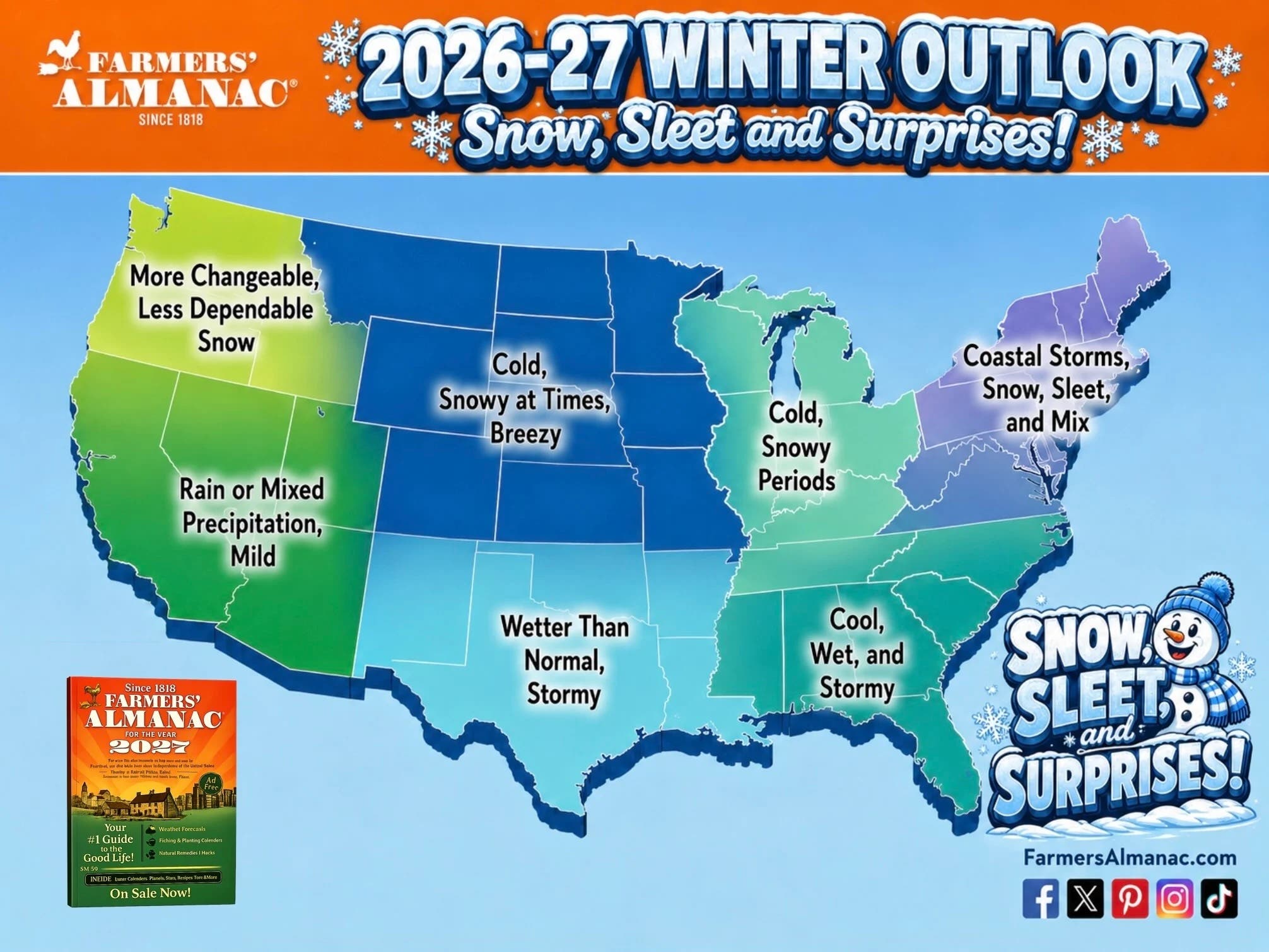
The Farmers’ Almanac, a publication that has provided long-range weather predictions for over two centuries, released its highly anticipated winter weather outlook for the 2026–2027 season on August 10, 2026. The forecast, which arrives during the peak of summer heat, suggests a winter defined by significant regional variations, driven largely by the persisting influence of the El Niño-Southern Oscillation (ENSO). According to the report, the upcoming season will feature an active storm track across the Southern United States, volatile temperature swings in the Northern Plains, and a complex, often "messy" precipitation profile for the Northeast.
As the outdoor recreation industry and agricultural sectors begin their seasonal preparations, the Almanac’s findings serve as a primary indicator for early planning, despite the inherent uncertainties of long-range meteorological modeling. The 2026–2027 forecast emphasizes a "season of contrasts," warning that while some regions may experience record-breaking snowfall, others will grapple with unseasonable thaws and rain-snow transitions.
The Influence of El Niño on the 2026–2027 Winter Cycle
The central pillar of the 2026–2027 forecast is the expected dominance of El Niño. This climate pattern occurs when sea surface temperatures in the central and eastern tropical Pacific Ocean rise above average, disrupting global atmospheric circulation. For North America, El Niño typically results in a strengthened southern jet stream, which directs moisture-rich storms across the southern tier of the United States.
The Farmers’ Almanac notes that this specific El Niño cycle appears robust, mirroring patterns seen in previous high-output winters. This alignment suggests that the storm track will likely originate in Southern California and the Desert Southwest, traversing through Texas and the Gulf Coast before moving up the Eastern Seaboard. Meteorologists at the National Oceanic and Atmospheric Administration (NOAA) have echoed similar sentiments in their preliminary extended outlooks, noting that the subtropical jet stream’s positioning will be the "wild card" for snowfall totals in the Southern Rockies and the Appalachian Mountains.
Regional Breakdown: From Powder Days to Rain-Snow Transitions
The Almanac’s regional analysis provides a granular look at how different parts of the continent may experience the coming months. For the ski industry, these predictions are particularly consequential, as they influence travel bookings and seasonal hiring.
The Southern Rockies and Southwest: A High-Probability Snow Zone
One of the most optimistic sections of the report focuses on the Southern Rockies, including southern Colorado and New Mexico. The active southern storm track associated with El Niño historically favors resorts such as Wolf Creek, Taos, and Arizona Snowbowl. The Almanac predicts that frequent moisture surges from the Pacific will collide with periodic cold air masses, creating ideal conditions for heavy mountain snow. However, the report cautions that at lower elevations, temperatures may remain marginal, leading to periods of sleet or wet snow rather than dry powder.
The Pacific Northwest and Northern West: High Variability
In contrast to the southern outlook, the Pacific Northwest—encompassing Washington, Oregon, and British Columbia—faces a more "changeable" winter. The Almanac suggests that the region may lack the consistent, deep-freeze cycles necessary for a record-breaking season. Instead, the forecast points toward a "feast or famine" scenario, where massive atmospheric river events are separated by prolonged mild stretches. This variability often poses challenges for mid-to-low-elevation ski areas that rely on consistent sub-freezing temperatures to maintain their base.
The Midwest and Northern Plains: The "Rollercoaster" Pattern
The interior of the country, particularly the Great Lakes and the Northern Plains, is expected to endure a winter of extremes. The Almanac forecasts a "rollercoaster" of temperatures, where bitter Arctic blasts are followed by rapid thaws. This pattern is often driven by the oscillation of the polar vortex. For the Upper Midwest ski industry, this translates to a high reliance on snowmaking capabilities to bridge the gaps between natural snow events and to repair surfaces during warm-weather spikes.
The Northeast: A Complicated Mix
Perhaps the most complex forecast is reserved for the Northeast and New England. The Almanac anticipates that inland regions, particularly the Green Mountains of Vermont and the White Mountains of New Hampshire, will see several rounds of heavy snow during January and February. However, the coastal corridor and southern New England are at risk of "messy" weather. The proximity of the El Niño-driven storm track to the Atlantic coastline means that many systems may track just far enough offshore to draw in warm maritime air, resulting in a mix of rain, ice, and heavy, wet snow.
Historical Context and Methodology of the Farmers’ Almanac
Founded in 1818, the Farmers’ Almanac utilizes a proprietary formula that considers sunspot activity, tidal action of the moon, and various planetary oscillations. While modern meteorology relies on supercomputers and satellite data, the Almanac maintains its traditional approach, claiming a historical accuracy rate of approximately 80 percent.
Critics in the scientific community often point out that long-range forecasts—defined as those looking more than 10 days into the future—are subject to significant error margins. However, the Almanac’s ability to predict broad seasonal trends has maintained its relevance among farmers, gardeners, and outdoor enthusiasts for over two centuries. The 2026–2027 forecast marks the 209th year of the publication’s winter outlook, a testament to its cultural and practical endurance in American life.
Economic Implications for the Ski and Outdoor Industry
The release of the winter forecast triggers a cascade of economic activity across the multi-billion-dollar outdoor recreation sector. For major resort operators such as Vail Resorts and Alterra Mountain Company, regional forecasts influence marketing strategies and the allocation of resources for snowmaking and grooming.
Travel and Tourism Trends
Data from previous El Niño years suggests that skiers often shift their travel plans based on early-season forecasts. If the Southern Rockies are predicted to have a banner year, resorts in Colorado and New Mexico typically see a spike in early-season pass sales and lodging reservations. Conversely, regions with "variable" outlooks may see a trend toward last-minute bookings as travelers wait for confirmed snow conditions.
The Snowmaking Necessity
The Almanac’s warning of "marginal temperatures" in the Northeast and Midwest highlights the increasing importance of snowmaking infrastructure. Industry analysts note that resorts have invested hundreds of millions of dollars into high-efficiency, automated snowmaking systems designed to capitalize on short windows of cold weather. This technological shift is a direct response to the "messy" and "changeable" winters described in the 2026–2027 outlook.
Expert Analysis: Navigating the Uncertainty
Meteorologists stress that while the Farmers’ Almanac provides a valuable baseline, the actual outcome of the winter will depend on short-term atmospheric phenomena that cannot be predicted months in advance. One such factor is the Arctic Oscillation (AO). If the AO enters a negative phase, it can push cold air much further south than an El Niño pattern alone would suggest, potentially turning the Northeast’s "messy mix" into a season of historic snowfall.
"Long-range forecasts are like a roadmap with several possible detours," says Dr. Elena Rodriguez, a climatologist specializing in North American weather patterns. "The Farmers’ Almanac correctly identifies El Niño as the primary engine for this winter, but we must also account for the warming of the Atlantic and how that might influence coastal storm intensification. The ‘asterisk’ the Almanac puts on the Northeast forecast is very appropriate; a five-degree difference in ocean temperature can be the difference between a foot of snow and a day of freezing rain."
Chronology of Winter Preparation
The release of the forecast on August 10 sets off a specific timeline for various stakeholders:
- August–September: Resort managers review the forecast to finalize maintenance on snowmaking systems and chairlifts. Marketing departments begin "Pray for Snow" campaigns and early-bird pass deadlines.
- October: The first high-altitude snow typically falls in the Rockies. Meteorologists begin to monitor the Pacific for the formal "locking in" of El Niño conditions.
- November: The "waiting game" begins. Early-season openings in the West and Northeast provide the first test of the Almanac’s regional accuracy.
- January–February: According to the Almanac, this will be the "heart of winter," featuring the most significant storm activity for the Northeast and the Southern Rockies.
Broader Impact and Final Implications
Beyond the slopes, the 2026–2027 winter outlook has implications for municipal budgets and the energy sector. Cities in the Northern Plains and Midwest must prepare for the "rollercoaster" of ice and snow, which often leads to higher expenditures for road salt and emergency services. In the South, the predicted wetter-than-normal conditions could provide much-needed relief for drought-stricken areas, though the risk of flash flooding during El Niño-driven storms remains a concern for local authorities.
For the average citizen, the Farmers’ Almanac forecast serves as a reminder of the seasonal cycles that dictate life in North America. Whether the predictions of "sharp contrasts" and "bitter cold" come to full fruition or the atmosphere takes an unexpected turn, the August release of the winter outlook remains a cultural milestone—a moment to look past the summer heat and begin preparing for the transformative power of winter. As the report concludes, the best strategy for the 2026–2027 season is flexibility: watching the short-term forecasts closely and being ready to "pounce" when the inevitable bursts of winter weather arrive.
