

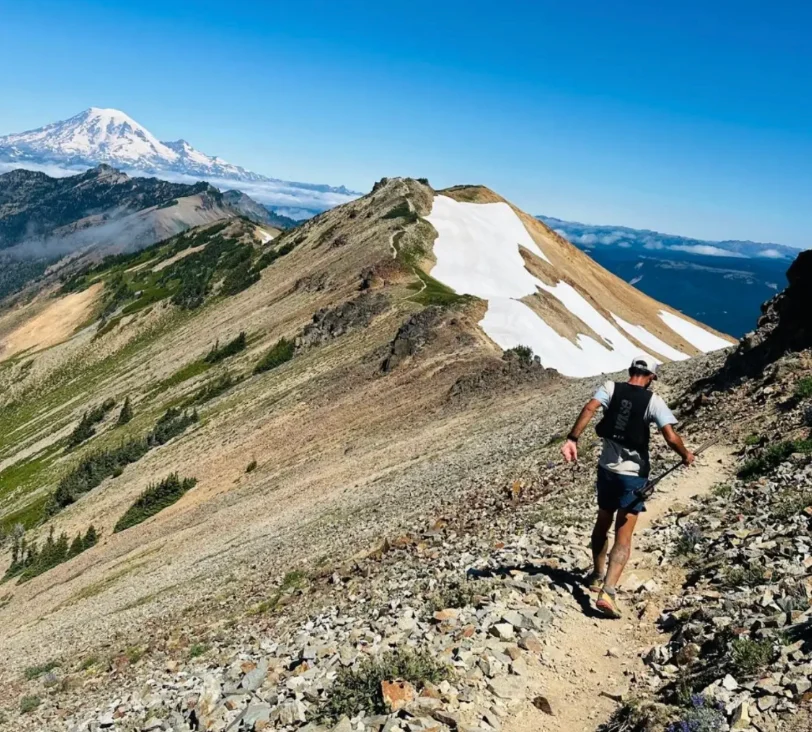
The Pacific Crest Trail (PCT), a legendary 2,650-mile ribbon of wilderness stretching from the arid heat of the Mexican border to the majestic forests of British Columbia, has long been a crucible for endurance. Typically, thru-hikers dedicate four to six months to traverse its diverse landscapes, a testament to human perseverance. However, French ultrarunner Aurélien Sanchez has just redefined the limits of speed and human endurance on this iconic route, establishing a new supported speed record that has sent ripples through the ultrarunning community.
Sanchez crossed the finish line on September 10, 2023, completing his monumental effort in an astonishing 45 days, 20 hours, and 15 minutes. This time shaves approximately 16.5 hours off the previous supported speed record, a feat achieved while battling relentless extreme weather, profound sleep deprivation, and even a serious bout of a foot infection that necessitated a hospital visit. This achievement not only underscores Sanchez’s extraordinary physical and mental fortitude but also highlights the evolving capabilities of elite athletes in extreme endurance challenges.
The Making of a Record-Breaker: Aurélien Sanchez’s Pedigree
At 35 years old, Aurélien Sanchez is no stranger to pushing the boundaries of human athletic potential. Hailing from France, he has carved a formidable reputation in the world of extreme endurance sports. His ascent into ultra-running stardom was cemented in 2023 when he emerged as one of only three finishers of the notoriously brutal Barkley Marathons, an event renowned for its punishing terrain and inscrutable course, often described as a "race against oneself."
Prior to his PCT triumph, Sanchez had already demonstrated his prowess in high-altitude environments. In 2018, he set the unsupported record for the John Muir Trail, a challenging 223-mile trek through the Sierra Nevada mountains, proving his capability to perform at peak levels with minimal external support. This history of success is built upon a unique combination of deeply honed technical trail skills, an exceptional tolerance for high-mountain discomfort, and a remarkably calm and focused demeanor. This blend of physical mastery and mental resilience has become his hallmark, enabling him to confront and overcome the immense challenges inherent in long-distance, high-stakes endeavors.
The Pacific Crest Trail: A Journey of Extremes
The Pacific Crest Trail is an immense undertaking, even for seasoned thru-hikers. Its 2,650 miles traverse a staggering variety of ecosystems, from the scorching deserts of Southern California to the alpine meadows of the Sierra Nevada, the volcanic landscapes of Oregon, and the dense rainforests of Washington. The trail boasts over 400,000 feet of cumulative elevation gain, an ascent equivalent to climbing Mount Everest nearly 14 times. This extreme topography, coupled with unpredictable weather patterns, presents a constant barrage of physical and mental hurdles.
Sanchez’s quest for the supported speed record was not a linear progression but a relentless cycle of intense effort, strategic recovery, and overcoming unexpected setbacks. The initial stages of his journey through the desert presented immediate challenges. The searing heat and vast, unyielding expanses of dirt roads and trails inflicted a profound fatigue, testing his resolve from the outset. Maintaining a demanding daily mileage while operating on severely limited sleep quickly depleted his energy reserves, forcing him to occasionally shorten his daily objectives to conserve what little strength he had.
As Sanchez progressed northward, the terrain became increasingly technical. The rocky and uneven paths in the mountainous regions began to exact a toll on his body, leading to persistent ankle issues. These problems threatened his stability on steep ascents and descents, raising concerns about his ability to maintain his aggressive pace. Despite these physical ailments, Sanchez demonstrated remarkable resilience, pushing through the pain and continuing his forward momentum. He reached the halfway point of the trail on day 25, a significant milestone in his ambitious undertaking.

However, the most critical challenge emerged later in his journey. Severe blistering on his feet escalated into a serious infection, forcing him to make an emergency detour to a hospital. The need for intensive antibiotic treatment presented a significant disruption to his meticulously planned schedule and physical condition. Yet, even in the face of this potentially race-ending adversity, Sanchez maintained his characteristic focus. Upon receiving medical attention and beginning his course of antibiotics, he promptly returned to the trail and resumed his relentless push towards the Canadian border. This episode underscores the extreme nature of the risks involved in such endeavors and the extraordinary mental fortitude required to continue after a medical emergency.
Trail Statistics and the Pantheon of Record Holders
The sheer scale of the PCT is difficult to comprehend. Its 2,650 miles are not merely a distance but a dynamic landscape that demands constant adaptation. The trail winds through diverse geological formations, presenting ascents and descents that cumulatively dwarf the height of the world’s tallest mountains. The elevation gain alone is a significant factor, requiring immense cardiovascular capacity and muscular endurance.
To achieve his record time, Sanchez maintained an average of nearly 56 miles per day. This is an astonishing daily output, requiring an intricate balance of efficient movement, strategic fueling, and minimal downtime. Such a pace is only sustainable with a highly optimized support crew managing logistics, nutrition, and immediate medical needs.
The supported speed record on the PCT is a highly coveted and fiercely contested title within the ultrarunning community. Sanchez’s accomplishment places him in an elite group of athletes who have pushed the boundaries of human endurance on this iconic trail. While the original article did not list previous record holders, the pursuit of such records typically involves a lineage of exceptional athletes. For instance, Pam Reed set the supported women’s record in 2001 at 161 days, 20 hours, and 21 minutes. In 2019, Joe McConaughy set the unsupported record at 53 days, 6 hours, 42 minutes. Sanchez’s new supported record signifies a substantial leap forward, demonstrating an acceleration of pace that suggests a meticulous optimization of training, nutrition, and support strategies.
Implications and the Future of Endurance Sports
Aurélien Sanchez’s new supported speed record on the Pacific Crest Trail is more than just a personal triumph; it is a landmark achievement that will undoubtedly influence the trajectory of ultra-endurance sports. The bar has been significantly raised, not only in terms of physical capability but also in the strategic planning and execution required for such expeditions.
The record serves as a powerful inspiration to aspiring trail runners, thru-hikers, and endurance athletes worldwide. It demonstrates that with a combination of exceptional talent, rigorous training, meticulous planning, and unwavering mental fortitude, even seemingly insurmountable challenges can be overcome. Sanchez’s journey highlights the critical role of a well-coordinated support team in achieving these extraordinary feats. The ability to manage nutrition, hydration, gear, and immediate medical needs effectively while the athlete is operating at their physical limit is paramount.
Furthermore, Sanchez’s performance may prompt further scientific inquiry into the physiological and psychological adaptations required for sustained high-level performance over extended periods. Understanding the precise mechanisms that allow athletes like Sanchez to maintain such an intense pace while recovering from significant physical challenges could offer valuable insights for athletes across a wide spectrum of disciplines.
The PCT, as a symbol of natural beauty and human endeavor, continues to be a proving ground for the limits of human potential. Aurélien Sanchez’s record is a testament to the enduring spirit of adventure and the relentless pursuit of excellence. As records are made to be broken, this latest achievement will undoubtedly inspire future generations to test their own boundaries and redefine what is possible in the world of ultra-endurance. The pursuit of such records is not merely about speed; it is a profound exploration of human resilience, determination, and the incredible capacity of the human body and mind when pushed to their absolute limits. The legacy of Sanchez’s PCT record will resonate for years to come, a beacon for all who dare to dream big and chase the seemingly impossible.
