

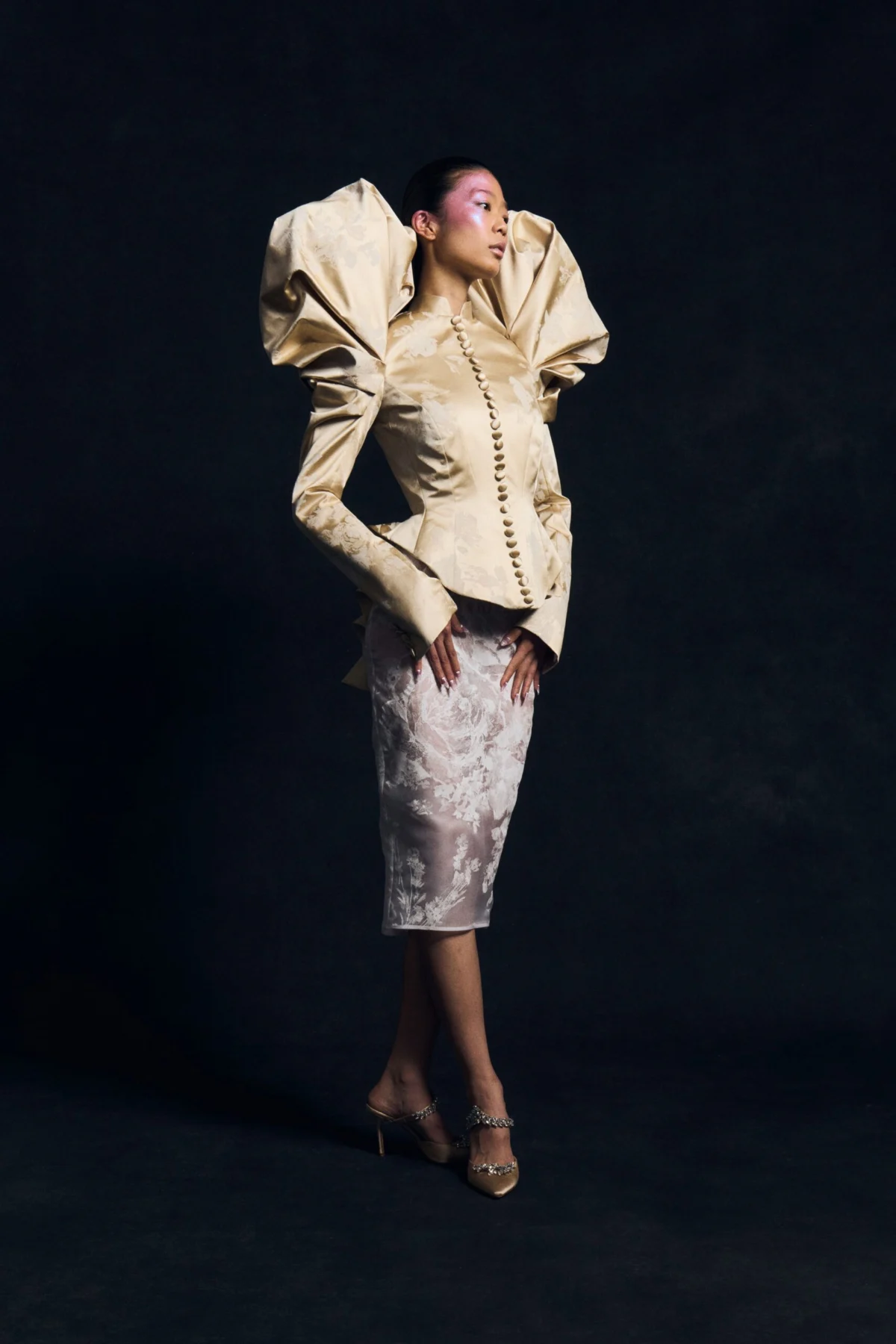
Harris Reed’s latest collection marks a significant departure, a deliberate grounding that feels both a reflection on his brand’s journey and a bold step towards a more accessible future. For the first time in recent memory, the designer eschewed the gravity-defying 18-centimeter platforms that have become a signature, signaling a tangible shift in his aesthetic. This move towards a more earthbound presentation was echoed in the collection itself, which predominantly featured a luminous palette of white, a stark contrast to the vibrant hues and dramatic silhouettes that have previously defined Reed’s oeuvre.
The salon-style presentation, held at the prestigious Mandarin Oriental Ballroom in Knightsbridge, London, offered an intimate glimpse into this transitional phase. The collection, which Reed described as a "phantom collection," is a spectral interpretation of his brand’s eleven-season history. This deliberate archival introspection, coupled with a laser focus on the contemporary customer, underscores a strategic evolution for the designer.
A Ghostly Reflection: The Allure of White and the Phantom Narrative
The dominant theme of the collection was an ethereal expanse of white. This monochromatic approach, broken only by a creamy gold jacket in hand-painted duchess satin that opened the show, a sequined corset, and the bridal gown finale featuring an exposed crinoline, was a conscious choice. "I have been looking back to the past 11 seasons of this brand and came up with this almost ghostly interpretation. It’s meant to be almost a phantom collection," Reed explained during a preview. This sentiment suggests a deconstruction and reinterpretation of his brand’s DNA, presenting a more refined and perhaps introspective vision.
The choice of white itself carries significant symbolic weight. In fashion, it often represents purity, new beginnings, and a blank canvas. For Reed, it appears to be a deliberate stripping away of excess, a focus on form and material. The "ghostly" interpretation hints at the ephemeral nature of fashion trends and the enduring power of classic design. By revisiting his brand’s past through this spectral lens, Reed is not merely rehashing old ideas but rather examining their essence and recontextualizing them for the present.
Navigating Transitions: From Dual Responsibilities to Singular Focus
This collection arrives at a pivotal moment for Harris Reed. The period between 2022 and the spring of this year saw the designer juggling his eponymous brand with the creative direction of Nina Ricci. His departure from Nina Ricci, a role he held for a significant tenure, has clearly allowed for a more concentrated focus on his own label. While some might have anticipated a sense of loss or disruption following this change, Reed has embraced it as an opportunity for renewed purpose and creative freedom.
The duality of his previous schedule, which involved splitting his time between London and Paris, undoubtedly presented logistical and creative challenges. However, it also provided him with invaluable experience and exposure to different fashion landscapes. His successful stewardship of Nina Ricci, a storied Parisian house, demonstrated his ability to adapt his distinct design language to established brand identities. Now, with his full attention returned to Harris Reed, he is channeling that experience into a more defined and customer-centric approach.
Redefining the Customer: From Grand Inspirations to Tangible Realities
Reed’s creative process for this collection deviated from his usual practice of starting with broad, abstract inspirations, such as historical periods. Instead, he prioritized a direct engagement with his customer. "I usually start collections with this big inspiration point like: ‘I started by looking at the Victorian this and that.’ And I will always have those references. But this time I was really just looking at like, ‘Who is our customer?’" he revealed.
This shift in methodology is reflected in every facet of the show’s staging. The pre-show cocktails, featuring classic dirty martinis, hinted at a sophisticated and discerning clientele. The salon-style format fostered an intimate and personal experience, allowing guests to engage more closely with the garments. The choice of the Mandarin Oriental Ballroom in Knightsbridge, a location synonymous with luxury and exclusivity in London, further solidified this connection. Reed identified his ideal customer as international but with a tangible presence in London, owning property in the city. This understanding has informed the collection’s design and the brand’s strategic expansion, including plans to open a dedicated salon in London in the coming months. This move signifies a commitment to providing a personalized and elevated retail experience for his core demographic.
A Refined Signature: Caging as a Character, Not the Protagonist
While the collection embraced a new sense of restraint, Harris Reed’s distinctive design vocabulary was still evident, albeit subtly integrated. His signature caging elements, which have often been a dominant feature in past collections, were present but relegated to a supporting role. Instead of defining entire looks, these cages acted as refined details, punctuating garments and adding a touch of architectural intrigue. This approach demonstrates a maturation of his design philosophy, where signature elements are used with greater intentionality and less as a singular defining characteristic.
The true spotlight of this collection was undeniably on the materials. Reed showcased an exceptional mastery of luxurious fabrics, employing hand-painted animal prints and floral motifs on delicate organza. The collection featured sumptuous double duchesse satin and intricate silk brocade, meticulously cut and expertly pieced together. These rich textiles were transformed into incredibly fine skirts and trousers, highlighting Reed’s skill in manipulating fabric to create both volume and fluidity. The artisanal craftsmanship evident in the patchwork and intricate detailing speaks to a renewed emphasis on the tactile and the exquisite. This focus on the inherent beauty and quality of the materials aligns perfectly with a customer who appreciates enduring luxury and exceptional craftsmanship.
The Promise of Flight: Embracing Change for Future Ascent
Transitions in any creative field are rarely seamless. They can be fraught with uncertainty and require significant adaptation. However, as the adage suggests, embracing these shifts rather than being overwhelmed by them can lead to unforeseen growth and elevation. Harris Reed appears to be on the cusp of such a moment. His recent collection, with its grounded aesthetic, introspective narrative, and customer-centric focus, suggests a designer who is not afraid to evolve.
The move away from extreme platforms, while seemingly a minor detail, is a powerful statement about the brand’s direction. It signifies a willingness to connect with a broader audience and to explore a more wearable yet still aspirational form of luxury. The "phantom collection" concept, by looking both inward and backward, has paradoxically illuminated a clear path forward. By honoring his brand’s history while firmly planting his feet in the present, Harris Reed is poised for a significant ascent, offering a vision of fashion that is both deeply personal and universally resonant. The opening of his London salon further solidifies this trajectory, creating a physical space for his vision to manifest and for his discerning clientele to experience it firsthand. This strategic move underscores the brand’s commitment to building lasting relationships and fostering a community around Reed’s unique design philosophy. The evolution of Harris Reed is not merely a collection of garments, but a testament to the power of intentional change and the enduring allure of authentic self-expression in the fashion landscape.
