

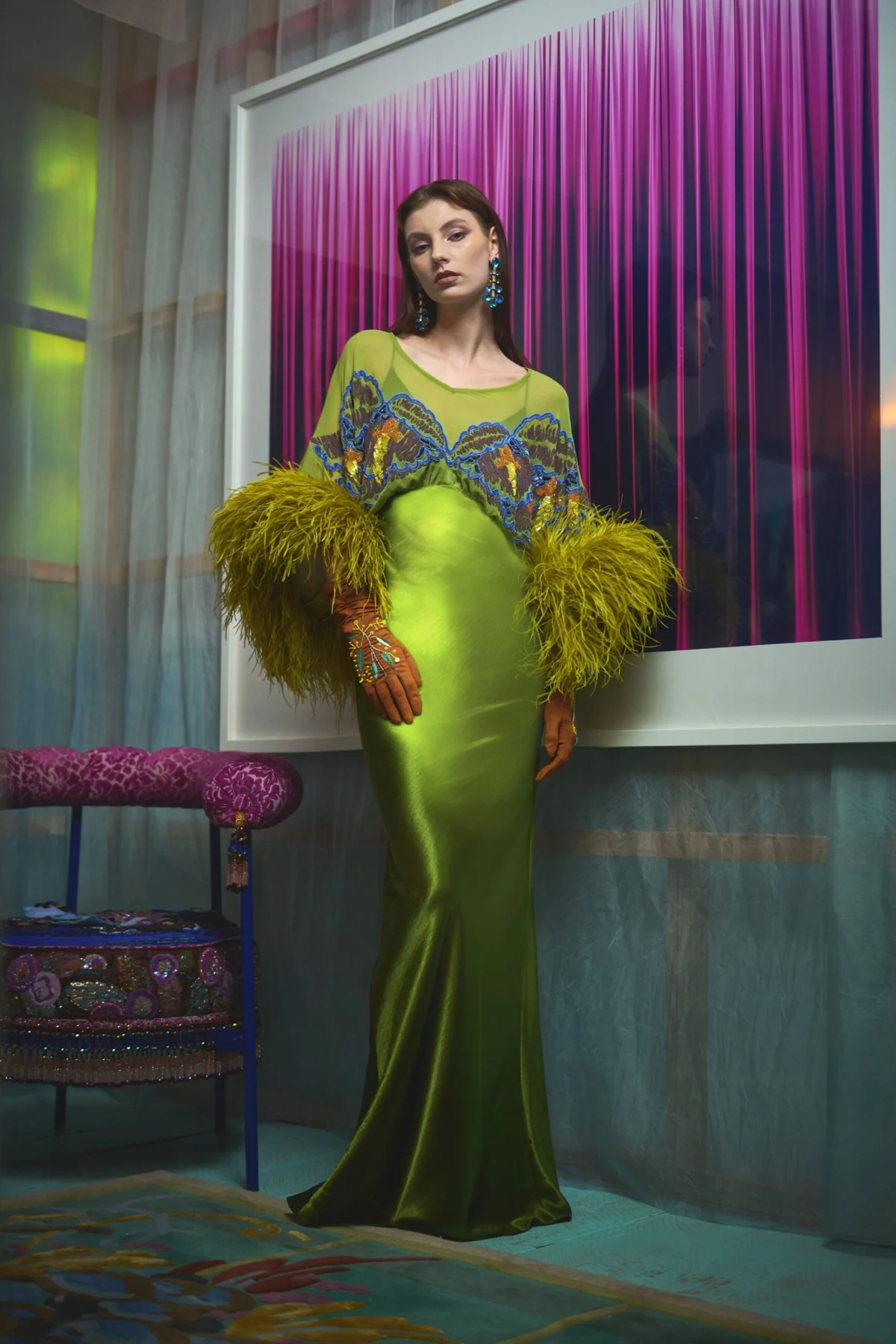
Romance Was Born, the celebrated Sydney-based fashion house that marked its 20th anniversary last year, has strategically shifted its presence during Australian Fashion Week. Rather than adhering to the conventional runway schedule, the brand, helmed by designers Luke Sales and Anna Plunkett, embraced an innovative partnership with Cultivated, Cult Furniture’s in-house sustainable furniture refurbishing program. This collaboration culminated in a captivating exhibition during Melbourne Design Week, showcasing a collection of meticulously recycled furniture pieces reimagined with the brand’s signature extravagant embellishments.
“It was an exciting project,” Luke Sales shared during a recent Zoom interview, the sunlight of an Australian morning illuminating his studio. “It’s something we’ve always wanted to do. We had a really amazing show last year for our 20th anniversary, and we decided to focus on [Design Week] instead.” This decision, while a departure from the traditional fashion calendar, underscores the brand’s evolving ethos and commitment to broader design dialogues. For devoted followers, Sales reassured that the brand’s dedication to seasonal collections remains steadfast.
The latest offering from Romance Was Born draws deeply from the multidisciplinary interests of its creative directors and its unique operational base. Their studio, strategically located within the Powerhouse Museum in Sydney, provides unparalleled access to a rich repository of historical textiles. This access has proven to be a fertile ground for inspiration, most notably through the exploration of traditional French lace and exquisite handmade Art Deco wallpaper. It was this latter element, specifically the artistry of Auguste Thomas, that served as the foundational muse for the collection.
This profound connection to modern antiquity is palpable in the collection’s aesthetic. Slender, bias-cut dresses, crafted from vintage Italian bedspreads, evoke a sense of timeless elegance. Some of these pieces are adorned with flowing capes, while others are sleeveless, showcasing the luxurious texture of the reclaimed fabric. The inclusion of feather trims and elegant evening gloves further amplifies this feeling of refined nostalgia. Complementing these heritage-inspired garments are more contemporary pieces, such as an intricately embellished denim pencil skirt paired with a soft flannel top, and a distinctly mod mini-dress styled over vibrant, contrasting coral tights, demonstrating a dynamic fusion of eras.
The exhibition’s visual narrative was deliberately curated to harmonize with its setting. “The collection was shot in the [Powerhouse Museum], and so we used garments that could talk to the furniture,” Sales explained. This deliberate synergy is evident in pieces like an embroidered patchwork jacket, featuring a striking fuchsia feather collar, which, upon closer inspection, mirrors the opulent upholstery of an upcycled couch displayed nearby. This immersive world-building experience, meticulously crafted within the museum’s historic halls, conjures the evocative atmosphere of a silent film meticulously restored with modern technological prowess. While some might find the approach delightfully theatrical, Sales and Plunkett’s penchant for opulent and often whimsical design is precisely the point. “There is kind of a weird humor in what we do,” Sales admitted, highlighting the brand’s unique ability to imbue their creations with a distinctive, often unexpected, wit.
A Strategic Shift in Fashion Week Presence
The decision by Romance Was Born to forgo a traditional runway show at Australian Fashion Week (AFW) in favor of a collaborative exhibition signifies a growing trend within the industry. AFW, an annual event that showcases Australian designers to a global audience, has historically been a crucial platform for brands to unveil their latest collections. However, the evolving landscape of fashion communication and the increasing emphasis on experiential marketing have led some designers to explore alternative avenues.
This year’s AFW, held from [Insert Year of AFW, if known] to [Insert Year of AFW, if known], featured a diverse range of designers presenting their Spring/Summer [Insert Year + 1, e.g., 2025/26] collections. The event typically attracts buyers, media, and fashion enthusiasts, offering a concentrated period of exposure. For Romance Was Born, the 20th-anniversary milestone provided a natural juncture for re-evaluation. Their participation in Melbourne Design Week, a prominent fixture on the Australian cultural calendar, allowed them to engage with a broader audience interested in design, art, and sustainability, rather than solely the fashion-centric attendees of AFW.
The Powerhouse Museum: A Muse and a Canvas
The selection of the Powerhouse Museum Sydney as the brand’s creative hub and exhibition space is a testament to Romance Was Born’s deep appreciation for heritage and craftsmanship. The Powerhouse, a museum of applied arts and sciences, holds an extensive collection of historical artifacts, including textiles, fashion, decorative arts, and design. This archival access has been instrumental in shaping the brand’s aesthetic, which often blends historical references with contemporary design.
The museum’s commitment to preserving and showcasing design history aligns perfectly with Romance Was Born’s philosophy of breathing new life into existing materials. The opportunity to work directly with historical textiles, such as the French lace and Art Deco wallpaper that inspired this collection, offers a tangible link to the past, enabling the designers to reinterpret and reimagine these elements for a modern audience. The museum’s architectural grandeur also provides a fitting backdrop for the brand’s elaborate creations, enhancing the immersive experience for visitors.
Cultivated: A Partnership Rooted in Sustainability
The collaboration with Cultivated, Cult Furniture’s sustainable furniture refurbishing program, is a significant aspect of Romance Was Born’s recent endeavors. In an era where environmental consciousness is paramount, this partnership highlights the brand’s commitment to circular economy principles. Cultivated focuses on rescuing, restoring, and revitalizing pre-loved furniture, transforming discarded pieces into unique, desirable items.
This initiative not only aligns with the growing demand for sustainable design solutions but also provides a tangible platform for Romance Was Born to extend its signature embellishment techniques beyond apparel. The exhibition demonstrated how the brand’s artistic vision can be applied to three-dimensional objects, creating a holistic aesthetic that blurs the lines between fashion, furniture, and art. This approach to design not only minimizes waste but also imbues each piece with a unique history and character, resonating with consumers who value both craftsmanship and ethical production. The demand for sustainable furniture has seen significant growth, with market research indicating a [Insert relevant data point, e.g., projected CAGR of X% from Y to Z year]. This trend suggests a broader consumer shift towards environmentally responsible purchasing decisions, which Romance Was Born is adeptly capitalizing on.
The Inspiration of Art Deco and Vintage Textiles
The collection’s deep dive into Art Deco aesthetics, particularly inspired by Auguste Thomas’s wallpaper designs, offers a rich tapestry of visual motifs. Art Deco, a style that emerged in the 1920s and 1930s, is characterized by its geometric shapes, bold symmetry, and opulent ornamentation. It drew inspiration from a wide range of sources, including ancient Egyptian art, Cubism, and the machine age, resulting in a distinctive blend of modernism and luxury.
The use of vintage Italian bedspreads as the primary material for the bias-cut dresses speaks volumes about the brand’s reverence for artisanal quality and the narrative potential of pre-existing materials. Bedspreads, often handcrafted with intricate stitching and elaborate patterns, carry a history of domesticity and comfort, which Romance Was Born recontextualizes into high fashion. This practice of upcycling and repurposing vintage textiles is not new to the brand, but its integration into a collection inspired by such specific historical design movements creates a compelling dialogue between past and present. The enduring appeal of Art Deco in contemporary design, evidenced by its resurgence in interior design and fashion, underscores the timeless quality of its aesthetic principles.
Implications for the Fashion Industry
Romance Was Born’s strategic pivot offers valuable insights into the evolving nature of fashion weeks and brand engagement. The success of their exhibition in Melbourne Design Week suggests that designers can achieve significant impact and reach new audiences by participating in events that align with their broader creative vision, rather than strictly adhering to traditional fashion calendars.
This approach allows for a more nuanced storytelling, where the brand’s values, inspirations, and commitment to sustainability can be communicated more effectively. It also opens doors for interdisciplinary collaborations, fostering a richer and more diverse creative landscape. The trend towards experiential marketing and the increasing importance of brand narrative suggest that more fashion houses may consider similar diversifications in their presentation strategies. Furthermore, the brand’s emphasis on sustainable practices, particularly through their collaboration with Cultivated, aligns with a growing consumer demand for ethical and environmentally conscious products. This not only enhances brand reputation but also taps into a significant and expanding market segment. The fashion industry, which has historically faced criticism for its environmental impact, is increasingly looking towards innovative solutions like those demonstrated by Romance Was Born, signaling a potential shift towards a more responsible and diversified future.
Looking Ahead: Continuity and Innovation
Despite this departure from the traditional runway, Luke Sales’s assurance that seasonal collections are not being abandoned provides comfort to the brand’s loyal following. The successful integration of their design ethos into a sustainable furniture exhibition demonstrates their versatility and commitment to innovation. As Romance Was Born continues to celebrate two decades in the industry, their forward-thinking approach, characterized by a deep respect for history, a commitment to sustainability, and a fearless embrace of artistic expression, positions them as a vital and dynamic force in the Australian and international design scenes. The brand’s ability to adapt and evolve, finding new platforms to showcase their unique vision, ensures their continued relevance and influence in the years to come.
