

In the three decades since the winter of 1994/95, the landscape of American winter recreation has undergone a transformation so profound that it is nearly unrecognizable to those who pioneered the field of snow safety. During that era, the infrastructure of avalanche forecasting was in its infancy. Knox Williams, Bruce Tremper, and Mark Moore presided over the primary avalanche centers in Denver, Utah, and Seattle, respectively. Jim Kanzler managed operations in Jackson Hole, while Brad Ray oversaw the center at Mount Washington. In Bozeman, a nascent avalanche center was only entering its fifth season of operation. At the time, major hubs for backcountry recreation such as the Chugach Range in Alaska, the Lake Tahoe region in California, and Mount Shasta lacked dedicated avalanche centers entirely.
The equipment of the mid-1990s reflected a different era of mountain travel. Backcountry skiers predominantly utilized telemark gear, often paired with leather boots that offered minimal support by modern standards. Snowmobiles were significantly less capable than today’s machines, lacking the power-to-weight ratios and specialized track designs that now allow riders to penetrate deep into high-elevation, high-consequence terrain. Furthermore, the concept of "sidecountry"—resort-adjacent backcountry accessed via chairlifts—was not yet a recognized term, as most ski areas maintained strictly closed boundaries. Perhaps most significantly, the digital revolution had not yet reached the mountains; the first avalanche advisories were only beginning to appear on the nascent World Wide Web at the conclusion of the 1995 season.
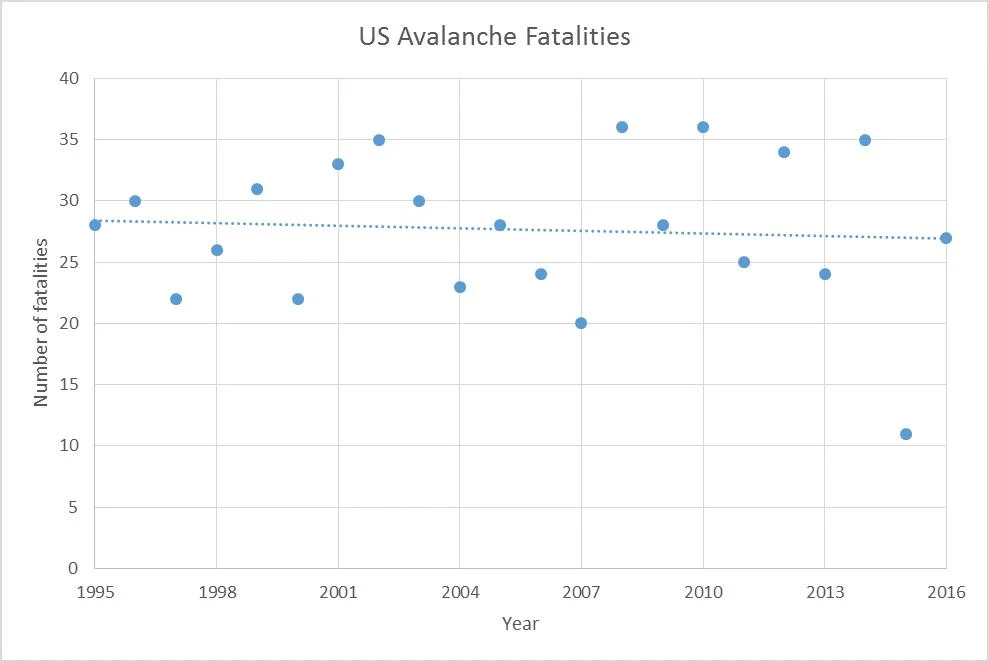
Despite these primitive beginnings and the subsequent "explosion" in backcountry participation, a startling statistical trend has emerged. Data analyzed over a 22-season period, beginning in 1994/95 and extending through 2015/16, reveals that the annual number of avalanche fatalities in the United States has remained remarkably steady. This stagnation in the death toll occurs against a backdrop of a literal revolution in technology, social media influence, and accessibility, suggesting a significant advancement in the efficacy of avalanche education and safety protocols.
Statistical Analysis of Fatality Trends
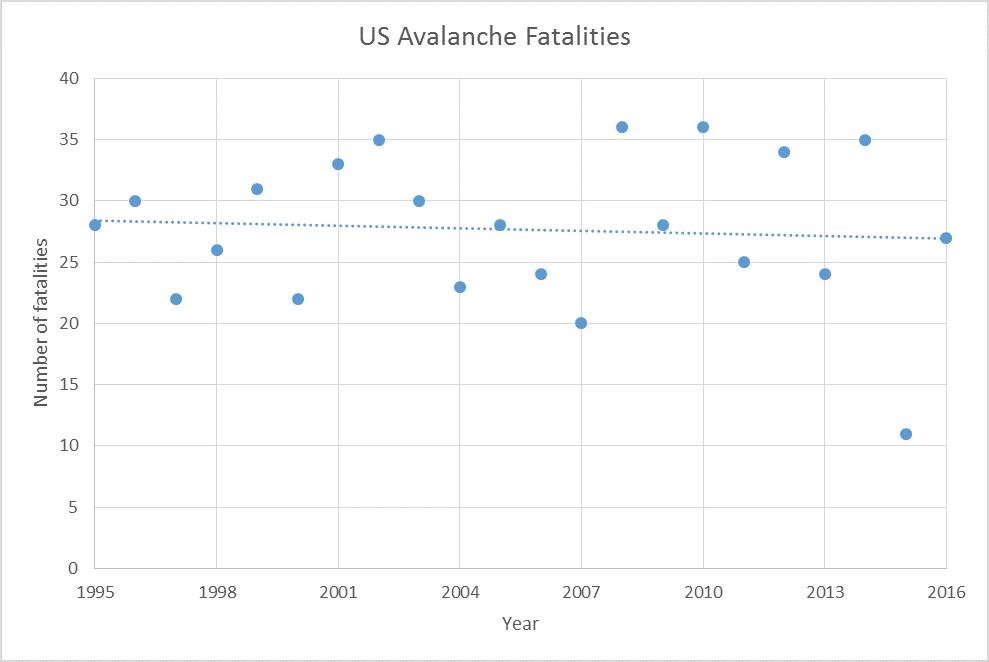
To understand the current state of mountain safety, researchers and forecasters, including Karl Birkeland of the National Avalanche Center, have scrutinized the historical data provided by the Colorado Avalanche Information Center (CAIC). The primary metric—total annual U.S. avalanche fatalities—shows a trend line that is essentially flat. From a statistical perspective, a "least squares trend line" applied to the data from 1994 to 2016 indicates a slight decrease, but with a p-value of 0.7, the result is not statistically significant. In the realm of data science, this indicates no evidence of a measurable change in the number of lives lost per year, despite the perception that the backcountry has become more dangerous.
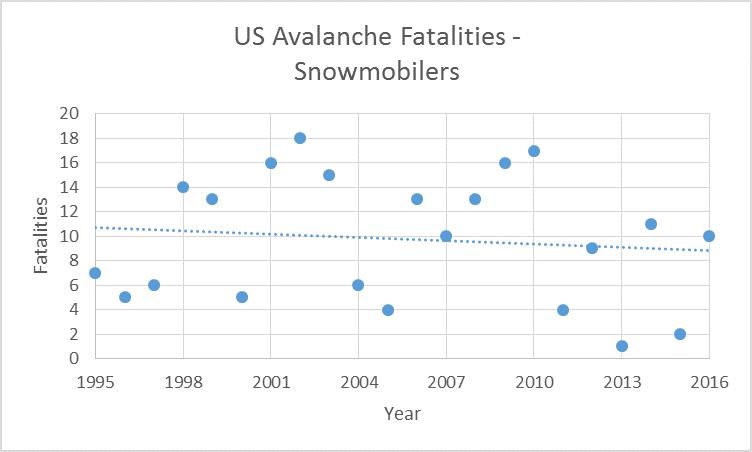
A more granular look at the data reveals nuances between different user groups. For snowmobilers, the fatality rate has remained similarly flat over the 22-year period. This is particularly noteworthy given that modern snowmobiles allow users to high-mark steeper slopes and travel further into remote wilderness than was possible in the 1990s. The statistical significance for this group (p = 0.6) mirrors the overall national trend.
Conversely, there is a slight deviation when examining backcountry skiers and snowboarders. While the trend is still relatively flat, the statistical evidence (p = 0.07) suggests a marginal increase in fatalities for this specific demographic. However, this minor uptick is overshadowed by the sheer volume of new participants entering the sport, which leads to a surprising conclusion regarding the individual risk profile of modern backcountry users.
Measuring the "Explosion" in Backcountry Use
Quantifying exactly how many people are recreating in the backcountry is a notorious challenge for land managers and safety organizations. Unlike ski resorts, the wilderness has no turnstiles or ticket sales to provide hard data. However, experts utilize "avalanche advisory usage" as a proxy for participation. By tracking how many people access daily forecasts provided by regional centers, a clear picture of growth emerges.
The numbers are staggering. Since 1994, the Utah Avalanche Center has reported a 12-fold increase in the number of people accessing its advisories. The Colorado Avalanche Information Center has seen a 17-fold increase. In Montana, the Gallatin National Forest Avalanche Center recorded a 36-fold increase, while the Northwest Avalanche Center in Washington saw usage skyrocket by a factor of 60.
While some of this growth can be attributed to the transition from phone hotlines to mobile apps and websites, the magnitude of the increase points toward a massive influx of users. Even using a highly conservative estimate—assuming that actual backcountry use has increased by only eight times since 1994—the implications for safety are profound. If the number of participants has increased eightfold while the number of deaths has remained constant, the "fatality rate" (the number of deaths per user-day) has effectively dropped by at least 800%.
Had the fatality rate remained the same as it was in the mid-1990s, experts estimate that the United States would be witnessing upwards of 200 avalanche fatalities every winter, rather than the average of 25 to 30 currently recorded.
The Pillars of Modern Avalanche Safety
The stabilization of fatality numbers in the face of exponential growth is regarded by the snow safety community as a monumental success. This achievement is credited to a multi-faceted approach involving education, technology, and professional forecasting.
1. The Evolution of Education
In the 1990s, avalanche education was often limited to intensive multi-day courses aimed at professionals or hardcore enthusiasts. Today, the "Know Before You Go" (KBYG) program provides a streamlined, high-impact awareness platform that reaches tens of thousands of students and casual recreationists annually. This tiered approach to education ensures that even those who do not intend to become amateur forecasters understand the basic tenets of safety: get the gear, get the training, get the forecast, get the picture, and get out of harm’s way.
2. Technological Advancements
The gear used by the modern backcountry traveler is lightyears ahead of the 1994 standard. Digital, three-antenna avalanche transceivers have replaced the difficult-to-use analog beacons of the past, significantly reducing search times during burials. Furthermore, the widespread adoption of avalanche airbag packs and "Avalungs" has provided users with a secondary layer of defense, increasing the chances of survival during an actual slide. Lightweight helmets and improved touring bindings (AT gear) have also made travel more efficient, reducing fatigue-related errors in judgment.
3. The National Avalanche Center Network
The expansion of the regional avalanche center network has been instrumental. These centers provide daily, high-resolution forecasts that allow users to plan their trips around specific localized hazards. The professionalization of these centers, supported by the American Avalanche Association (A3) and the U.S. Forest Service, has created a culture where checking the "avvy report" is as reflexive for a backcountry skier as checking the weather is for a pilot.
4. Professional Guiding and Resort Management
The rise of professional guiding services and the implementation of rigorous "sidecountry" management by ski resorts have also played a role. By providing controlled environments and expert leadership, these entities help manage the risk for those who are new to the mountain environment.
Industry Reactions and Future Implications
The data compiled by the CAIC and analyzed by figures like Karl Birkeland serves as a "proof of concept" for the entire avalanche safety industry. Inferred reactions from the professional community suggest a sense of cautious pride. The fact that fatalities have not spiked alongside participation is a "win" for every educator, forecaster, and equipment manufacturer in the field.
However, the slight upward trend in skier and snowboarder fatalities (p = 0.07) serves as a warning. As social media continues to drive users toward high-consequence terrain and "hero shots," the pressure on safety organizations to innovate remains high. The next frontier in avalanche safety likely involves "human factors" or behavioral psychology—understanding why people often ignore forecasts or their own training when faced with the temptation of fresh powder.
The current flat fatality trend is a testament to the resilience and adaptability of the winter sports community. While the ultimate goal remains zero fatalities, the ability to maintain a steady death toll while the backcountry population grew by nearly an order of magnitude is a historic achievement in public safety. It confirms that the current strategies of widespread education, real-time digital forecasting, and technological innovation are not only working but are essential for the continued growth of mountain recreation.
Acknowledgments and Data Sources
The insights into these trends are derived from decades of meticulous record-keeping. The Colorado Avalanche Information Center remains the primary repository for U.S. avalanche accident data, a task that requires the cooperation of numerous regional centers and individual reporters. The efforts of personnel at the CAIC, along with contributions from experts such as Simon Trautman, Doug Chabot, and Spencer Logan, ensure that the lessons learned from every tragedy are documented and shared with the public to prevent future accidents. This collaborative spirit within the avalanche community is perhaps the most significant factor in keeping the fatality line flat in an era of unprecedented mountain use.
