

Sheroanawe Hakihiiwe, a leading contemporary artist from Venezuela, is captivating the international art scene with his deeply personal and ecologically resonant work. His journey from the remote Yanomami community of Mahekoto in the Amazon rainforest to his first solo museum exhibition in the United States at the Institute of Contemporary Art, Miami (ICA Miami), offers a profound glimpse into a life dedicated to observation, cultural preservation, and environmental advocacy. The exhibition, presented in partnership with the Fondation Cartier pour l’art contemporain, showcases over 100 works spanning Hakihiiwe’s decades-long career, from his early explorations on handmade paper to ambitious installations and a newly commissioned film reflecting his recent spiritual transformation.
A Life Rooted in the Rainforest
Hakihiiwe’s home, Mahekoto, is an isolated Yanomami village nestled deep within the Amazon, home to approximately 300 people. Reaching this sanctuary requires a multi-stage journey: first, a flight from Caracas to Puerto Ayacucho, followed by an arduous eight-day boat trip along the Orinoco River. The absence of electricity and phone signal in Mahekoto fosters a life of intimate connection with the natural world. Hakihiiwe’s days are spent in traditional Yanomami activities such as fishing, hunting, and gathering, all while meticulously documenting his surroundings in a notebook through drawings. This practice of close observation forms the bedrock of his artistic output, a commitment he has maintained for the past 30 years.

"I want to show both the grandeur of the rainforest and the quiet importance of something as delicate as an insect’s eyelash," Hakihiiwe states. "Every element, no matter how small, contributes to that balance and the way life functions." This philosophy permeates his art, imbuing each line and form with a sense of interconnectedness and ecological awareness.
The Genesis of an Artistic Vision
Hakihiiwe’s artistic path began in 1992, sparked by a workshop led by Mexican artist Laura Anderson Barbata, who introduced his community to the craft of papermaking. This initiative culminated in the creation of Shapono (1996), a significant early work that utilized recycled paper and threads spun from pineapple leaves. Today, Shapono stands as the earliest piece featured in the ICA Miami exhibition. However, Hakihiiwe’s artistic lineage traces back to his childhood, observing his mother, a skilled artisan, as she wove and painted baskets. "She taught me how to paint," he recalls, "and words she once shared with me remain deeply important: ‘This is the path for you; you must not abandon it. In time, you will see how well things turn out.’"
Heeding his mother’s counsel, Hakihiiwe dedicated his life to art, gradually developing a unique visual language that articulates Yanomami life and culture. He continues to create many of his paintings and prints on paper made from local plant fibers and trees, maintaining a tangible link to his homeland. His international recognition began with his first exhibition in Caracas in 2010, leading to his work being exhibited globally, including prestigious events like the Venice Biennale and the Biennale of Sydney in 2022.

An Immersive Exhibition Experience at ICA Miami
The exhibition at ICA Miami, running through March 28, 2027, offers a comprehensive survey of Hakihiiwe’s artistic evolution. The exhibition space itself has been thoughtfully designed to evoke the spirit of his home. Taller de Arquitectura, the Mexico City-based studio led by Mauricio Rocha Iturbide, has transformed the museum’s second floor into an environment reminiscent of the shapono, the traditional Yanomami communal dwelling. Modular walls in earthy tones, coupled with soft, filtered lighting, create an intimate atmosphere. The gallery windows have been reframed to highlight the surrounding tree canopies, an architectural choice that ensures "nature isn’t just an image on the wall, but an active presence within the space," as Rocha Iturbide explained.
This thoughtful curation aims to immerse visitors in Hakihiiwe’s world, fostering a deeper understanding of the cultural and environmental contexts that inform his practice. The exhibition design itself becomes a narrative element, bridging the gap between the visitor’s experience and the artist’s origins.
A Microcosm of the Amazon: Detailed Observation and Ecological Urgency
The exhibition powerfully showcases Hakihiiwe’s meticulous, almost taxonomic approach to art, born from profound observation and repetition. One prominent wall features Kamie ya uriji pi jami Parawa ujame theperekui uriji terimi thepe komi kua (Donde yo vivo también viven todos estos animales en el Orinoco) (2018). This series comprises approximately 60 works on paper, each filled with recurring drawings in red and black ink. At first glance, these appear as abstract lines and symbols, akin to a script. However, closer inspection reveals that each gesture meticulously represents an animal native to the Orinoco basin – the distinct eyes of crabs, the delicate forms of heron feet, or the intricate patterns of ticks.

Another compelling piece, Tarara (Casa de hormigas grandes) (2023), plays with perception in a similar vein. Red acrylic lines spread across cotton paper, suggesting a cosmic web or a map of neural pathways. Yet, as the title indicates, these lines trace the structure of a large ant colony’s dwelling. This deliberate ambiguity invites viewers to engage actively with the artwork, deciphering the layers of meaning and connection Hakihiiwe embeds within his creations.
Beneath the pared-back aesthetic of Hakihiiwe’s works lies a palpable sense of urgency. The Amazon rainforest, a vital ecosystem that harbors a significant portion of Earth’s biodiversity, plays a critical role in carbon sequestration and influences weather patterns globally. However, it faces severe threats from illegal mining, deforestation, pollution, and climate change. Scientific estimates suggest that approximately 20% of the rainforest has been lost over the past five decades, a stark reality that Hakihiiwe’s art addresses directly.
Michela Alessandrini, curator at the Fondation Cartier, highlights this crucial aspect of Hakihiiwe’s work: "Hakihiiwe calls our attention to the ecological crisis affecting the Amazon forest, reminding us that we are all together in this problem, on a planetary scale. His take on this matter is brave, conscious, yet tender. His work is an important reminder of the fragility of our planet, and a representation of the manifestations it grants humans on a daily basis, if they just pay attention."

Expanding Horizons: Landscapes and Spiritual Transformation
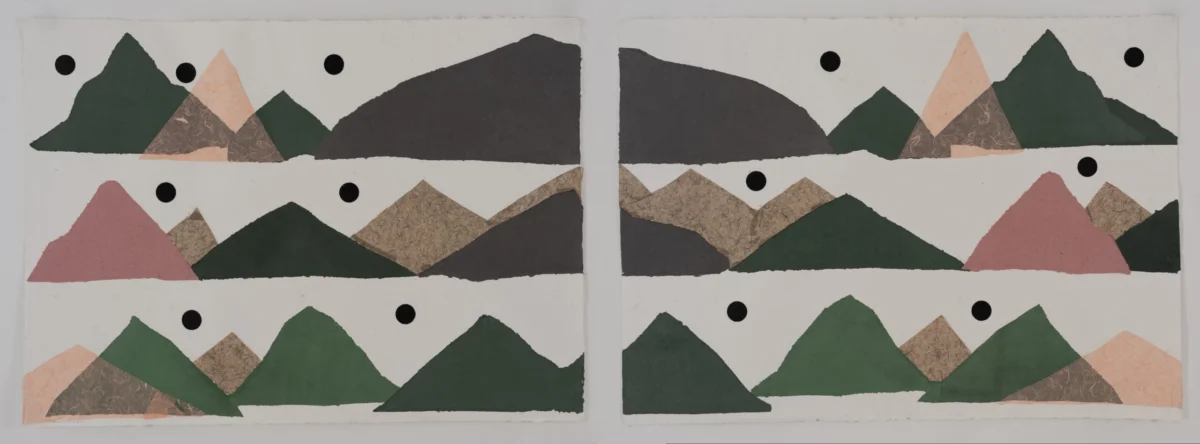
Beyond the detailed depictions of flora and fauna, the exhibition also presents a series of landscapes that offer a broader perspective on the ecosystems inspiring Hakihiiwe. A standout piece is the expansive diptych He hupe (Mountains) (2026). Crafted from pigmented pressed cotton pulp and incorporating screen printing, this work evokes the majestic mountains of the Orinoco region. Alessandrini elaborates on its significance: "Hakihiiwe always carries his native surroundings with him through his dreams and his art, wherever he goes… These mountains are constructed through layers of different techniques and colors, reading as an accumulation of dreamlike visions, memories, and natural elements separated across time and space." The layered construction of the piece mirrors the accumulation of memory and experience, demonstrating how Hakihiiwe translates his inner world and external observations into tangible art.
A significant dimension of the exhibition explores the impact of Hakihiiwe’s recent initiation as a shaman in 2024. This spiritual transformation has infused his work with a deeper connection to dreams and visions. A new film, Hekura peni ware puhi aupouhe (The Spirits Wash My Face) (2026), features animated kaleidoscopic drawings set to Hakihiiwe’s own chanting, emphasizing his profound bond with the spiritual entities that visit him in his sleep. Additionally, an installation of three on-site created red shamanic poles underscores the increasingly sacred and ritualistic nature of his artistic practice. This integration of shamanic experiences into his art signifies a new phase of his creative journey, where the boundaries between the material and spiritual worlds blur.
A Cosmological Framework: Circularity of Forms
Across the diverse range of works in the exhibition, from the smallest ink drawings to the grandest installations, recurring visual elements underscore a consistent thematic and aesthetic approach. For the Yanomami, as explained by Gean Moreno, co-curator of the exhibition, all forms of existence are interconnected. The cosmos relates to the patterns of ceremonial body paint, and a feather crown finds resonance in the shape of the communal house.

"The pattern in the shamanic poles at the center of the exhibition space appears identical to the alligator skin of the mythical figure Irawire, who brought fire to the Yanomami," Moreno observes. "Rather than a logic of originality and representation, we have something like a circular movement of forms reiterating one another and reinforcing the overall cosmological whole at every turn." This concept of circularity, where forms and meanings echo and reinforce each other, is central to understanding Hakihiiwe’s artistic vision and the Yanomami worldview he so powerfully represents. It challenges Western notions of linear progression and originality, instead emphasizing a holistic and cyclical understanding of existence.
A Renewed Creative Drive
For Hakihiiwe, the understanding of a world where everything is interconnected has deepened significantly since his shamanic initiation. "Now I feel a coolness in my chest, like a gentle breeze passing through," he shares. "I feel more deeply connected to the spirits, to the wind, and to the living world, and that gives me an even greater desire to create." This heightened spiritual awareness fuels his artistic output, allowing him to explore new dimensions of his practice and to communicate his profound connection to the natural and spiritual realms with even greater clarity and passion.
The exhibition "Sheroanawe Hakihiiwe" at ICA Miami is more than a showcase of an artist’s oeuvre; it is an invitation to engage with a worldview that prioritizes ecological balance, cultural continuity, and the profound interconnectedness of all life. Hakihiiwe’s journey from the heart of the Amazon to the global stage serves as a powerful testament to the enduring strength of indigenous knowledge and artistic expression in a rapidly changing world. His work stands as a vital reminder of our shared responsibility to protect the planet and to listen to the wisdom embedded in its natural rhythms and the voices of its original stewards.
