

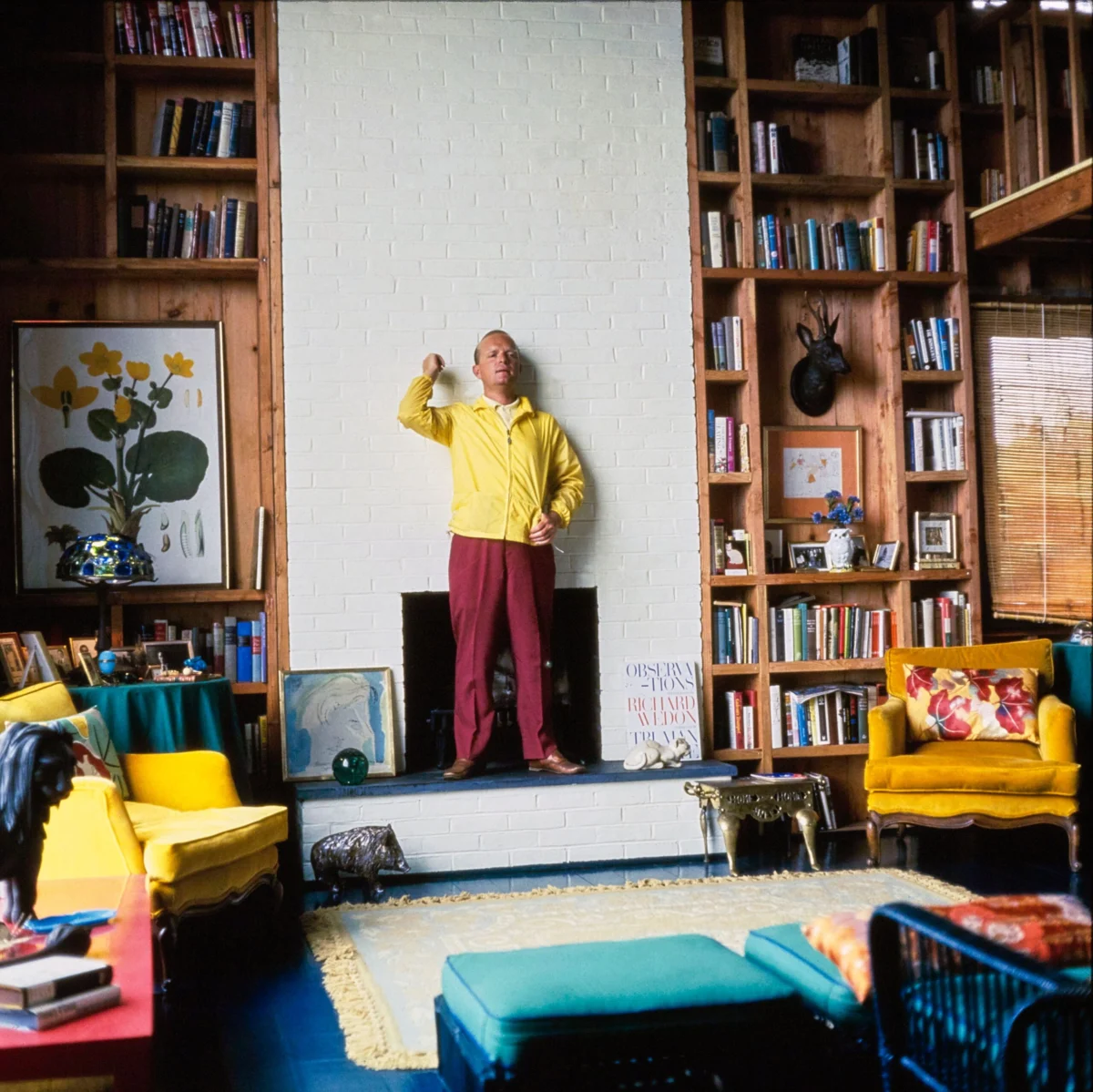
In the November 1, 1965, issue of Vogue, a rare glimpse was offered into the creative sanctuary of one of America’s most celebrated literary figures: Truman Capote. Photographed by the iconic Horst P. Horst, the feature unveiled the writer’s meticulously designed beach studio on Long Island, a space conceived with singular purpose – to facilitate the intense concentration required for his groundbreaking work. This particular studio marked the completion of the galleys for In Cold Blood, a non-fiction novel that would redefine the true-crime genre and cement Capote’s legacy.
The article, a testament to Capote’s unique approach to his craft, highlighted a dichotomy in his lifestyle. When not immersed in the demanding process of writing, Capote reveled in a life of considerable luxury and social engagement. His itinerant existence was punctuated by periods spent on opulent Mediterranean cruises aboard grand yachts, visits to the esteemed residences of friends, and a penchant for lively conversation and entertainment. He was renowned as one of the era’s most engaging conversationalists, a skill that often overshadowed the profound dedication he brought to his literary endeavors. Crucially, Capote maintained a strict separation between his professional and personal pursuits. The notion of "nipping upstairs to write for an hour or so" was antithetical to his disciplined methodology.
The Monastic Approach to Literary Creation
Capote’s beach studio on Long Island represented the embodiment of this disciplined approach. Designed for concentrated work, the space was characterized by its austere simplicity. Within its confines, a narrow, almost monastic office featured little more than a table and a typewriter – elements meticulously chosen to eliminate any potential distractions. This deliberate sparseness was intended to create an environment where Capote could engage in sustained periods of intense focus, allowing him to delve deeply into the narrative and factual intricacies of his projects.
The studio’s design philosophy mirrored Capote’s own persona: straightforward, yet possessing an undeniable charm and polish. Situated a few hundred yards from the Atlantic Ocean, the plain, grey-brown wooden house was nestled within a strip of moorland between wheat and potato fields. This setting, far removed from the urban bustle and social demands of his other residences – his Brooklyn house and his apartment in Verbier, Switzerland – provided the ideal backdrop for his solitary creative process. The house, much like its owner, was described as embodying a "straightforward American" aesthetic, infused with an "amusing, polished" quality and "good proportions." The addition of what the article termed "an attractive shake of Capote charm" underscored the personal imprint he had left on the dwelling, making it not just a workspace, but a reflection of his distinct character and sensibilities.
In Cold Blood: A Literary Landmark
The completion of In Cold Blood in this dedicated workspace was a significant moment in Capote’s career and in literary history. The book, published in 1966, detailed the brutal 1959 murders of the Clutter family in Holcomb, Kansas. Capote spent years researching the crime, immersing himself in the lives of both the victims and the perpetrators, Richard Eugene Hickock and Perry Edward Smith. His meticulous attention to detail, his ability to evoke empathy for all involved, and his innovative narrative structure, which blended journalistic reporting with novelistic techniques, earned In Cold Blood widespread critical acclaim and commercial success.
The genesis of In Cold Blood can be traced back to a brief article Capote read in The New York Times in December 1959, reporting on the murders. Intrigued by the human drama and the stark contrast between the idyllic setting and the horrific event, Capote, then a successful fiction writer known for works like Breakfast at Tiffany’s, saw an opportunity to explore a new literary frontier. He proposed to The New Yorker magazine that he cover the story, a decision that marked a significant departure from his previous fiction.
Capote’s commitment to the project was absolute. He and his longtime partner, Jack Dunphy, relocated to Kansas for an extended period, conducting hundreds of interviews with locals, law enforcement officials, and, crucially, Hickock and Smith themselves. The legal proceedings, including the trials and subsequent appeals of the convicted murderers, spanned several years. Capote meticulously documented every facet of the case, a process that demanded immense patience, emotional resilience, and an unwavering dedication to truth. The galleys finished in his Long Island studio represented the culmination of this arduous, decade-long endeavor.

The Impact of In Cold Blood
In Cold Blood was a critical and commercial phenomenon. It spent 91 weeks on The New York Times Best Seller list, selling millions of copies. More importantly, it elevated the true-crime genre from sensationalist pulp to serious literary art. Capote’s empathetic yet unsparing portrayal of the killers, his exploration of the societal factors that might have contributed to their actions, and his profound meditation on the nature of violence and justice resonated deeply with readers and critics alike. The book was lauded for its journalistic integrity, its psychological depth, and its literary artistry.
The success of In Cold Blood solidified Capote’s position as a literary giant. It also had a profound impact on the way true crime was perceived and produced. Writers and journalists were inspired by Capote’s immersive approach and his commitment to crafting compelling narratives from real-life events. The book’s influence can be seen in countless subsequent works of narrative journalism and true-crime storytelling.
Supporting Data and Context
The period in which Capote was completing In Cold Blood was a dynamic one for American literature and journalism. The 1960s saw a burgeoning interest in non-fiction narratives that explored complex social issues and individual psychology. The rise of "New Journalism," with practitioners like Tom Wolfe and Gay Talese, championed subjective reporting, literary techniques, and deep immersion in subject matter. Capote’s work on In Cold Blood predated much of this movement but shared its spirit of innovation and its ambition to push the boundaries of traditional reporting.
The magazine Vogue, known for its coverage of fashion and culture, also provided a platform for in-depth features and profiles. By featuring Capote’s studio, Vogue not only highlighted a significant literary event but also offered its readership an insight into the creative process of a major cultural figure. The choice of Horst P. Horst, a photographer renowned for his elegant and evocative portraits, further underscored the sophisticated presentation of Capote’s life and work.
Statements and Reactions (Inferred)
While direct quotes from Capote regarding the specific design of his studio are not provided in the original excerpt, his actions and the description of the space offer insight into his intentions. The emphasis on a "monastic office with only a table and a typewriter" and the absence of distractions strongly suggest a deliberate strategy to foster intense focus. One can infer that Capote, a writer who was keenly aware of the demands of his craft, sought to create an environment that was conducive to the meticulous work required for a project of In Cold Blood‘s scale and complexity.
It is also reasonable to infer that individuals within Capote’s literary circle and those familiar with his working habits would have recognized the significance of such a dedicated space. His publisher, Random House, would have eagerly anticipated the completion of In Cold Blood, and the news of its imminent finalization would have been met with great anticipation. Similarly, fellow writers and critics would have understood the importance of a writer’s environment in shaping their output.
Broader Impact and Implications
The story of Truman Capote’s country studio is more than just a vignette about a writer’s workspace; it is a testament to the power of intentional design in facilitating creative achievement. Capote’s ability to compartmentalize his life, dedicating specific environments to distinct activities, allowed him to harness his intellectual and creative energies with remarkable efficacy. This approach has implications far beyond the literary world, resonating with anyone who strives for deep work and focused productivity in an increasingly distracting world.
The enduring legacy of In Cold Blood, and by extension, the environment in which it was brought to fruition, underscores the fundamental principle that great art often requires not only talent and inspiration but also discipline, dedication, and the creation of optimal conditions for its emergence. Capote’s beach studio, a simple yet profound space, stands as a symbol of this commitment, a quiet testament to the focused pursuit of literary excellence. The insights provided by this archival piece from Vogue continue to offer valuable lessons for creators and professionals across disciplines, reminding us of the profound connection between our surroundings and our capacity for profound accomplishment.
