

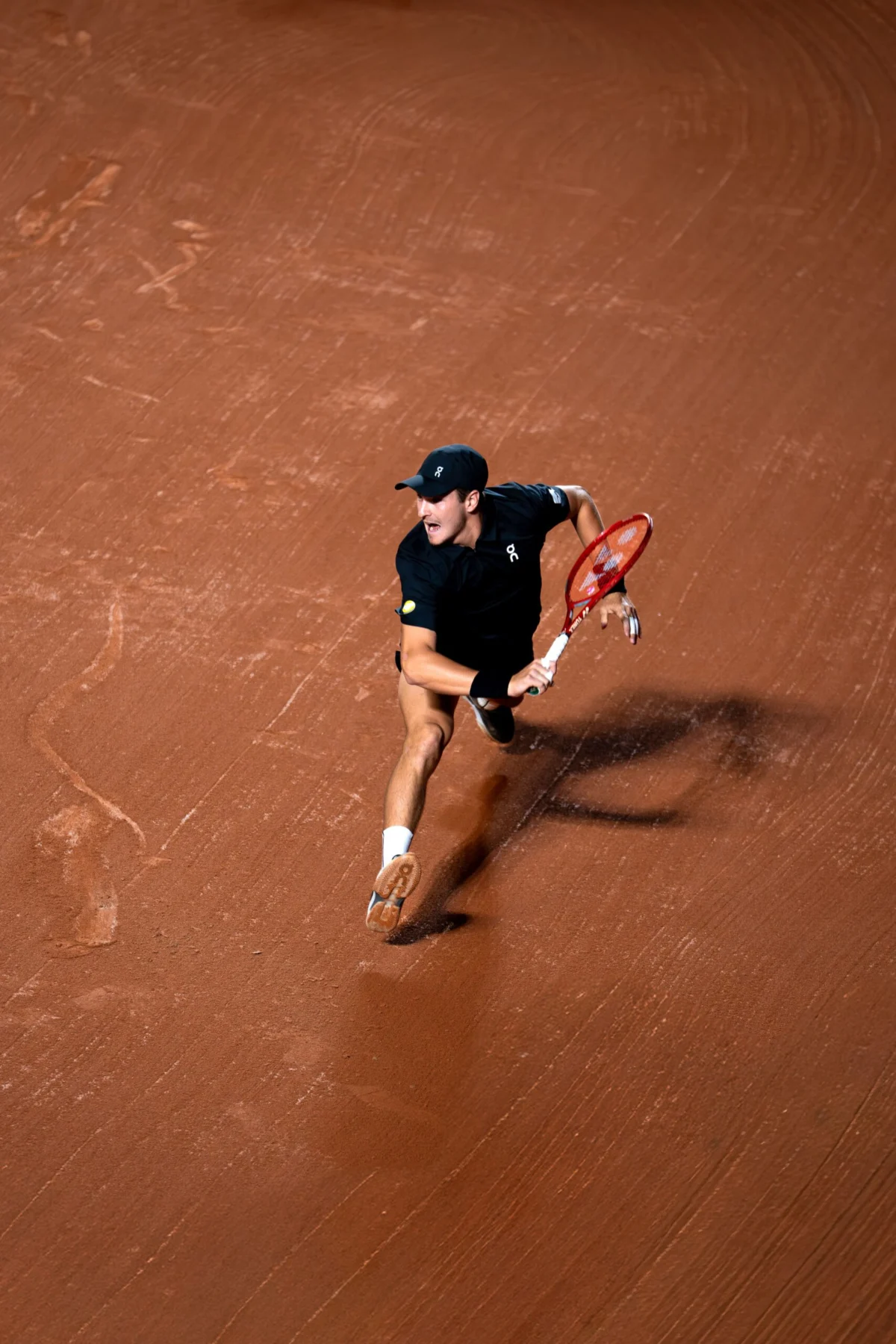
In the bustling heart of Miami Gardens’ Hard Rock Stadium, amidst the pre-tournament media frenzy of the Miami Open, 19-year-old Brazilian tennis prodigy Joao Fonseca exuded an undeniable aura. Even in casual attire – a subtly branded On T-shirt, a Whoop fitness band, and a classic Rolex – his presence commanded attention. Reporters and creators, accustomed to the usual media gauntlet, found their gaze drawn to him as he navigated the room, a testament to his rapidly growing stature in the sport. This wasn’t just a young athlete making the rounds; it was a glimpse into the emergence of a potential future titan, marked by an assured gait and a quiet confidence that belied his years.
Fonseca’s media obligations, a modern necessity for athletes aiming for global recognition, offered a playful counterpoint to his on-court intensity. Attempts at lighthearted social media content, like balancing a banana on a room divider with an extendable arm (a challenge met with amusing failure), were interspersed with more demanding queries. A question about the ten youngest ATP Tour 1000-level tournament winners tested even the most knowledgeable tennis aficionados. When the conversation shifted to cinema, Fonseca, though time-constrained by his demanding schedule, mentioned having seen the Oscar-nominated film The Secret Agent, directed by fellow Brazilian Kleber Mendonça Filho and starring another compatriot, Wagner Moura. This brief cultural interlude highlighted a developing facet of his persona, a connection to his Brazilian roots beyond the tennis court.
However, it was Fonseca’s palpable "presence" that truly resonated. As he moved through the room, every eye seemed to follow, every individual eager for a moment of his time. His team, though adept at managing his schedule, couldn’t possibly accommodate every request, yet the universal desire to connect with him underscored his burgeoning appeal. His physical presence, still possessing the lanky, long-limbed build of a teenager, was imbued with an assurance that spoke of his two years on the professional tour and, crucially, his exponential ascent in the last 12 months. Fonseca appeared to have not only leveled up his game but also found a comfortable footing in the demanding world of professional tennis.
"I think I’m understanding a little bit more about how the top players play—not technically, but mentally," Fonseca shared during a walk, his words reflecting a strategic evolution beyond mere shot-making. "How to deal with important points, how to open a match. I’m starting to understand more tricks of the game." This insight into his mental approach is a critical differentiator, signaling a maturation that transcends raw talent and points towards a deep understanding of the psychological warfare inherent in elite tennis.

A Defining Performance Against a Top Contender
The fruits of Fonseca’s developing understanding were vividly demonstrated just weeks prior at the BNP Paribas Open in Indian Wells, California. In a highly anticipated round of 16 encounter, he faced world number two Jannik Sinner for the first time in his career. The match was a grueling test of wills, with Fonseca pushing Sinner to tiebreaks in both sets and even securing three set points in the opening set. Clad in his distinctive On gear, which featured a dazzling camouflage pattern, and unleashing his signature powerful forehands, Fonseca presented a formidable challenge to Sinner’s dominance. This performance, occurring in the shadow of the enduring rivalry between Sinner and Carlos Alcaraz, the two most dominant forces in men’s tennis over the past three years, positioned Fonseca as a credible contender for their echelon.
Reflecting on this pivotal match, Fonseca acknowledged the difficulty of finding weaknesses in Sinner’s game. "I knew there wasn’t much of a weakness that I could try to put my power against," he stated. "I knew that if I went hard, it was going to come back hard as well, so I think one of the biggest things [for me when I play Jannik] is to keep consistency at the highest level. He just doesn’t miss the ball." His analysis is astute; Sinner’s near-flawless consistency and defensive prowess are hallmarks of his game, demanding an equally unwavering level of execution from his opponents. Fonseca’s ability to not only match Sinner’s intensity but also create crucial scoring opportunities underscores his rapid development.
Charting a Course for the Top Ranks
Despite the pervasive speculation within the tennis community about his potential to challenge the established order of Sinner and Alcaraz, Fonseca remains grounded in his self-belief. His breakout year in 2023 saw him make significant strides at both the Australian Open and the Miami Open. He went on to secure two tour titles later in the season, solidifying his rising trajectory. While a recent lower back injury temporarily impacted his ranking, the performance in Indian Wells served as a powerful indicator that he has not only recovered but is poised for an even stronger resurgence.
"I am feeling 100% now, and good on the court," Fonseca confirmed, his recovery a significant development for his aspirations. "I’d say we’re trying to improve my game, but also my mentality—and my physique—to compete at the level I want to be, which is top five in the world. It’s also important for me to focus on little things, too." This holistic approach, encompassing technical, mental, and physical conditioning, is indicative of a player with a clear vision for his career. His focus on the "little things" suggests a meticulous attention to detail, a trait often found in champions.
Managing the inherent downtime on the professional tour is a critical aspect of a player’s development, particularly in safeguarding against overthinking. For Fonseca, this often translates to engaging in activities like playing Catan with his team, a strategy to maintain focus and mental well-being away from the intense pressures of competition. This emphasis on mental resilience and effective downtime management is as crucial as any on-court drill.

The Miami Open: A Home Away From Home
As Fonseca moved towards the stadium court, the vibrant atmosphere of South Florida was palpable. The air itself seemed to shimmer, complementing the cyan hues of his On apparel, though he admitted a preference for plain colors during matches, describing himself as "a simple guy." The presence of fellow top players like Casper Ruud warming up nearby and Flavio Cobolli engaged in conversation underscored the caliber of talent gathered for the event.
Miami, with its substantial Brazilian expatriate community, has become a significant hub for Fonseca’s growing fanbase. The tournament director, former professional James Blake, has publicly advocated for Fonseca to be featured on the stadium court for the duration of his participation, a clear indication of his marketability and fan appeal. This preferential treatment is a strong possibility for his second-round match against Carlos Alcaraz, a highly anticipated clash that will serve as a significant benchmark for Fonseca’s progress. He had already navigated a challenging three-set first-round victory against Hungary’s Fábián Marozsán, setting the stage for this early-round test against one of the sport’s elite.
Fonseca embraces the energy of such high-stakes environments. "When I was younger, I was a little bit shy on the court," he confessed. "I felt the [audience] almost more as pressure. Here it’s crowded, it’s loud, it has the Miami vibe… and it’s just amazing." This evolution from apprehension to enjoyment of the crowd’s energy is a testament to his mental growth and adaptability.
A Future Defined by Confidence and Preparation
Looking down the hall, a determined glint in his eyes, Fonseca concluded, "I am more used to it now. I am prepared." This statement encapsulates his journey: a rapid ascent fueled by talent, refined by experience, and anchored by a growing mental fortitude. His ability to translate pressure into an energizing force, coupled with his strategic understanding of the game and a commitment to continuous improvement, positions Joao Fonseca not merely as a rising star, but as a genuine force shaping the future of professional tennis. The Miami Open, a stage befitting his growing prominence, promises to be another significant chapter in his compelling narrative.
