

The winter of 1994/95 stands as a distinct marker in the evolution of North American backcountry recreation, a period characterized by a nascent avalanche awareness infrastructure and a distinctly different recreational landscape. At that time, the vanguard of avalanche safety was comprised of a dedicated few. Knox Williams helmed the avalanche center in Denver, Bruce Tremper was a leading figure in Utah, and Mark Moore directed efforts in Seattle. Further west, Jim Kanzler managed the center in Jackson Hole, Wyoming, while Brad Ray led the avalanche safety initiatives at Mount Washington in New Hampshire. In Bozeman, Montana, a fledgling avalanche center, established just five seasons prior, was beginning to carve out its niche. Notably, significant backcountry regions like the Chugach Mountains of Alaska, the Tahoe basin, and Mount Shasta were without dedicated avalanche centers.
The equipment and technology of the era also paint a stark contrast to today. The vast majority of backcountry skiers were equipped with telemark gear, often including traditional leather boots. Snowmobiles, while present, were considerably less powerful and maneuverable than their modern counterparts, limiting their reach and impact. Ski areas operated with more defined boundaries, and the concept of "sidecountry" – terrain accessible from ski resorts but outside of managed boundaries – had yet to enter mainstream parlance, a term that would take over a decade to gain widespread usage. The digital revolution was in its infancy; the internet was just beginning to gain traction, with the first avalanche advisories making their way online only at the close of that 1994/95 season. This was a world before smartphones, social media, and the ubiquitous access to real-time information that now defines our digital age.
A Surprising Statistical Plateau
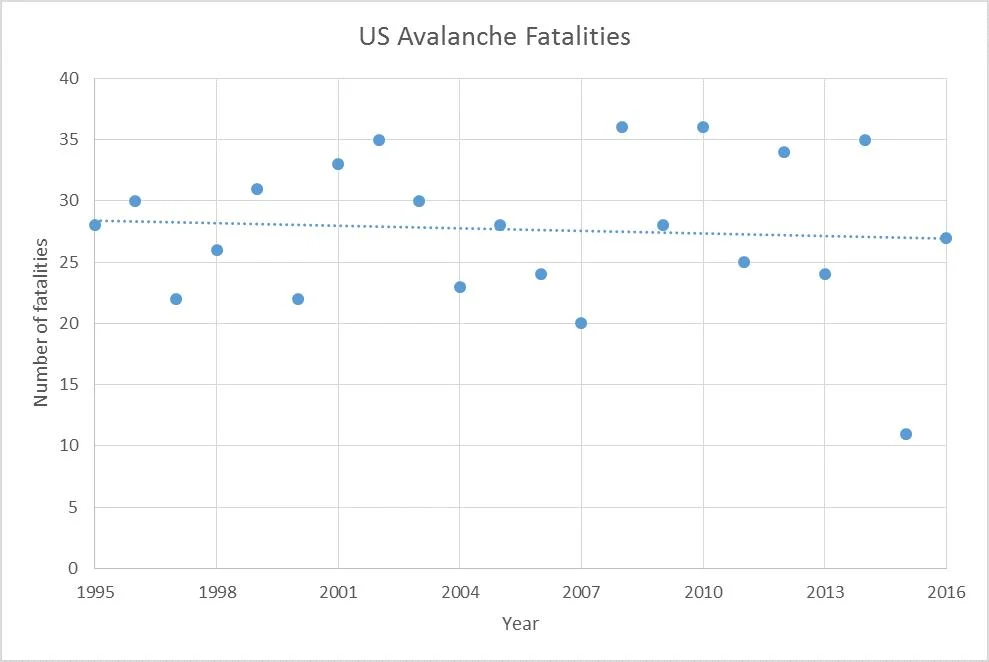
Against this backdrop of a vastly different recreational environment, a recent analysis of U.S. avalanche fatalities reveals a surprising and statistically significant trend: the annual number of avalanche-related deaths in the United States has remained remarkably stable since that 1994/95 winter. Over the subsequent 22 seasons, despite a dramatic transformation in backcountry access, equipment, and user demographics, the overall number of avalanche fatalities has not escalated. This finding is presented in Figure 1, which illustrates the U.S. avalanche fatalities from the 1994/95 winter through the 2015/16 winter. A statistical analysis of this data indicates a slightly decreasing trend line, but this trend is not statistically significant (p = 0.7), meaning there is no robust evidence to suggest a change in the overall number of avalanche fatalities during this extensive period.
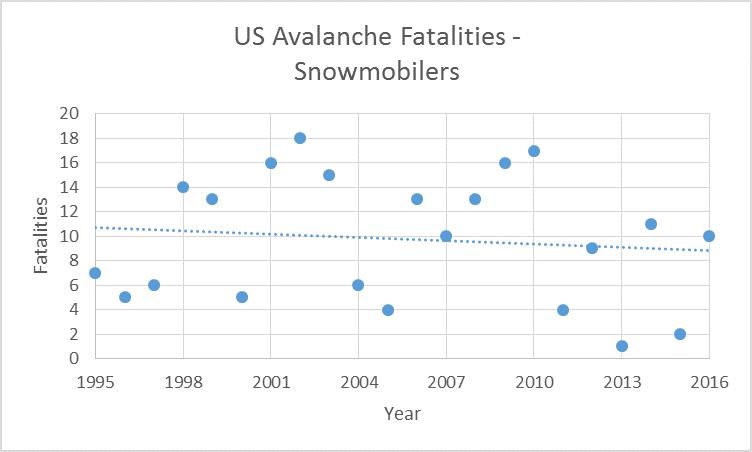
Further examination of specific user groups within this data set provides additional insights. Figure 2, detailing snowmobile avalanche fatalities, shows a similar pattern of stability. The number of fatalities involving snowmobilers in avalanche incidents has remained flat over the past 22 seasons. The trend line here also shows a slight decrease, which, like the overall trend, is not statistically significant (p = 0.6). This suggests that advancements in snowmobile technology, increased usage, or changes in rider behavior have not led to a statistically discernible increase in avalanche fatalities within this user group.
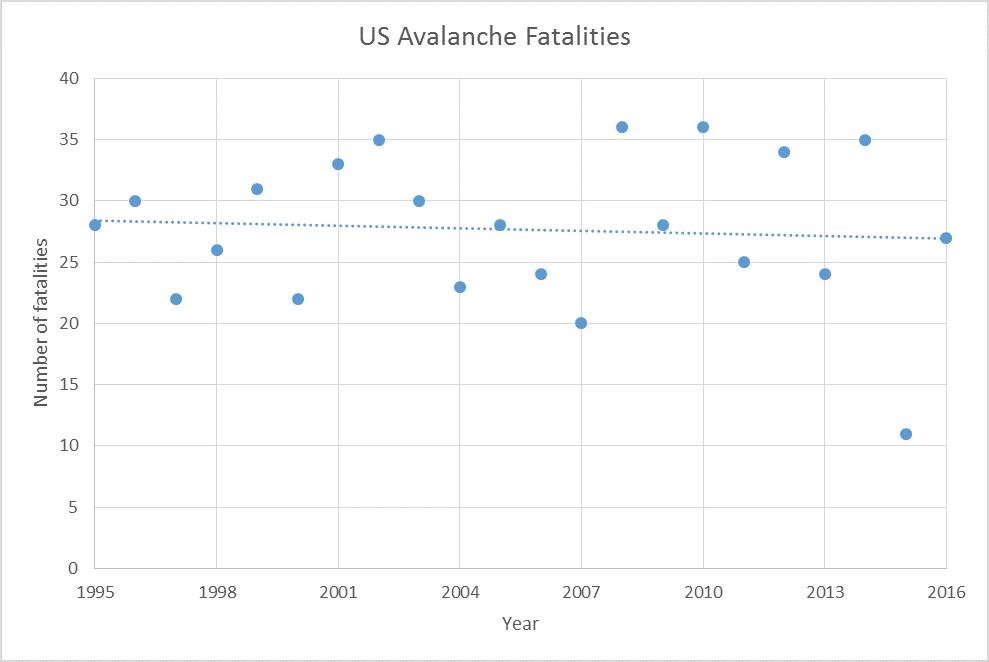
In contrast, Figure 3, which focuses on backcountry skier and snowboarder avalanche fatalities, presents a slightly different picture. While this data also shows a relatively flat trend, there is some statistical evidence, with a p-value of 0.07, suggesting a potential, albeit slight, increase in fatalities within this demographic over the observed time period. This nuanced observation warrants further investigation into the specific factors influencing skier and snowboarder avalanche incidents.
The Unprecedented Surge in Backcountry Engagement
The constancy of avalanche fatalities becomes all the more remarkable when juxtaposed with the exponential growth in backcountry use over the same 22-year period. While precise, quantifiable data on dispersed winter recreation is inherently challenging to collect, the utilization of avalanche advisory services offers a compelling proxy. Over the past two decades, avalanche centers across the country have reported astonishing increases in the number of individuals seeking crucial safety information.
The Utah Avalanche Center, for instance, has witnessed a twelve-fold increase in advisory usage. The Colorado Avalanche Information Center has experienced an even more dramatic seventeen-fold surge. The Gallatin National Forest Avalanche Center in Montana has seen a remarkable thirty-six-fold increase, and the Northwest Avalanche Center has documented an astounding sixty-fold increase in advisory engagement. While it is undeniable that the ease of accessing information via the internet and mobile devices contributes to these numbers, this substantial rise unequivocally points to a significantly larger population venturing into the backcountry.
A Dramatic Decline in Fatality Rate
The implication of a static number of fatalities against a backdrop of massively increased user numbers is profound. Assuming a conservative estimate of backcountry use increasing eightfold over the past 22 years, and combining this with the observed flat trend in avalanche fatalities, the fatality rate—defined as avalanche fatalities per backcountry user day—has plummeted. This analysis suggests that the fatality rate has decreased by at least a factor of eight, and likely more, over the past two decades. If the fatality rate had remained constant during this period of explosive growth, the United States could have potentially seen well over 200 avalanche fatalities per winter, a grim scenario that has, thankfully, been averted.
A Collective Success Story
The sustained, low number of U.S. avalanche fatalities, especially in the face of escalating backcountry engagement, represents a significant achievement for the entire avalanche safety community. While the ultimate goal remains zero fatalities, this plateau is a testament to the effectiveness of a multifaceted approach to avalanche education and safety.
This success is a victory for avalanche educators at all levels, from those providing comprehensive professional courses to instructors delivering vital "Know Before You Go" awareness presentations to novice users. It is also a win for backcountry guiding operations and ski area professionals who are dedicated to protecting and educating their clients. Furthermore, equipment manufacturers deserve commendation for their innovation, developing a range of highly effective safety gear. This includes vastly improved avalanche beacons, the integration of Avalungs, lightweight helmets, and the increasingly prevalent airbag packs, all of which contribute to enhanced survivability.
Crucially, this trend highlights the immense value of the regional avalanche center network. These centers provide the public with indispensable avalanche education and deliver timely, reliable avalanche information critical for safe decision-making in the backcountry. Ultimately, the consistent fatality numbers during a period of unprecedented backcountry expansion serve as powerful evidence that current safety strategies and educational initiatives are working. This collective success should instill a sense of pride and encourage continued commitment to advancing avalanche safety for all who venture into the winter wilderness.
Acknowledgements and Future Directions
The data underpinning this analysis was primarily provided by the Colorado Avalanche Information Center (CAIC). The broader avalanche community owes a substantial debt of gratitude to the CAIC, its dedicated personnel who meticulously compile this vital data, and all individuals who report and document avalanche accidents. Their efforts provide invaluable lessons learned, contributing to the collective knowledge base that enhances safety for everyone. Constructive reviews and feedback on this analysis were also provided by Simon Trautman, Doug Chabot, and Spencer Logan, whose contributions have been instrumental in refining this perspective.
Looking ahead, the focus remains on continued improvement and innovation within the avalanche safety domain. Ongoing research into human factors, the effectiveness of different educational approaches, and the development of new technologies will be crucial. As backcountry use continues to evolve, adapting safety strategies to meet emerging challenges and ensuring accessibility of information and education to all user groups will be paramount. The goal of reaching zero fatalities is an ambitious one, but the progress observed over the past two decades provides a strong foundation for future endeavors in making the backcountry a safer place for all.
The evolution of backcountry recreation and avalanche safety is a dynamic narrative. From the rudimentary setups of the mid-1990s to the sophisticated gear and information systems of today, the journey has been marked by both significant advancements and persistent challenges. The statistical plateau in avalanche fatalities, while a cause for cautious celebration, also underscores the ongoing need for vigilance, education, and community collaboration. The data suggests that while the overall risk of being involved in a fatal avalanche has not increased despite a surge in participants, the subtle upward trend for skiers and snowboarders warrants a deeper dive into the contributing factors. This could involve analyzing accident reports for commonalities in decision-making, terrain selection, or group dynamics. Furthermore, understanding how the increasing popularity of splitboarding and the accessibility of increasingly steep and complex terrain might influence this trend will be vital for future safety initiatives. The story of avalanche safety is far from over; it is an ongoing commitment to learning, adapting, and prioritizing the well-being of those who seek adventure in the mountains.
