

The winter of 1994/95 marked a starkly different era for backcountry enthusiasts and avalanche professionals in the United States. The landscape of avalanche safety and backcountry recreation was nascent, characterized by a handful of dedicated avalanche centers, rudimentary technology, and a much smaller cohort of participants. Knox Williams helmed the Denver Avalanche Center, Bruce Tremper managed operations in Utah, and Mark Moore led the Seattle-based center. In Jackson Hole, Jim Kanzler was the driving force, while Brad Ray directed efforts at Mount Washington. A nascent avalanche center in Bozeman, established by the author, was only in its fifth season. Notably, major backcountry regions like the Chugach, Tahoe, and Mt. Shasta lacked dedicated avalanche centers. The vast majority of backcountry skiers utilized telemark gear, often with leather boots, a testament to the more traditional approach to the sport. Snowmobiles, a significant factor in backcountry access and often involved in avalanche incidents, were considerably less powerful, less mobile, and heavier than their modern counterparts. Ski resorts typically operated with strict closed boundaries, and the term "sidecountry," referring to areas accessible from resorts but outside their operational control, would not enter common parlance for over a decade. The digital revolution was in its infancy; the internet was just beginning to gain traction, and the first avalanche advisories posted online would appear at the close of that very season.
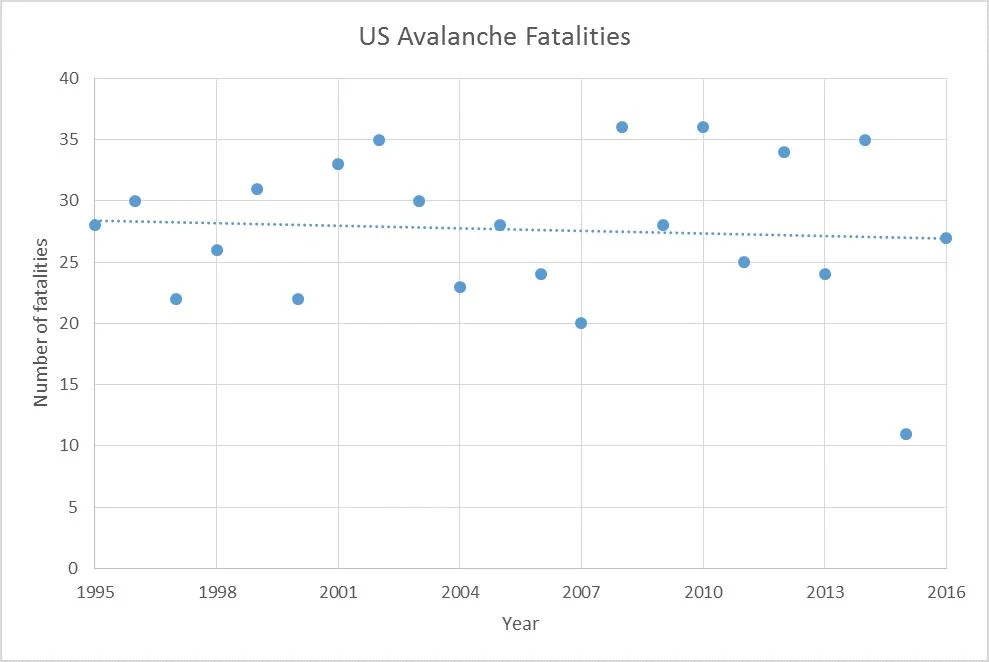
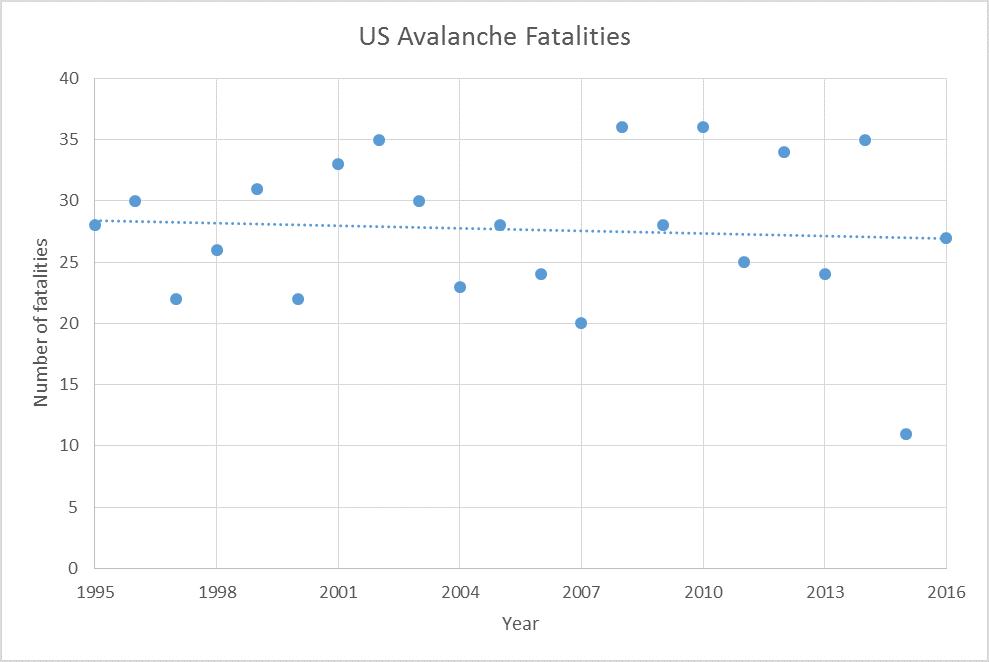
In stark contrast to the technological and recreational boom that has since reshaped the American backcountry, a recent analysis of avalanche fatalities reveals a surprising and statistically significant trend: the annual number of U.S. avalanche fatalities has remained remarkably consistent since that 1994/95 winter. Over the subsequent 22 seasons, despite the proliferation of smartphones, social media, lightweight backcountry skiing equipment, powerful snowmobiles, and an undeniable explosion in backcountry use, the number of seasonal avalanche fatalities has held steady. This observation is supported by data presented in Figure 1, which illustrates U.S. avalanche fatalities from the 1994/95 winter through the 2015/16 winter. A statistical analysis of this data shows a slightly decreasing least squares trend line, but this trend is not statistically significant (p = 0.7), indicating no statistically verifiable change in the overall number of avalanche fatalities during this period.
Snowmobile Fatalities Remain Stable
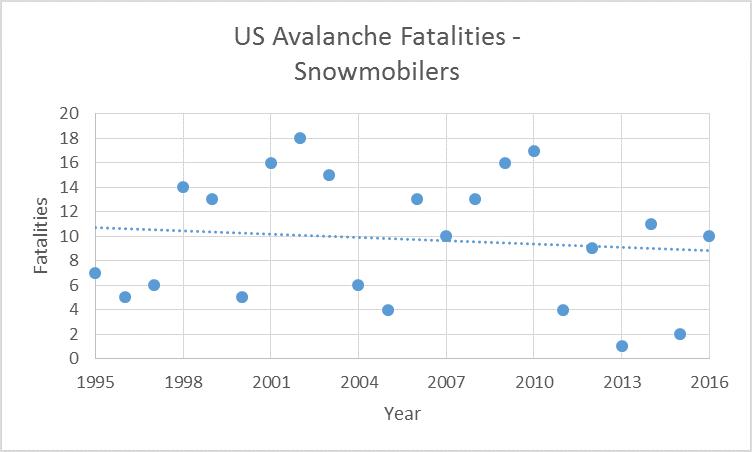
Intriguingly, the trend of stable fatality numbers extends to snowmobile-related avalanche incidents. Figure 2, which charts the number of snowmobile avalanche fatalities over the same 22-season period, also reveals a flat trajectory. Similar to the overall fatality rate, the slightly decreasing trend line for snowmobile fatalities is not statistically significant (p = 0.6), suggesting no substantial change in this specific category of risk.
A Nuance in Skier and Snowboarder Fatalities
While overall fatalities have stabilized, a closer examination of backcountry skier and snowboarder fatalities, as depicted in Figure 3, reveals a subtle shift. This figure indicates that the number of fatalities within this demographic remains relatively flat. However, there is some statistical evidence, with a p-value of 0.07, suggesting a slight, albeit not definitively conclusive, increase over the analyzed time period. This nuance highlights the complex dynamics at play within different user groups in the avalanche-prone environment.
The Unseen Driver: Exploding Backcountry Participation
The stability of avalanche fatality numbers would be less remarkable if backcountry use had also remained static. However, anecdotal evidence and available proxy data strongly suggest a dramatic surge in participation. Anyone who has spent time in the backcountry over the past two decades can attest to the visibly increased human presence. While obtaining precise figures for dispersed winter recreation is inherently challenging, the usage of avalanche advisories provides an imperfect but compelling proxy for participation levels.
For instance, over the past 22 seasons, the Utah Avalanche Center has reported a staggering 12-fold increase in avalanche advisory usage. The Colorado Avalanche Information Center has witnessed a 17-fold increase, the Gallatin National Forest Avalanche Center an impressive 36-fold increase, and the Northwest Avalanche Center has experienced a remarkable 60-fold surge in advisory engagement. While a portion of these increases can undoubtedly be attributed to the enhanced accessibility of information through digital platforms, these figures unequivocally indicate a substantial rise in the number of individuals venturing into the backcountry.
A Dramatic Decline in Fatality Rate
The implications of a stable fatality count coupled with a significant increase in participation are profound. Assuming a conservative estimate of an eight-fold increase in backcountry use and combining this with the observed flat fatality trend, it can be inferred that the fatality rate—defined as avalanche fatalities per backcountry user day—has dropped dramatically. This suggests that the fatality rate has decreased by at least a factor of eight, and likely more, over the past 22 years. To contextualize this, if the fatality rate had remained constant while usage increased by a factor of eight, the United States might have experienced well over 200 avalanche fatalities per winter.
A Collective Success Story for Avalanche Safety
The U.S. avalanche community continues its unwavering commitment to reducing fatalities to zero. However, it is imperative to acknowledge the significance of this flat trend amidst unprecedented growth in backcountry engagement. This outcome represents a substantial victory for avalanche educators at all levels, from those providing comprehensive professional courses to those delivering essential "Know Before You Go" awareness presentations. It is a testament to the dedication of backcountry guiding operations and ski area personnel who prioritize the safety and education of their clients.
Furthermore, this success is a credit to equipment manufacturers who have innovated and developed a range of life-saving gear. This includes significantly improved avalanche beacons, Avalungs, lightweight helmets, and advanced airbag systems, all of which have contributed to enhanced safety in the backcountry. Crucially, this achievement is a monumental win for the network of regional avalanche centers across the nation. These centers provide the public with vital avalanche education and deliver current, reliable avalanche information crucial for informed decision-making in the backcountry.
Ultimately, this sustained, flat trend in avalanche fatalities, occurring concurrently with an explosive expansion of backcountry recreation, serves as compelling evidence that current safety initiatives and educational efforts are effective. This is a source of collective pride for everyone involved in avalanche safety and backcountry stewardship.
Historical Context and Evolution of Avalanche Centers
The early days of avalanche forecasting were a testament to the pioneering spirit of a few individuals. In the winter of 1994/95, the operational landscape was vastly different. The centers mentioned—Denver, Utah, Seattle, Jackson Hole, and Mount Washington—were the primary hubs for avalanche information and education. The absence of centers in regions like the Chugach, Tahoe, and Mt. Shasta meant that backcountry users in those areas often relied on more localized knowledge or lacked formal advisories altogether. The limited reach of early internet technology meant that information dissemination was a slower, more deliberate process, primarily through word-of-mouth, printed bulletins, and limited radio communication.
The evolution of avalanche centers has been marked by technological advancements and increased funding. The ability to post advisories online, coupled with the widespread adoption of smartphones, has revolutionized how people access critical safety information. This ease of access, as noted, has likely contributed to increased usage but also underscores the importance of the information being readily available.
Technological Advancements and Their Impact
The transformation of backcountry gear has also played a pivotal role. The shift from heavy leather boots and telemark setups to lightweight alpine touring (AT) gear has made backcountry travel more accessible and appealing to a broader demographic. Similarly, the evolution of snowmobiles from relatively cumbersome machines to powerful, agile vehicles has expanded the reach of snowmobilers into previously inaccessible terrain, bringing with it new avalanche risks.
The development of advanced avalanche safety equipment represents a significant leap forward. Avalanche beacons have become more sophisticated, offering greater range and more precise locating capabilities. The introduction of the Avalung, which allows a buried victim to breathe for a limited time, and the widespread adoption of airbag backpacks, designed to help keep a skier or snowboarder on the surface of an avalanche, have provided crucial layers of safety.
Data Sources and Methodology
The data underpinning this analysis, primarily sourced from the Colorado Avalanche Information Center (CAIC), provides a critical snapshot of avalanche fatalities over two decades. The CAIC, along with other regional avalanche centers, meticulously collects data on avalanche incidents, including fatalities, near misses, and avalanche characteristics. This data compilation is an arduous but essential task, providing the foundation for understanding avalanche trends and informing safety strategies. The figures presented in this article are based on these comprehensive datasets, allowing for a statistically robust examination of fatality trends.
Broader Implications for Risk Management
The findings suggest a paradigm shift in backcountry risk management. While the absolute number of fatalities has not decreased, the rate of fatalities has significantly diminished due to increased participation. This implies that educational efforts, technological advancements, and improved forecasting are collectively mitigating the risks associated with a larger user base.
However, the slight statistical indication of a rise in skier and snowboarder fatalities warrants continued attention. This could be attributed to various factors, including increased risk-taking behavior, venturing into more challenging terrain, or simply the sheer volume of people participating, leading to more incidents even with a stable rate. Further research into the specific circumstances of these incidents could provide deeper insights.
The Role of Avalanche Education and Forecasting
The success highlighted in this analysis is inextricably linked to the robust network of avalanche education providers and forecasting centers. These entities serve as the frontline in promoting safety and mitigating risk. Avalanche courses, ranging from introductory AIARE (American Institute for Snow Safety) Level 1 courses to advanced Level 3 certifications, equip individuals with the knowledge and skills to assess avalanche hazards.
Avalanche forecasting centers, through their daily advisories, provide essential, real-time information on snowpack stability, weather conditions, and avalanche danger levels. The increasing usage of these advisories underscores their value and the growing reliance of backcountry users on this critical resource. The accessibility of these advisories via websites and mobile applications has democratized access to vital safety information.
Acknowledgements and Future Directions
The insights presented in this analysis are built upon the diligent work of numerous individuals and organizations within the avalanche community. The Colorado Avalanche Information Center, in particular, deserves significant commendation for compiling and providing the data that underpins this discussion. The dedication of CAIC personnel and other individuals who report and document avalanche accidents is invaluable, allowing the broader community to learn from these events. Constructive reviews and feedback from experts such as Simon Trautman, Doug Chabot, and Spencer Logan have further refined this analysis.
Looking ahead, the challenge remains to continue driving fatality numbers toward zero. This will require ongoing commitment to education, innovation in safety technology, and sustained support for avalanche forecasting and research. Understanding the nuances of different user groups and evolving backcountry practices will be crucial in developing targeted strategies to further enhance safety in the mountains. The current trend, while encouraging, should not breed complacency but rather serve as a powerful motivator to build upon this success. The collective efforts of the avalanche community have demonstrated that progress is achievable, even in the face of exponential growth in backcountry engagement.
