

The winter of 1994/95 marked a vastly different era for backcountry recreation in the United States. The landscape of avalanche forecasting and backcountry access was nascent, with only a handful of established avalanche centers serving a relatively small community of enthusiasts. Knox Williams led the Denver avalanche center, Bruce Tremper oversaw operations in Utah, and Mark Moore managed the Seattle center. In Jackson Hole, Jim Kanzler directed avalanche efforts, while Brad Ray helmed the center at Mount Washington. A fledgling center in Bozeman, established by the author, was entering its fifth year of operation. Notably, significant backcountry regions like the Chugach Mountains in Alaska, the Lake Tahoe area, and Mount Shasta in California lacked dedicated avalanche centers.
The equipment and technology of that time further underscore the contrast with today. The vast majority of backcountry skiers relied on telemark gear, often with leather boots, a far cry from the lightweight, high-performance alpine touring (AT) equipment prevalent now. Snowmobiles, a significant mode of backcountry access for some, were considerably less powerful, maneuverable, and lighter than their modern counterparts. Ski resorts generally operated with strict in-bounds policies, and the concept of "sidecountry" access, while perhaps practiced informally, was not yet a widely recognized or utilized term in recreational parlance. Furthermore, the internet was in its infancy, with the first avalanche advisories only beginning to appear online towards the end of that 1994/95 season.
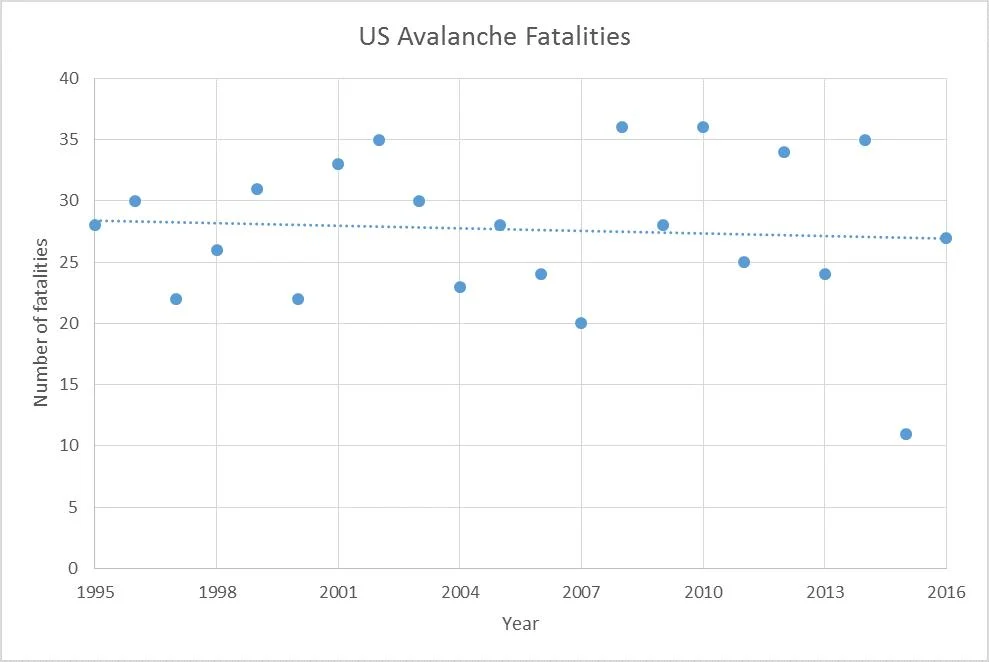
Against this backdrop of a less developed infrastructure and a smaller user base, a striking trend has emerged over the subsequent 22 seasons: the annual number of U.S. avalanche fatalities has remained remarkably stable. This observation is particularly noteworthy given the dramatic transformation of the backcountry landscape. The past two decades have witnessed the widespread adoption of smartphones and social media, the proliferation of lightweight AT gear, the development of significantly more powerful snowmobiles, and an undeniable explosion in the popularity of backcountry skiing, snowboarding, and snowmobiling.
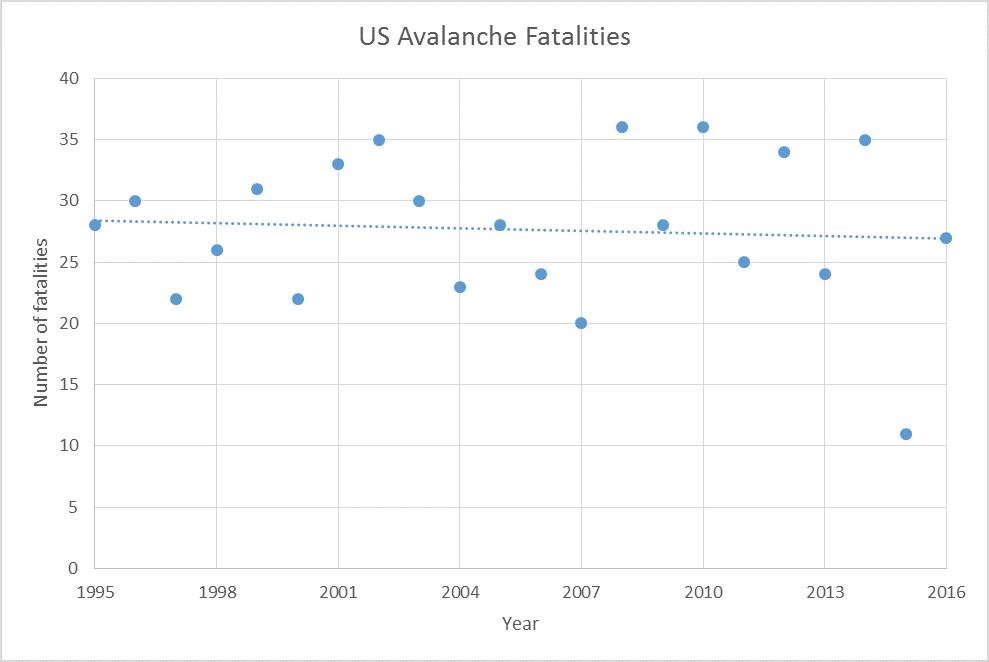
Despite these profound changes and the exponential increase in backcountry participation, data compiled over the past 22 winters, from 1994/95 through 2015/16, indicates no statistically significant increase in overall U.S. avalanche fatalities. This stability is visually represented in Figure 1, which displays the annual number of avalanche fatalities. A least squares trend line fitted to this data shows a slight decrease, but this trend is not statistically significant (p = 0.7), meaning there is no robust evidence to suggest a change in the overall number of avalanche fatalities over this period.
Snowmobile Fatality Trends Mirror Overall Stability
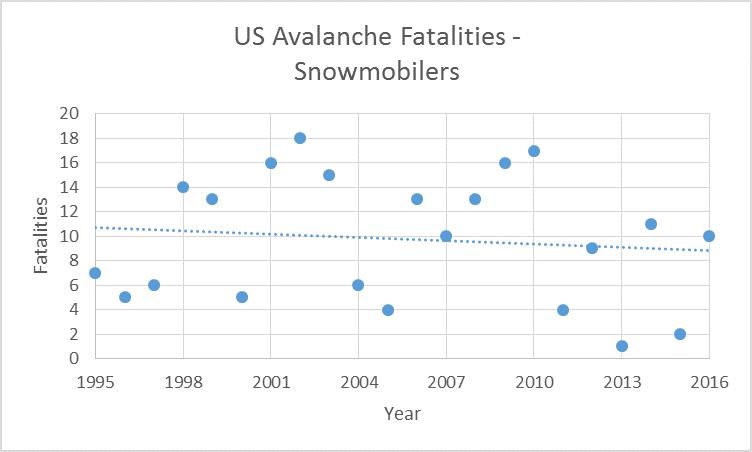
Interestingly, the trend in snowmobile avalanche fatalities also mirrors the overall stability observed in general avalanche fatalities. Figure 2 illustrates that the number of snowmobile-related avalanche deaths has also remained flat over the past 22 seasons. Similar to the overall trend, a slightly decreasing trend line for snowmobile fatalities is not statistically significant (p = 0.6), reinforcing the notion that this mode of backcountry travel has not seen a commensurate rise in fatal avalanche incidents despite potential increases in use and machine capabilities.
Subtle Rise in Skier and Snowboarder Fatalities Noted
While the overall picture is one of stability, a closer examination of specific user groups reveals a more nuanced trend. Figure 3, which tracks backcountry skier and snowboarder avalanche fatalities, shows a relatively flat trend. However, there is some statistical evidence, with a p-value of 0.07, suggesting a slight, though not definitively conclusive, increase in fatalities within this demographic over the observed period. This subtle upward trend, while not statistically overwhelming, warrants continued attention and analysis by the avalanche safety community.
Backcountry Use Skyrockets: A Dramatic Drop in Fatality Rate
The stability in absolute fatality numbers would be less remarkable if backcountry usage had remained constant. However, anecdotal evidence and proxy data strongly suggest that backcountry use has surged dramatically over the past 22 years. While precise, comprehensive statistics on dispersed winter recreation are challenging to obtain, avalanche advisory usage serves as a valuable, albeit imperfect, indicator of this increased engagement.
The Utah Avalanche Center, for example, reports a twelvefold increase in advisory usage over the past two decades. The Colorado Avalanche Information Center (CAIC) has experienced a seventeenfold increase in usage. The Gallatin National Forest Avalanche Center has seen an astonishing thirty-sixfold increase, and the Northwest Avalanche Center has observed a sixtyfold surge in advisory access. While a portion of these increases can be attributed to the enhanced accessibility of information through online platforms and mobile devices, these figures undeniably point to a substantially larger number of individuals venturing into avalanche terrain.
Assuming a conservative estimate that backcountry use has increased by a factor of eight over the past 22 years, and combining this with the observed flat trend in avalanche fatalities, the implication is a dramatic decrease in the fatality rate – defined as avalanche fatalities per backcountry user day. This suggests that the fatality rate has dropped by at least a factor of eight, and likely more, over the past two decades. Had the fatality rate remained static while usage increased eightfold, the U.S. could have potentially seen well over 200 avalanche fatalities per winter. This substantial reduction in the fatality rate represents a significant achievement for the backcountry community.
A Collective Win for Avalanche Safety Efforts
The consistent number of avalanche fatalities, especially in the face of such dramatic increases in backcountry participation, is a testament to the cumulative impact of various safety initiatives and advancements. This outcome is not attributable to a single factor but rather to a multifaceted approach that has evolved over decades.
Avalanche Education and Awareness: The success is a clear win for avalanche educators at all levels. This includes professional avalanche course providers who equip individuals with in-depth knowledge of snowpack assessment, route finding, and rescue techniques. It also encompasses those delivering crucial avalanche awareness presentations, such as the widely adopted "Know Before You Go" programs, which introduce fundamental safety concepts to a broader audience. These educational efforts have demonstrably improved decision-making in avalanche terrain.
Professional Guiding and Ski Area Operations: Backcountry guiding services and ski area operations that manage backcountry access or offer guided tours have also played a vital role. Their commitment to client safety, risk management, and ongoing education contributes significantly to mitigating avalanche hazards for those under their care.
Equipment Innovations: The avalanche safety equipment industry has seen remarkable advancements. Manufacturers have developed a sophisticated array of gear that enhances safety in the backcountry. This includes significantly improved avalanche transceivers (beacons) with greater range and accuracy, devices like the Avalung that can extend breathing time in a burial, lightweight and protective helmets, and, critically, avalanche airbag packs that can significantly increase a person’s chances of staying on the surface of an avalanche. These technological innovations provide critical layers of safety.
Regional Avalanche Center Network: The robust network of regional avalanche centers across the United States is a cornerstone of this success. These centers provide the public with invaluable, current, and location-specific avalanche information and forecasts. Their work, coupled with ongoing public education outreach, empowers individuals to make informed decisions before and during their backcountry excursions. The accessibility and quality of their advisories have undoubtedly contributed to the reduction in the fatality rate.
Looking Ahead: The Path Towards Zero Fatalities
While acknowledging this significant achievement, the avalanche safety community remains committed to further reducing avalanche fatalities and ultimately striving for zero deaths. The current flat trend, while positive, indicates that fatalities are still occurring, and each loss represents a tragedy for families and communities.
The data suggests that the ongoing efforts in education, technology, and information dissemination are proving effective in helping a growing number of people navigate avalanche terrain more safely. This trend provides a strong foundation for continued investment and innovation in avalanche safety. Future efforts will likely focus on further refining educational curricula, promoting the consistent use of safety equipment, enhancing the accessibility and understanding of avalanche forecasts, and potentially addressing the subtle increase observed in skier and snowboarder fatalities through targeted awareness campaigns.
The collective progress demonstrated over the past 22 years serves as a powerful reminder that coordinated efforts and a commitment to safety can yield tangible results, even in the face of rapidly evolving recreational trends. This success story is a shared accomplishment for everyone involved in the backcountry community, from the forecasters and educators to the recreationalists themselves who are embracing safer practices.
Data Compilation and Acknowledgements
The data underpinning this analysis was primarily provided by the Colorado Avalanche Information Center (CAIC). The CAIC, along with its dedicated personnel, plays a crucial role in collecting, compiling, and disseminating avalanche accident data. This information is invaluable for the entire avalanche safety community, allowing for continuous learning and improvement from past incidents. Acknowledgment is also extended to individuals such as Simon Trautman, Doug Chabot, and Spencer Logan for their constructive reviews and feedback on this analysis, contributing to its accuracy and clarity. The ongoing efforts of all those who report and document avalanche accidents are fundamental to advancing avalanche safety knowledge.
