

The winter of 1994/95 marked a distinct era in North American backcountry recreation. For those venturing into the snow-laden wilderness, the landscape of avalanche safety and awareness was fundamentally different from today. At the helm of the nascent avalanche centers were figures like Knox Williams in Denver, Bruce Tremper in Utah, and Mark Moore in Seattle. Jim Kanzler managed operations in Jackson Hole, while Brad Ray led the efforts at Mount Washington. In Bozeman, a fledgling avalanche center, established just five seasons prior, was diligently working to inform the public. Critically, major avalanche centers in regions now experiencing significant recreational use, such as the Chugach Mountains of Alaska, Lake Tahoe, and Mount Shasta, did not yet exist.
The gear of choice for backcountry enthusiasts was predominantly telemark equipment, often featuring leather boots, a stark contrast to the lightweight, high-performance bindings and boots common today. Snowmobiles, while present, were significantly less powerful and maneuverable than their modern counterparts. Ski resorts typically operated with strict in-bounds policies, and the concept of "sidecountry" – terrain accessible from resorts but outside their managed boundaries – was not yet a widely recognized term, with its popularization still more than a decade away. The digital revolution was in its infancy; the internet was just beginning to gain traction, and the first avalanche advisories posted online would only appear at the close of that very season.
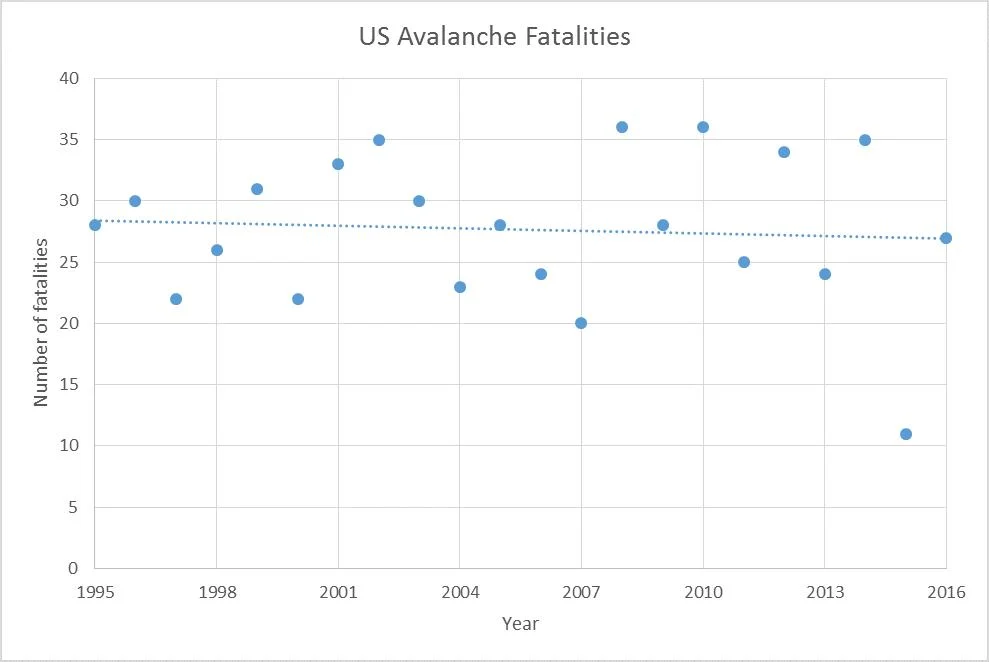
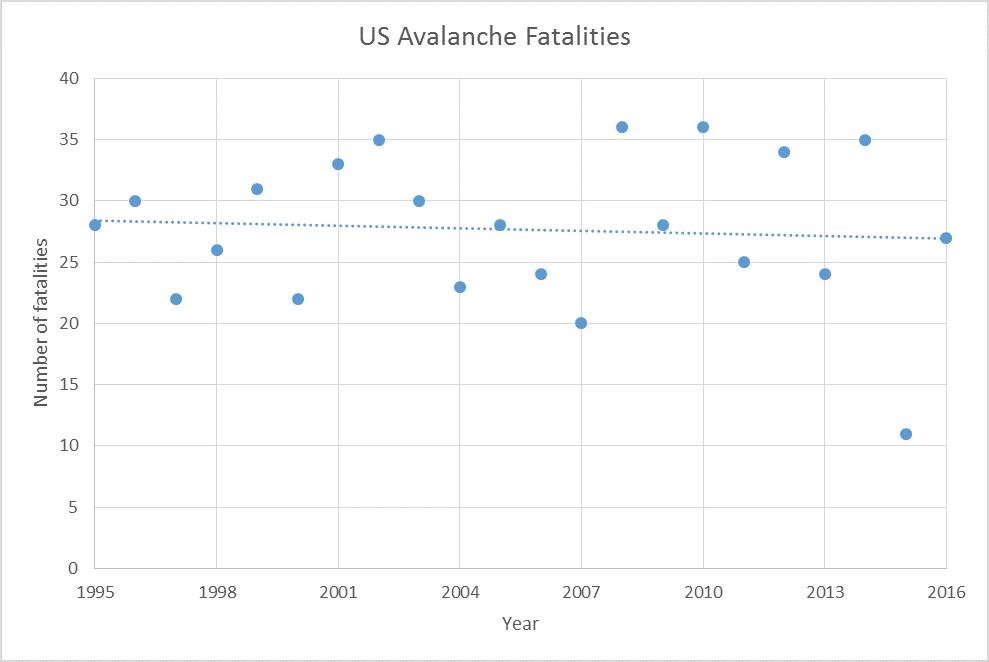
In this drastically altered environment of technological advancement, increased accessibility, and a surge in outdoor participation, a surprising statistic has emerged: the annual number of avalanche fatalities in the United States has remained remarkably consistent since the 1994/95 winter. Over the subsequent 22 seasons, despite the proliferation of smartphones, social media platforms, lightweight AT (alpine touring) gear, exceptionally powerful snowmobiles, and an undeniable explosion in backcountry usage, the overall seasonal U.S. avalanche fatality count has not seen a statistically significant increase. This trend is illustrated in Figure 1, which charts U.S. avalanche fatalities from the 1994/95 season through the 2015/16 winter. The data reveals a slight, non-statistically significant decreasing trend line (p = 0.7), indicating no demonstrable change in the overall number of avalanche deaths during this period.
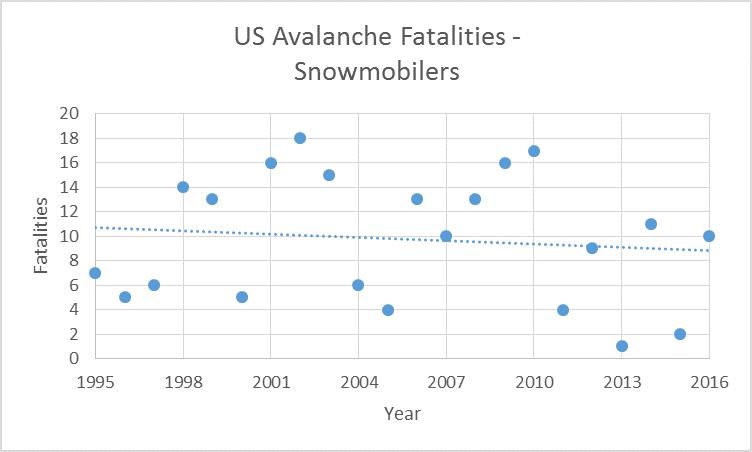
Further analysis of related recreational activities reveals nuances within this overarching trend. Interestingly, the number of snowmobile-related avalanche fatalities has also remained flat over the same 22-year timeframe, as depicted in Figure 2. The slightly decreasing trend line observed here is also not statistically significant (p = 0.6), suggesting that advancements in snowmobile technology and increased usage have not translated into a higher number of fatalities in avalanche incidents for this demographic. However, Figure 3, which examines backcountry skier and snowboarder avalanche fatalities, indicates a different pattern. While the trend for this group remains relatively flat, there is some statistical evidence (p = 0.07) suggesting a slight, upward drift in the number of fatalities. This subtle increase, while not definitively significant, warrants further attention and analysis within the broader context of backcountry safety.
The stability of overall avalanche fatalities becomes even more striking when juxtaposed with the dramatic increase in backcountry participation. Anecdotal evidence and proxy data strongly suggest that the number of individuals venturing into the backcountry for winter recreation has skyrocketed over the past two decades. While precise, quantifiable data on dispersed winter recreation is inherently challenging to obtain, the usage of avalanche advisory resources offers a compelling, albeit imperfect, indicator. For instance, the Utah Avalanche Center reports a staggering 12-fold increase in advisory usage over the past 22 seasons. The Colorado Avalanche Information Center (CAIC) has witnessed a 17-fold increase, the Gallatin National Forest Avalanche Center has experienced a 36-fold increase, and the Northwest Avalanche Center has seen an astonishing 60-fold surge in advisory engagement. While the increased ease of accessing this information online undoubtedly contributes to higher usage numbers, it undeniably reflects a substantially larger population engaging with backcountry terrain.
The Dramatic Decline in Fatality Rate
Assuming a conservative estimate that backcountry use has increased by at least eightfold over the past 22 years, and combining this with the observed flat trend in overall avalanche fatalities, the fatality rate per backcountry user day has plummeted dramatically. This implies that the risk of dying in an avalanche for an individual venturing into the backcountry has decreased by at least a factor of eight, and likely more. Without the advancements in education, technology, and information dissemination, and with an eightfold increase in use, one might conservatively expect over 200 U.S. avalanche fatalities per winter season. This stark contrast highlights the effectiveness of the multifaceted approach to avalanche safety that has evolved over this period.
A Collective Success Story in Avalanche Safety
The consistent, or even slightly declining, trend in avalanche fatalities, particularly when contrasted with the exponential growth in backcountry use, represents a significant achievement for the entire avalanche safety community. This success is not attributable to a single factor but rather to a synergistic combination of dedicated efforts across multiple sectors.
"Our community will continue to do all we can to push the number of fatalities toward zero," stated Karl Birkeland, author of the original analysis. "However, we also need to take a step back and recognize that this flat line for U.S. avalanche fatalities is big deal. It’s a win for avalanche educators at all levels, from those providing professional courses to those giving Know Before You Go awareness presentations."
This sentiment underscores the vital role of formalized avalanche education. Programs ranging from comprehensive professional training courses to introductory awareness sessions have equipped countless individuals with essential knowledge about snowpack assessment, terrain analysis, and safe travel practices. The widespread adoption of these educational initiatives has demonstrably contributed to a more informed and risk-aware backcountry user base.
Furthermore, the contributions of backcountry guiding services and ski area operations have been instrumental. These entities, operating on the front lines of public access to mountainous terrain, play a crucial role in protecting and educating their clients. Through responsible guiding practices and internal safety protocols, they help mitigate risks for those participating in guided activities and, by extension, contribute to a broader culture of safety.
The innovation and development by equipment manufacturers have also been pivotal. The past two decades have witnessed a revolution in avalanche safety gear. Modern avalanche beacons are lighter, more powerful, and feature advanced digital displays. The development and widespread adoption of Avalungs, lightweight helmets, and, most notably, airbag packs have provided backcountry users with critical life-saving technologies. These advancements offer increased chances of survival and burial avoidance in avalanche events.
The robust network of regional avalanche centers across the United States has served as the backbone of public avalanche information and education. These centers provide crucial, up-to-date avalanche advisories, snowpack analysis, and educational resources, enabling the public to make informed decisions about their backcountry pursuits. The dramatic increase in advisory usage directly correlates with the enhanced accessibility and perceived value of the information provided by these vital institutions.
Ultimately, the stable avalanche fatality trend during a period of unprecedented backcountry expansion is powerful evidence that the collective efforts of educators, guides, manufacturers, and the avalanche center network are yielding tangible results. This success story should instill a sense of pride and accomplishment within the entire backcountry community, reinforcing the value of continued investment and commitment to avalanche safety.
Data and Contextualizing the Trends
The figures presented in the original analysis offer a compelling quantitative basis for understanding these trends. Figure 1, depicting U.S. avalanche fatalities from 1994/95 to 2015/16, shows a general fluctuation between approximately 20 and 35 fatalities per season. While there are yearly variations, the overall trend line, as noted, is not statistically significant, indicating a plateau rather than a definitive increase or decrease.
Figure 2, focusing on snowmobile avalanche fatalities, presents a similar pattern. The numbers in this category are generally lower than the overall total, often ranging from a few to a dozen fatalities per season. The lack of a significant upward trend suggests that technological advancements in snowmobiles, while increasing their capabilities, have not proportionally increased the number of avalanche-related deaths among riders. This could be attributed to increased rider awareness, improved training, or the integration of safety features.
Figure 3, which isolates skier and snowboarder fatalities, presents the most nuanced picture. While still relatively flat, the slight upward statistical evidence (p = 0.07) suggests a potential, albeit marginal, increase in fatalities within this demographic. This could be linked to factors such as the increasing popularity of more challenging terrain, a greater willingness to push boundaries, or a potential disconnect between increased participation and a commensurate increase in advanced avalanche education for all new users.
Historical Perspective on Avalanche Centers
To fully appreciate the significance of the current avalanche safety infrastructure, it is important to revisit the early days. The 1994/95 winter saw a handful of dedicated professionals operating with limited resources and nascent communication tools. The establishment and growth of avalanche centers were often grassroots efforts, driven by passionate individuals recognizing a critical need for public safety information.
The Colorado Avalanche Information Center (CAIC), for instance, has been a cornerstone of avalanche forecasting and education for decades. Its extensive data collection and analysis have been instrumental in understanding avalanche phenomena and informing public safety messages. The CAIC’s commitment to data integrity and public outreach has been a model for other avalanche centers across the nation.
The growth of these centers has mirrored the growth in backcountry use. What began as a few key locations has expanded to a comprehensive network, with centers serving nearly every major mountainous region in the U.S. This expansion has been fueled by a growing understanding of the importance of avalanche forecasting and a recognition of the increasing number of people venturing into avalanche terrain.
Broader Implications and Future Outlook
The flat trend in overall avalanche fatalities, despite surging participation, carries profound implications for public safety policy, outdoor recreation management, and the future of avalanche education. It validates the effectiveness of current strategies and provides a strong foundation for future endeavors.
The data suggests that current educational programs and the accessibility of avalanche information are effectively mitigating risk for a growing population. However, the slight uptick in skier and snowboarder fatalities, even if statistically marginal, serves as a reminder that complacency is not an option. Continued emphasis on advanced training, especially for those venturing into more complex terrain or seeking to push their limits, remains crucial.
Furthermore, the evolving nature of backcountry access, with technologies like GPS devices and sophisticated mapping applications, necessitates ongoing adaptation of safety messages. Ensuring that increased technological reliance does not lead to a decreased emphasis on fundamental avalanche knowledge and critical decision-making skills will be a key challenge.
The continued growth in backcountry recreation is almost certain. As more people discover the allure of powder skiing, splitboarding, and snowshoeing, the demand for accessible and accurate avalanche information will only intensify. The existing avalanche center network, bolstered by technological integration and sustained funding, is well-positioned to meet this demand.
The success observed over the past 22 years is a testament to the collaborative spirit of the avalanche community. It is a narrative of progress, resilience, and a shared commitment to safety. As the backcountry landscape continues to evolve, so too must the strategies and resources dedicated to ensuring that this growing passion for the outdoors is met with the highest standards of safety and awareness. The "unseen triumph" of stable fatality rates is a powerful indicator that the collective efforts are indeed working, paving the way for a safer future in the mountains.
Acknowledgements: The Colorado Avalanche Information Center provided the data for this analysis. The entire avalanche community owes a profound debt of gratitude to the CAIC, its personnel, and all those who diligently report and document avalanche accidents, thereby enabling invaluable lessons to be learned and shared. Appreciation is also extended to Simon Trautman, Doug Chabot, and Spencer Logan for their constructive reviews and feedback on this subject.
