

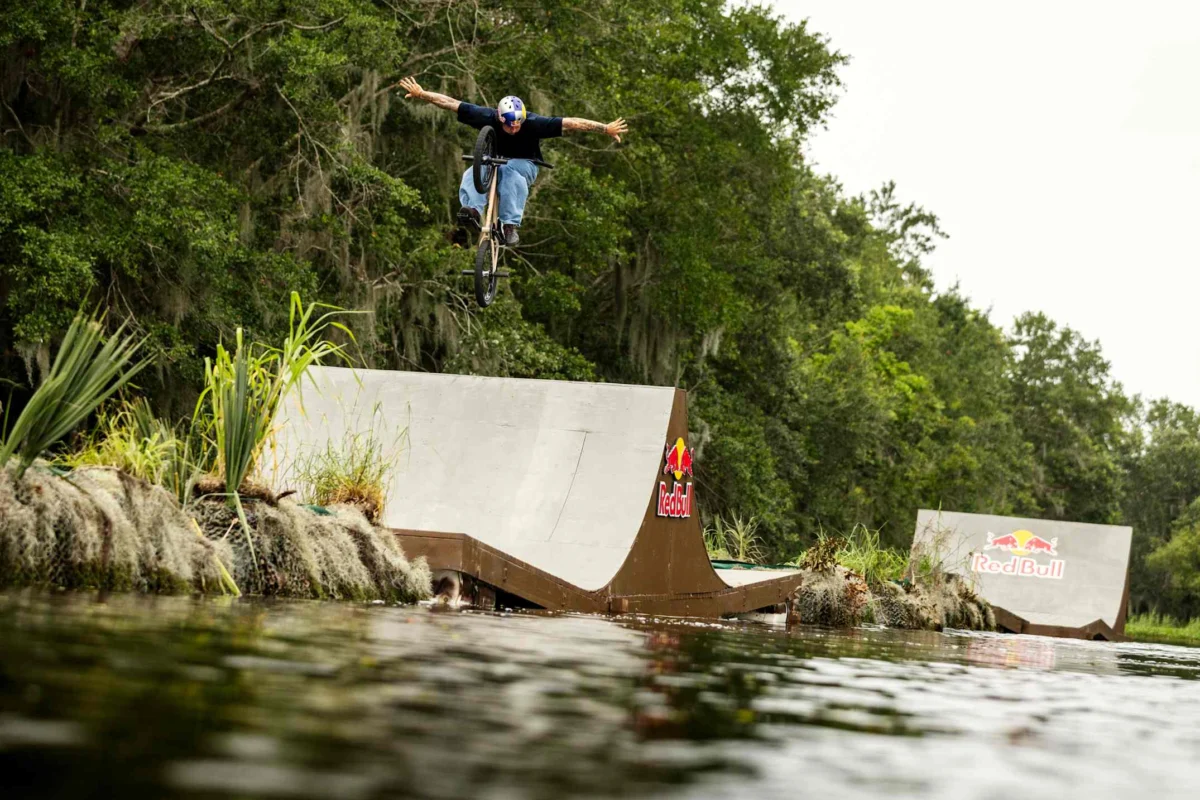
Southern Louisiana’s Jean Lafitte Wetlands, a sprawling expanse of bayous and cypress swamps, recently served as the unprecedented stage for a groundbreaking feat in action sports: the creation and successful navigation of a fully floating BMX course. Red Bull athlete Broc Raiford, a native of the region, transcended the conventional boundaries of BMX, typically a sport tethered to solid ground, by constructing a complex sequence of ramps, rails, and "lily pads" on the water’s surface. This ambitious project, dubbed "BMX on the Bayou," represents not only a remarkable engineering challenge but also a profound personal triumph for the 32-year-old rider, marking a significant milestone in his recovery from a severe career-threatening injury.
A Vision Rooted in the Bayou: The Genesis of an Extraordinary Concept
For Broc Raiford, the wetlands of Louisiana are more than just a backdrop; they are an intrinsic part of his identity. Growing up in Destrehan, just outside New Orleans, the unique biome surrounding his home fueled a long-held dream of interacting with this environment in a way only he could envision. For years, Raiford harbored the idea of integrating his passion for BMX with the ethereal landscape of the bayou, imagining what it would be like to ride through the labyrinthine waterways on a custom-built, floating setup. This long-standing vision began to materialize into a concrete plan, moving from speculative concept to an actionable engineering challenge.
The initial validation of this audacious idea came in 2025. Raiford and his dedicated crew undertook a preliminary test, deploying three floating lily pads into the wetlands. This pilot project was crucial for assessing the feasibility of the concept, evaluating buoyancy, stability, and the practicalities of constructing modular elements on water. The successful outcome of this initial phase provided the necessary proof-of-concept, paving the way for the development of a much larger, more intricate course. The data gathered from the 2025 test, including observations on water currents, material performance, and anchoring techniques, proved invaluable in scaling up the ambition to a full-fledged, multi-element BMX park.
Engineering an Unstable Playground: Course Design and Construction in Detail
The full "BMX on the Bayou" course was a marvel of temporary aquatic engineering, meticulously designed to withstand the dynamic forces of the wetland environment while providing a functional and challenging platform for high-level BMX riding. The final configuration comprised a total of five custom-built floating lily pads, acting as central platforms, interconnected with various traditional BMX obstacles adapted for water. These included two quarter pipes, offering opportunities for aerial maneuvers, a spine ramp for transfers and transitions, a flat bar specifically designed to connect different docks, and a hip transfer section, allowing for directional changes and creative lines.
The construction of such a course in the Jean Lafitte Wetlands presented a unique set of logistical and engineering hurdles. Each component had to be designed for optimal buoyancy and stability, utilizing materials that were durable enough for the elements yet environmentally conscious. The core challenge lay in preventing the entire setup from drifting apart in the slow but persistent currents of the bayou. This was achieved through a sophisticated system of anchoring and interconnecting the various modules. Specialized mooring lines and subsurface anchors were employed to secure the larger docks and lily pads, while robust lashing systems ensured that the ramps and rails remained firmly attached to their floating bases. The modular design allowed for precise placement and adjustment, a critical factor in a dynamic aquatic setting. Engineers and fabricators worked closely with Raiford to translate traditional BMX dimensions and angles into floating structures, accounting for the inherent instability of the water. This meant meticulous calculations for weight distribution, load bearing, and wave absorption, ensuring that the structures could support the impact of a rider and bike performing complex tricks.
The Unprecedented Riding Challenge: Adapting to the Water’s Rhythm
Riding a BMX course where every landing shifts and every takeoff behaves unpredictably introduces an entirely new dimension of difficulty to a sport already defined by precision and control. For Raiford, this meant a complete re-evaluation of his riding technique. Unlike concrete parks or dirt tracks, where surfaces are static and predictable, the floating nature of the bayou course demanded an extraordinary level of adaptive control.

Raiford reportedly spent approximately an hour on the course simply learning its rhythm before attempting any complex tricks. This initial period was dedicated to understanding the subtle movements of each element: the gentle sway of the lily pads, which offered a relatively consistent but still mobile platform, contrasted sharply with the ramps mounted to docks. These docks were particularly challenging as their height and angle could change minutely with the water’s undulations, requiring instantaneous adjustments in balance, timing, and power delivery. The consequence of a miscalculation was not just a fall, but a plunge into the murky waters of the bayou, adding an additional layer of psychological pressure. Riders typically rely on muscle memory built on consistent surfaces; this project forced Raiford to develop a new form of "aquatic muscle memory," adapting to a constantly evolving terrain. The successful linking of the entire course required an unparalleled fluidity and improvisation, turning a series of unstable obstacles into a coherent, rideable line. This demanded a complete mastery of bike control, where every pump, carve, and jump had to account for the potential for movement beneath the wheels.
A Personal Triumph: Recovery, Resilience, and Redefinition
Beyond its innovative engineering and athletic demands, "BMX on the Bayou" carries profound personal significance for Broc Raiford. The project served as a powerful capstone to a rigorous two-year journey of recovery and rehabilitation following a devastating injury suffered in 2023. While competing at the X Games in Japan, Raiford endured a severe knee injury, tearing his anterior cruciate ligament (ACL) and patellar tendon, alongside significant damage to his meniscus, lateral collateral ligament (LCL), and femoral cartilage. Such an injury, particularly for an athlete whose career relies on explosive power and precise impact absorption, is often career-ending.
Raiford’s path back to competitive form involved two extensive surgeries and a grueling, protracted rehabilitation period spanning nearly two years. This phase was not merely about rebuilding physical strength; it was also about painstakingly reconstructing his confidence, overcoming the mental scars of such a severe setback. Returning to BMX after such an injury is a monumental task, but attempting it on a floating, unstable course pushed the boundaries of recovery and mental fortitude even further. The project asked Raiford to do something uniquely difficult: repeatedly land on moving targets, maintain composure, and execute complex maneuvers, all while linking together an entire course. This was a true test of his rebuilt knee’s stability and his mind’s resilience. For Raiford, the bayou project was not just a return to the sport; it was a redefinition of what was possible, a powerful statement of his unwavering dedication and ability to transcend adversity. It transformed his personal comeback into a public demonstration of human tenacity.
Environmental Stewardship in the Jean Lafitte Wetlands
The decision to construct such a unique project within the Jean Lafitte Wetlands necessitated a rigorous approach to environmental stewardship. The Jean Lafitte National Historical Park and Preserve, along with other state and federal agencies such as the Louisiana Department of Wildlife and Fisheries and the U.S. Army Corps of Engineers, uphold stringent regulations to protect this vital ecosystem. While specific permits and consultations were not detailed in the original brief, it is standard practice for projects of this scale and nature to undergo comprehensive environmental impact assessments and secure necessary permissions.
It can be inferred that Raiford’s team, likely in collaboration with Red Bull’s production arm, implemented a detailed plan to minimize ecological disruption. This would typically include:
- Material Selection: Using environmentally benign or inert materials for construction where possible, or materials that could be fully recovered.
- Construction Methodology: Employing techniques that limit disturbance to the sensitive wetland floor and vegetation. This might involve using specialized shallow-draft boats or temporary platforms for assembly.
- Waste Management: A strict protocol for preventing any debris or waste from entering the water, ensuring all materials were accounted for and removed upon project completion.
- Wildlife Protection: Adhering to guidelines to avoid disturbing local wildlife, particularly protected species native to the bayou, such as alligators, various bird species, and aquatic life.
- Restoration: A plan for complete and thorough removal of all course elements, leaving the wetlands in their original, undisturbed state.
The careful execution of "BMX on the Bayou" within such a sensitive natural environment serves as an example of how extreme sports projects can potentially coexist with ecological preservation, provided that meticulous planning and adherence to environmental guidelines are paramount.
Collaboration and Production: Bringing the Vision to Life
The scale and ambition of "BMX on the Bayou" necessitated a significant collaborative effort, with Red Bull playing a pivotal role as both a sponsor and a production partner. Known for supporting innovative and boundary-pushing athletic endeavors, Red Bull’s involvement provided the resources, expertise, and global platform required to transform Raiford’s dream into a tangible reality and a compelling narrative.

The team involved in this project extended far beyond Raiford himself. It included a diverse group of professionals:
- Engineers and Fabricators: Tasked with designing, constructing, and ensuring the structural integrity and buoyancy of the floating course elements.
- Construction Crew: Responsible for assembling and deploying the course in the wetland environment.
- Logistics and Safety Personnel: Managing the complex operations in a remote, aquatic setting, including emergency response and water safety.
- Film and Photography Crew: Capturing the athletic feat and the stunning visual narrative of the project. Filming in a wetland environment, often with challenging light and unpredictable weather, requires specialized equipment and experienced cinematographers.
- Environmental Consultants: Ensuring compliance with local regulations and minimizing ecological impact.
The resulting documentation of the project, likely a high-quality film or video series, plays a crucial role in its broader impact. It not only showcases Raiford’s incredible athletic achievement and personal journey but also highlights the meticulous planning, engineering ingenuity, and the unique beauty of the Louisiana wetlands. This content reaches a global audience, inspiring other athletes and enthusiasts while subtly drawing attention to the natural wonders of the region.
Broader Implications for Action Sports and Beyond
"BMX on the Bayou" is more than just an impressive stunt; it carries significant implications for the future of BMX, action sports, and the creative integration of human endeavors with natural environments.
-
Innovation in BMX: The project fundamentally challenges the traditional perception of BMX as an urban or dirt-bound sport. By successfully constructing and riding a complex course on water, Raiford has expanded the conceptual boundaries of where and how BMX can be performed. This could inspire other athletes and course designers to explore unconventional locations and materials, fostering a new wave of innovation within the sport. It demonstrates a radical departure from the standard skate park or trail, proving that the sport’s principles of balance, control, and agility can be applied to virtually any stable (or in this case, semi-stable) surface.
-
Athlete Resilience and Narrative: Broc Raiford’s journey from a devastating injury to conquering this unprecedented challenge reinforces a powerful narrative of resilience, determination, and the human spirit’s capacity to overcome adversity. His story serves as a profound inspiration, not just within the action sports community but more broadly, demonstrating how personal challenges can be channeled into extraordinary achievements.
-
Environmental Integration and Responsible Exploration: The project highlights the potential for extreme sports to engage with natural landscapes in innovative ways, provided that environmental considerations are at the forefront of planning and execution. It sets a precedent for how such projects can be undertaken responsibly, with respect for sensitive ecosystems, potentially opening doors for similar endeavors in other unique natural settings around the world. It prompts a dialogue about how to balance the desire for unique athletic expression with the imperative of ecological preservation.
-
Cross-Disciplinary Inspiration: The engineering challenges overcome in "BMX on the Bayou" could inspire cross-disciplinary innovations. Techniques developed for floating structures in dynamic water environments might find applications in other fields, from temporary event staging to disaster relief infrastructure.
-
Elevating the Profile of Wetlands: By showcasing the Jean Lafitte Wetlands in such a dramatic and visually compelling way, the project indirectly raises awareness about these crucial ecosystems. It presents them not just as conservation areas but as living, dynamic landscapes capable of inspiring human creativity and athletic endeavor.
The finished project stands as a testament to years of dreaming, months of meticulous building, and one very unconventional, yet profoundly successful, BMX session in the heart of the Louisiana wetlands. Broc Raiford’s "BMX on the Bayou" is etched into the annals of action sports as a singular achievement, blending athletic prowess, engineering ingenuity, and an unwavering connection to home.
