

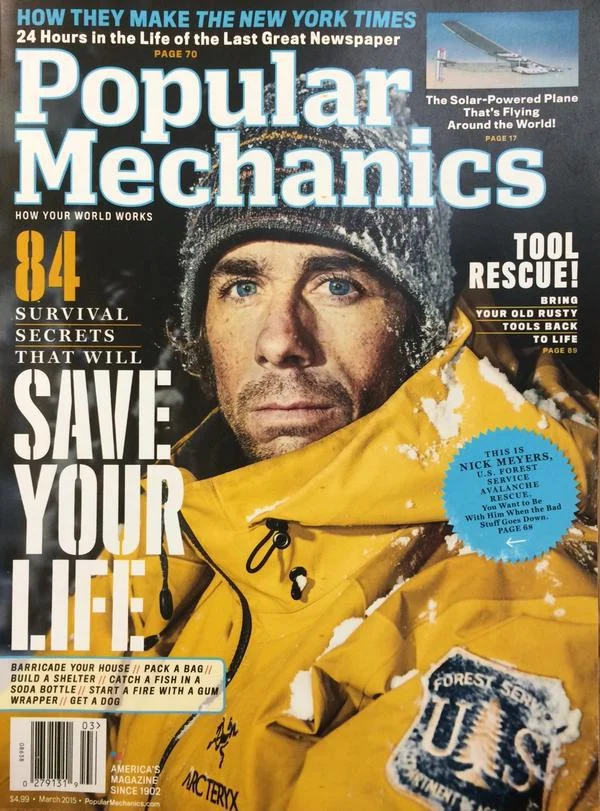
Nick Meyers, the Director of the Mount Shasta Avalanche Center and the Lead Climbing Ranger for the Shasta-Trinity National Forest, has achieved national recognition for his expertise in mountain safety and rescue operations through a featured cover story in Popular Mechanics magazine. The publication, which focuses on the intersection of science, technology, and practical application, selected Meyers to illustrate the rigorous demands of avalanche forecasting and the critical equipment required for survival in extreme alpine environments. This high-profile media coverage underscores the increasing importance of specialized mountain safety programs as backcountry recreation continues to grow in popularity across the United States.
The feature, titled "10 Survival Essentials an Avalanche Rescue Expert Always Carries," serves as both a profile of Meyers’ professional life and a technical guide for outdoor enthusiasts. By highlighting Meyers, Popular Mechanics brings attention to the specialized skill sets required to manage the risks associated with Mount Shasta, a 14,179-foot stratovolcano known for its volatile weather patterns and complex snowpack. The recognition of a USDA Forest Service professional on a national stage emphasizes the federal government’s role in public safety and environmental stewardship in high-risk recreational areas.
The Professional Trajectory of Nick Meyers
Nick Meyers has served as a cornerstone of the Mount Shasta climbing and safety community for nearly two decades. His dual role as Lead Climbing Ranger and Director of the Mount Shasta Avalanche Center (MSAC) requires a unique combination of physical endurance, technical mountaineering skill, and scientific analytical capability. As the Lead Climbing Ranger, Meyers is responsible for overseeing search and rescue (SAR) operations on the mountain, maintaining climbing routes, and interacting with the thousands of climbers who attempt to summit the peak annually.
Under his leadership at the MSAC, the center has expanded its reach and technical capabilities. The MSAC provides daily avalanche forecasts during the winter and spring months, offering critical data on snow stability, weather trends, and hazard levels. Meyers’ transition from a field ranger to a director-level position reflects a career dedicated to understanding the mechanics of snow and the psychology of human decision-making in high-stress environments. His appearance on the cover of Popular Mechanics is a culmination of this expertise, positioning him as a leading voice in the field of North American avalanche safety.
Technical Analysis of Avalanche Survival Gear
The Popular Mechanics feature focuses heavily on the "essentials" that Meyers utilizes during his rotations on Mount Shasta. This list is not merely a suggestion for hobbyists but represents the professional standard for those working in "avalanche country." The technical equipment discussed includes:
- Avalanche Transceivers: Modern digital beacons that allow rescuers to locate buried individuals through electromagnetic signals.
- Probes and Shovels: Collapsible tools designed for rapid deployment to pinpoint and excavate victims from high-density snow.
- Communication Devices: Satellite-linked messengers and high-frequency radios necessary for coordinating rescues in areas without cellular coverage.
- Navigation Tools: GPS units and topographic maps that remain functional in whiteout conditions.
- First Aid and Survival Kits: Specialized medical supplies tailored for trauma and hypothermia management.
Meyers emphasizes that while technology has improved significantly, the most important tool remains the user’s ability to interpret environmental data. The article highlights that gear is a secondary defense; the primary defense is the professional forecasting and risk assessment that Meyers and his team perform daily.
The Geographic and Meteorological Challenges of Mount Shasta
To understand the significance of Meyers’ work, one must consider the environment of the Shasta-Trinity National Forest. Mount Shasta is not part of a continuous range like the Rockies; it is an isolated peak that rises abruptly from the surrounding terrain. This isolation subjects the mountain to "orographic lifting," where moist air from the Pacific Ocean is forced upward, leading to massive snowfall and extreme wind speeds.
The mountain’s topography—featuring deep glacial cirques and steep volcanic ridges—creates a variety of avalanche trigger points. Meyers and his team must monitor different aspects (the direction a slope faces) to account for solar warming and wind-loading, both of which can lead to catastrophic slab avalanches. The data collected by the MSAC is vital because Mount Shasta attracts a diverse range of users, from world-class mountaineers to casual hikers, many of whom may not be aware of the invisible risks beneath the snow surface.
Historical Context and the Evolution of the MSAC
The Mount Shasta Avalanche Center was established to mitigate the rising number of accidents on the mountain. Historically, Mount Shasta has seen numerous fatalities and near-misses due to avalanches and falls. The formalization of the center allowed for a systematic approach to safety, moving from reactive rescue operations to proactive public education.
Since its inception, the MSAC has transitioned through several stages of technological integration. In the early years, data collection was manual and dissemination was limited to physical bulletin boards. Today, under Meyers’ direction, the center utilizes remote weather stations, automated snow sensors, and digital platforms to provide real-time updates to the public. The partnership between the USDA Forest Service and the non-profit "Friends of the Mount Shasta Avalanche Center" (FMSAC) has also been instrumental in securing the funding necessary for these technological advancements.
Supporting Data: Avalanche Trends and Public Safety
The relevance of Meyers’ feature in Popular Mechanics is supported by national statistics regarding winter recreation. According to data from the Colorado Avalanche Information Center (CAIC), which tracks national trends, the number of people venturing into the backcountry has increased by over 200% in certain regions over the last decade. While equipment sales have spiked, the level of education among new participants has not always kept pace.
- National Statistics: On average, 27 people die in avalanches each year in the United States.
- Rescue Success Rates: If a victim is recovered within 15 minutes, the survival rate is approximately 90%. After 35 minutes, that rate drops to 30%.
- Economic Impact: Search and rescue operations can cost taxpayers tens of thousands of dollars per incident, highlighting the economic value of preventative programs like the MSAC.
Meyers’ work directly impacts these statistics by providing the education necessary to prevent incidents before they occur. The Popular Mechanics article serves as a mass-media extension of this educational mission.
Institutional and Community Reactions
The recognition of Nick Meyers has been met with widespread approval from both the Forest Service and the local community of Mount Shasta. Representatives from the Shasta-Trinity National Forest have noted that such national exposure validates the hard work of the entire ranger district. It also brings attention to the "Lead Climbing Ranger" program, which serves as a model for other national parks and forests.
Local outdoor retailers and guide services have also expressed that Meyers’ visibility helps emphasize the "safety first" culture they strive to promote. By being featured in a magazine that reaches millions of readers, Meyers has effectively become an ambassador for the region, highlighting Mount Shasta as a premier, yet serious, mountaineering destination.
Analysis of Broader Implications for Outdoor Safety
The feature of an avalanche expert on the cover of a mainstream technology and mechanics magazine indicates a shift in public interest toward technical outdoor skills. It suggests that the general public is increasingly interested in the "how" and "why" of survival, rather than just the spectacle of the sport.
For the Forest Service, this coverage is a powerful tool for recruitment and public relations. It showcases the professional and scientific nature of the agency’s work, moving beyond the stereotypical image of a park ranger to one of a highly trained technical expert. Furthermore, it highlights the necessity of federal funding for avalanche centers. As climate change leads to more erratic weather patterns and "atmospheric river" events in California, the expertise of individuals like Meyers will become even more critical in predicting and managing mountain hazards.
Conclusion and Future Outlook
Nick Meyers’ appearance on the cover of Popular Mechanics is more than a personal accolade; it is a significant moment for the field of avalanche science and mountain rescue. By distilling years of experience into accessible survival essentials, Meyers provides a service to the broader public that extends far beyond the slopes of Mount Shasta.
As the Director of the Mount Shasta Avalanche Center, Meyers continues to oversee the evolution of safety protocols and the integration of new technologies into the field. The attention garnered from this national feature is expected to drive more visitors to the MSAC website and increase participation in avalanche safety courses. In an era where more people are seeking solace in the wilderness, the work of Nick Meyers and his team stands as a vital barrier between adventure and tragedy, ensuring that the majesty of Mount Shasta can be experienced with the respect and caution it demands.
