

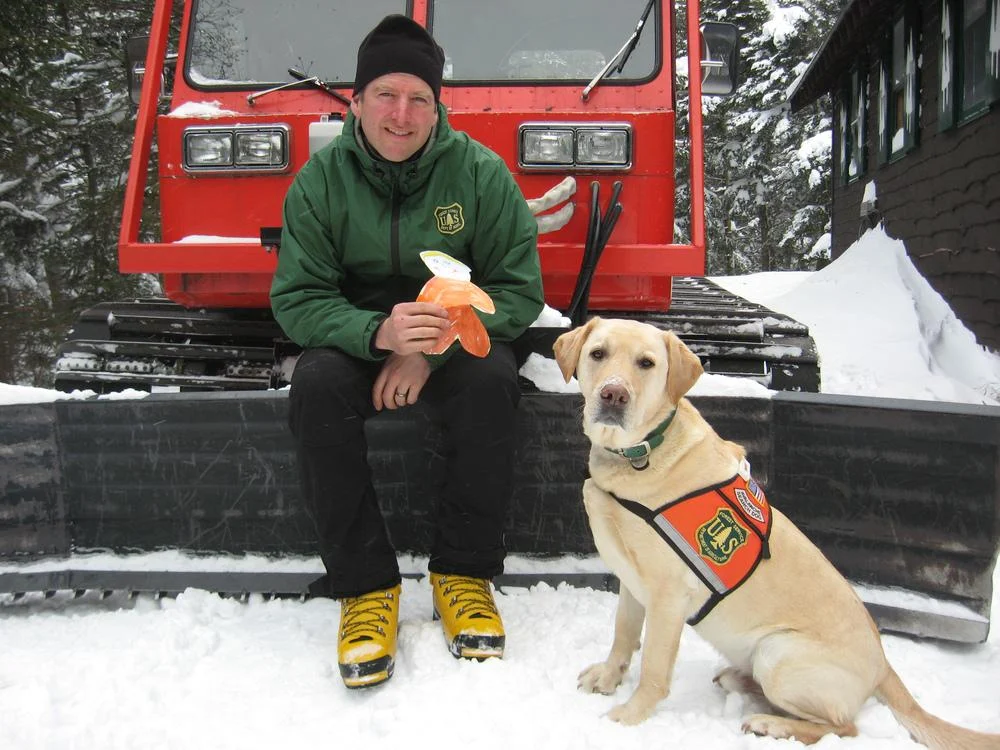
The Mount Washington Avalanche Center (MWAC) and the broader search and rescue community of the White Mountain National Forest are mourning the loss of Cutler, a dedicated avalanche rescue dog who served as a cornerstone of mountain safety for over a decade. Cutler, who passed away at the age of 14, spent 11 years—nearly 80% of his life—on the rugged slopes of the Presidential Range, working alongside his handler and the Director of the Mount Washington Avalanche Center, Chris Joosen. His career was defined not only by his technical proficiency in locating subjects buried under snow but also by his unique ability to serve as a bridge between the United States Forest Service and the thousands of winter recreationists who visit the White Mountains annually.
A Career Dedicated to the Presidential Range
Cutler’s tenure at the Mount Washington Avalanche Center spanned a period of significant growth in winter backcountry use. Throughout his 11 years of service, he became a familiar sight in the high-alpine terrain of Tuckerman Ravine and Huntington Ravine, areas known for their extreme weather and high avalanche potential. In the context of the White Mountain National Forest, which encompasses nearly 800,000 acres across New Hampshire and Maine, the presence of a specialized K9 unit is a critical component of the Forest Service’s emergency response infrastructure.
Mount Washington is frequently cited as having some of the most treacherous winter conditions in the world. With recorded wind speeds exceeding 230 miles per hour and rapid temperature fluctuations, the margin for error for hikers, skiers, and climbers is razor-thin. Cutler’s role was to provide a rapid-response capability that human rescuers simply cannot replicate. In the event of an avalanche, the first 15 to 30 minutes are the most critical for the survival of a buried victim. While a human "probe line" of 20 rescuers can take hours to search a one-hectare area, a trained avalanche dog like Cutler can sweep the same area in approximately 20 to 30 minutes, using a sense of smell that is tens of thousands of times more sensitive than a human’s.
The Chronology of a Working Life
Cutler’s journey began with intensive training designed to prepare him for the high-stress environment of the Presidential Range. Avalanche dogs are typically introduced to the snow as puppies, learning to associate the scent of human beings under the snow with the reward of play and positive reinforcement. By the time he reached full operational status, Cutler was capable of working in sub-zero temperatures and gale-force winds, often being transported via snowcat or helicopter to reach accident sites.
Over his 11 years of active duty, Cutler’s schedule mirrored the seasonal rhythms of the mountain. From late autumn until the final snows of June, he was stationed at the Hermit Lake Shelters or the Pinkham Notch Visitor Center, ready to deploy at a moment’s notice. His career saw him through numerous "avalanche cycles"—periods of high instability where the risk to the public is at its peak.
In his later years, as is common with working K9s in high-altitude environments, Cutler transitioned into a more emeritus role, focusing heavily on education and public relations before his eventual retirement. His passing at age 14 marks the end of an era for the MWAC, as he was one of the most long-serving and recognizable K9s in the history of the program.
Supporting Data: The Statistics of Mountain Rescue
The importance of dogs like Cutler is underscored by the statistics of the region. The Mount Washington Avalanche Center issues daily advisories for Tuckerman and Huntington Ravines, where the "Special Use" areas see heavy traffic. On a single spring weekend, Tuckerman Ravine can see upwards of 2,000 to 3,000 visitors.
According to historical data from the American Avalanche Association and the Forest Service:
- Survival Rates: A victim buried in an avalanche has an 80% to 90% chance of survival if recovered within 15 minutes. This drops to 30% after 35 minutes, primarily due to asphyxiation.
- Search Efficiency: One avalanche dog can do the work of approximately 30 to 50 human searchers in a fraction of the time.
- Incident Volume: New Hampshire’s White Mountains account for a significant portion of avalanche incidents in the Eastern United States, necessitating a permanent and professional K9 presence.
Cutler’s 11-year career contributed to a period of heightened safety awareness. During his time on the mountain, the MWAC saw an increase in the adoption of safety gear, such as beacons, probes, and shovels, among the public—a trend that Cutler himself helped facilitate through his public appearances.
Public Relations and the "Cutler Effect"
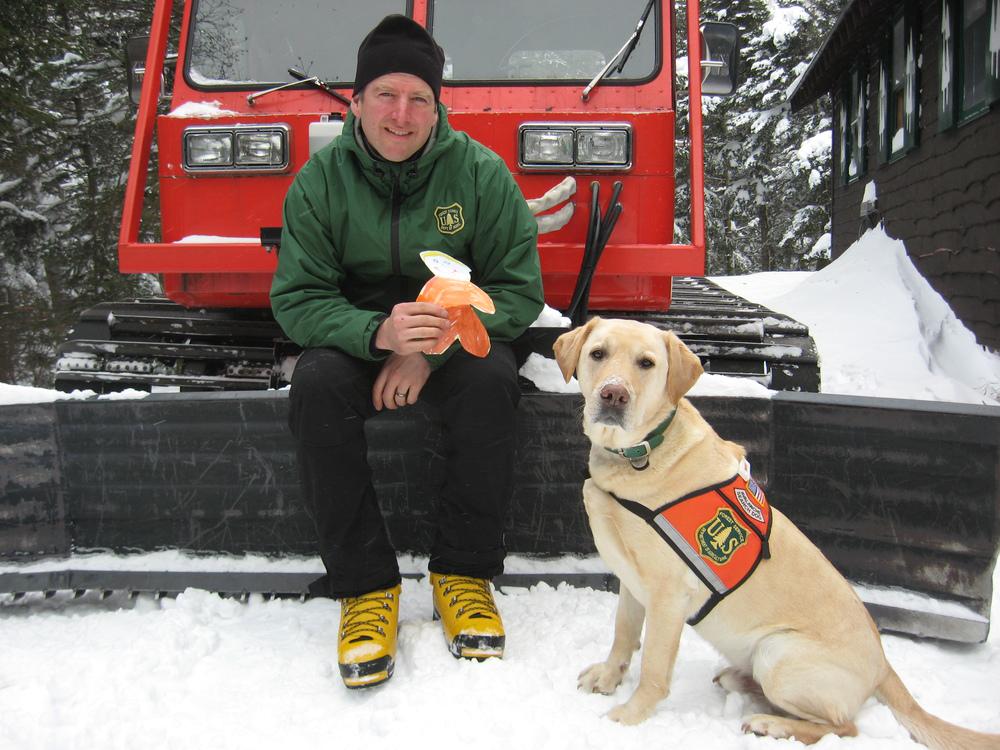
Beyond the technical aspects of search and rescue, Cutler excelled in a role that is often undervalued in emergency services: public relations. For many visitors, the Snow Rangers of the U.S. Forest Service can appear as authoritative figures primarily concerned with enforcement. Cutler changed that dynamic.
As Chris Joosen noted in his reflections on Cutler’s life, the dog acted as a "social lubricant," making the Snow Rangers more approachable. When people stopped to pet Cutler, it provided a natural opening for Joosen and other rangers to discuss the day’s avalanche forecast, the stability of the snowpack, and the necessity of proper equipment. This "Cutler Effect" allowed the MWAC to reach a demographic of younger or less experienced backcountry users who might otherwise have avoided interaction with officials.
Educational outreach is the primary tool for avalanche fatality prevention. By humanizing the rescue team, Cutler directly contributed to the MWAC’s mission of "education through observation." His presence at trailheads and in the ravines served as a living reminder of the stakes involved in mountain travel, while his calm demeanor provided a sense of security to those navigating the often-intimidating terrain of Mount Washington.
Official Responses and Handler Reflection
Chris Joosen, the Director of the Mount Washington Avalanche Center and Cutler’s handler, shared a poignant tribute to his partner, highlighting the 14 years of companionship they shared. Joosen’s reflections emphasized that while Cutler was a professional asset to the Forest Service, he was also a member of the family and a loyal companion who thrived in the harsh beauty of the White Mountains.
The Mount Washington Snow Rangers and the White Mountain National Forest staff have expressed their gratitude for Cutler’s service. In internal communications and public blog posts, the sentiment remains the same: Cutler was a "good boy" who did a "great job." The bond between a handler and an avalanche dog is unique; they must trust one another implicitly in life-and-death situations. Joosen’s ability to read Cutler’s body language—identifying the difference between a "scent hit" and a mere distraction—was the result of thousands of hours of training and field experience.
Broader Impact and the Future of K9 Units
The legacy of Cutler extends beyond the borders of New Hampshire. His career serves as a case study for the effectiveness of K9 units in smaller, high-traffic mountain ranges. While the massive peaks of the Western United States often dominate the conversation regarding avalanche safety, the Presidential Range presents unique challenges, including higher visitor density and more frequent "ice-crust" layers in the snowpack.
Cutler’s success has reinforced the commitment of the Mount Washington Avalanche Center to maintain a K9 program. The training protocols and public engagement strategies developed during his 11-year tenure will serve as a blueprint for future rescue dogs and their handlers.
Furthermore, Cutler’s passing highlights the psychological benefits of SAR dogs for the rescuers themselves. Search and rescue operations are often grueling and emotionally taxing. The presence of a dog like Cutler provides a source of morale and stress relief for the human members of the team, who must often work in "recovery" rather than "rescue" mode.
Conclusion: A Legacy Carved in Granite
As the winter winds continue to scour the ridges of Mount Washington, the impact of Cutler’s service remains. He was more than just a search tool; he was a symbol of the dedication required to keep the White Mountains accessible and safe. His 14-year life, 11 of which were spent in the service of others, stands as a testament to the enduring partnership between humans and dogs in the world’s most unforgiving environments.
The Mount Washington Avalanche Center will continue its work, issuing forecasts and patrolling the ravines, but the absence of the "four-legged ranger" will be felt by the local community and the thousands of hikers who once crossed his path. Cutler’s story is a reminder that in the face of nature’s volatility, sometimes the most effective technology we have is a wet nose, a wagging tail, and an unbreakable spirit of service. Through his rescue work and his ability to educate the public, Cutler saved lives—some through direct intervention and many more through the simple act of a friendly encounter on a snowy trail. He leaves behind a mountain that is safer, better informed, and deeply grateful for his 11 years of watch.
