

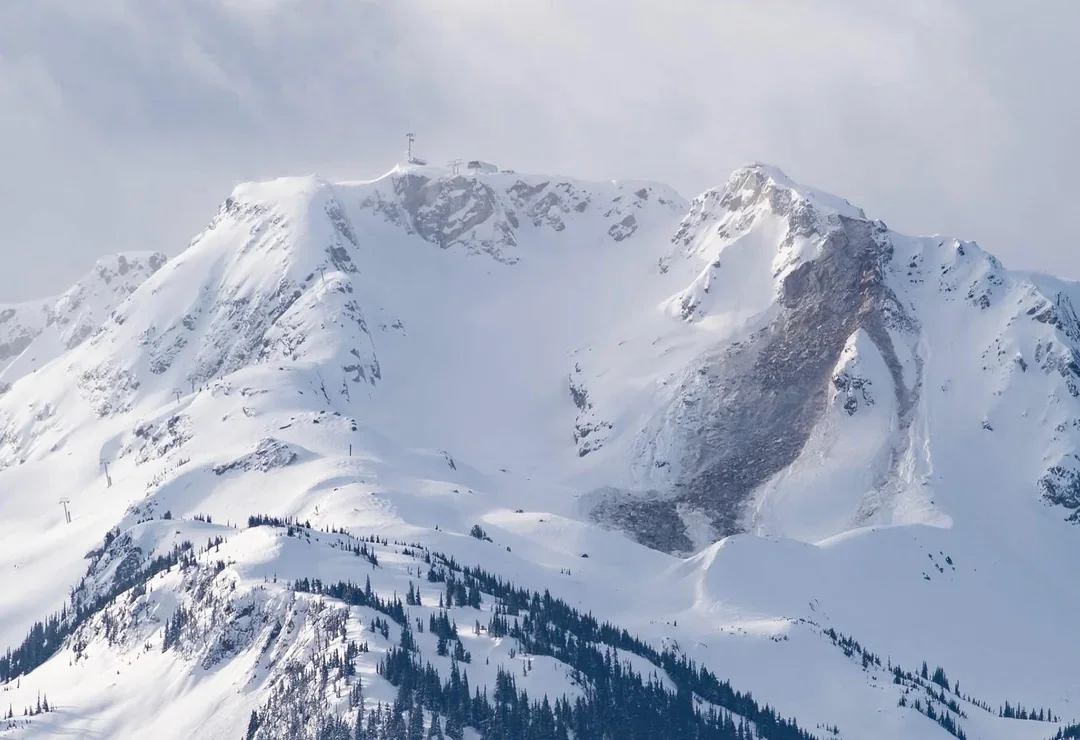
A significant geological event has reshaped a portion of Whistler Blackcomb, Canada’s largest ski resort, with a substantial rockslide occurring on Thursday morning. The approximately 100-meter wide rockfall originated from the ridge between the West Cirque and Monday’s, two of the resort’s most challenging expert terrain areas. This dramatic event has led to the immediate and indefinite closure of the Peak Express Chair, severing access to the highest alpine reaches of the mountain. Resort officials and geological experts are now undertaking a thorough assessment of the affected slopes to ensure the safety of both staff and, eventually, the public.
The incident, which occurred in the early hours of Thursday, has not resulted in any injuries, as the resort was not yet open to the public. The sheer scale of the rockslide, however, has fundamentally altered the landscape in a prominent and highly regarded part of Whistler Blackcomb’s skiable terrain. This event serves as a stark reminder of the dynamic and ever-changing nature of mountainous environments, even those that are heavily managed for recreational purposes.
Understanding the Geological Forces at Play
Experts point to a confluence of environmental factors as the primary drivers behind this rockslide, with frost wedging and thermal stress identified as the key culprits. The recent weather patterns at Whistler Blackcomb involved a significant period of heavy rainfall, followed by a rapid and deep drop in temperature. This cycle is particularly conducive to geological instability in alpine regions.
Frost wedging is a natural process where water seeps into existing cracks and fissures within rocks. When temperatures drop below freezing, this trapped water expands by approximately 9% as it turns to ice. This expansion exerts immense pressure on the surrounding rock, gradually widening the cracks over time. In mountainous environments, where rocks are subjected to freeze-thaw cycles, this process can weaken rock formations significantly.
Whistler Blackcomb’s summit temperatures reportedly plummeted to around -11 degrees Celsius (12 degrees Fahrenheit) in the lead-up to the rockslide. At these sub-zero temperatures, the ice expansion would have exerted thousands of pounds of pressure per square inch against the rock walls within the existing fractures. This relentless pressure, acting over potentially many freeze-thaw cycles, would have weakened the rock mass to a critical point.
Compounding the effects of frost wedging, the area experienced intense wind gusts, with speeds reportedly reaching up to 180 kilometers per hour (approximately 112 mph). These high winds would have stripped away any insulating snow cover from the exposed rock faces, leaving them more vulnerable to rapid temperature fluctuations. The exposed rock would then have been subjected to thermal shock – rapid changes in temperature – which can further exacerbate existing weaknesses and fractures, leading to eventual failure. The metamorphic rock common in the Coast Mountains, while generally robust, is not immune to these powerful natural forces when subjected to such extreme conditions.
Chronology of the Event and Initial Response
While the precise moment of the rockslide is difficult to pinpoint without direct on-site observation at the time of its occurrence, it is understood to have happened in the early hours of Thursday morning. The initial discovery of the rockfall would have been made by resort patrol during their pre-opening safety checks or through remote monitoring systems.
Upon confirmation of the rockslide’s magnitude and location, Whistler Blackcomb’s mountain operations team would have immediately enacted its emergency protocols. The highest priority was to confirm that no individuals were in the affected area, which was fortunately the case due to the timing of the event. Subsequently, the decision was made to close the Peak Express Chairlift to prevent any access to the unstable terrain and to safeguard against any potential secondary rockfalls.
The resort’s internal teams, likely including avalanche control specialists and ski patrollers with geological training, would have conducted an initial visual assessment of the slide path and the surrounding slopes. Recognizing the scale and the potential for ongoing instability, the resort would have also engaged external geological consultants. This collaborative approach is standard practice for such significant geological events in a resort environment.

The immediate focus for the mountain operations team would be to establish a safety perimeter and to gather more detailed information about the rockslide’s extent and the stability of the remaining slope. This would involve using specialized equipment and potentially aerial surveys to map the debris field and identify any loose or precarious rock formations.
Impact on Resort Operations and Access
The closure of the Peak Express Chairlift has a significant and immediate impact on Whistler Blackcomb’s operational capabilities and the experience it offers to advanced skiers and snowboarders. The Peak Express accesses the highest alpine terrain at the resort, renowned for its challenging chutes, bowls, and off-piste opportunities. This area is a significant draw for expert riders seeking steep descents and a true high-alpine experience.
The rockslide’s path directly affected key access routes and popular skiing zones. The debris field has fundamentally altered the topography, making the area impassable and unsafe for skiing until a comprehensive assessment and remediation plan can be implemented. The closure is not merely a temporary inconvenience; it signifies the loss of access to a substantial portion of the resort’s most demanding terrain.
For Whistler Blackcomb, the economic implications of such a closure, while secondary to safety, are also a consideration. The Peak Express is a critical component of the resort’s offering, particularly for its more adventurous clientele. The duration of the closure will depend entirely on the geological assessment and the time required to ensure the stability of the affected slopes.
Broader Implications and Future Considerations
This rockslide at Whistler Blackcomb underscores a growing concern in mountainous regions worldwide: the impact of climate change on geological stability. While frost wedging and thermal stress are natural processes, the increasing frequency and intensity of extreme weather events, such as rapid freezes after heavy rainfall and prolonged periods of fluctuating temperatures, can accelerate these processes.
As global temperatures continue to rise, mountain environments are experiencing more pronounced freeze-thaw cycles. This can lead to increased permafrost thaw in some areas, and in others, more extreme temperature swings at lower elevations, all of which can contribute to greater rockfall and landslide activity. Ski resorts, often situated in high-altitude, geologically active areas, are particularly susceptible to these changes.
The long-term implications for Whistler Blackcomb, and indeed for other mountain resorts, include the need for enhanced geological monitoring and potentially the adaptation of operational strategies. Resorts may need to invest in more sophisticated early warning systems, conduct more frequent and detailed geological surveys, and possibly re-evaluate the development of terrain in areas prone to instability.
The event also serves as a powerful educational moment, highlighting the raw power of nature and the importance of respecting the dynamic forces that shape our planet. While technology and engineering can mitigate some risks, the mountains ultimately remain wild and unpredictable. The altered landscape at Whistler Blackcomb is a testament to this enduring reality.
The resort’s commitment to safety will dictate the timeline for any reopening of the Peak Express Chair. This will involve a rigorous process of evaluation, likely including detailed geotechnical studies, to determine the stability of the slopes and to develop strategies for managing any residual risks. Until such a time, the highest alpine terrain at Whistler Blackcomb will remain silent, a striking reminder of the powerful geological forces at play. The resort’s ability to adapt to these changing environmental conditions will be crucial for its long-term sustainability and its capacity to offer safe and exhilarating experiences to its visitors. The focus remains on thoroughness and safety, ensuring that any future access to this iconic terrain is undertaken with the utmost confidence in its stability.
