

The winter of 1994/95 marked a distinct era for avalanche safety and backcountry recreation in the United States. At that time, the landscape of avalanche forecasting was nascent, with only a handful of dedicated avalanche centers operating across the nation. Knox Williams helmed the Denver Avalanche Center, Bruce Tremper was the leading figure at the Utah Avalanche Center, and Mark Moore directed efforts in Seattle. Further west, Jim Kanzler managed the Jackson Hole Avalanche Center, while Brad Ray led the program at Mount Washington. In Bozeman, Montana, a fledgling avalanche center, established just five years prior, was carving out its niche. Significant regions like the Chugach Mountains in Alaska, the Tahoe Basin, and Mount Shasta were notably absent from this network of formalized avalanche advisories.
The gear of the era also reflected a different approach to winter travel. Telemark skiing was the dominant form of backcountry skiing, often with participants utilizing leather boots, a stark contrast to the robust and user-friendly equipment available today. Snowmobiles, while present, were significantly less powerful, less mobile, and considerably heavier than their modern counterparts. Ski areas typically maintained strict closed-boundary policies, and the concept of "sidecountry" – terrain accessible from a resort but outside the ski area boundary – was not yet a widely recognized or utilized term. Furthermore, the internet, in its infancy, was just beginning to offer rudimentary access to information, with the first avalanche advisories appearing online only at the tail end of the 1994/95 winter season.
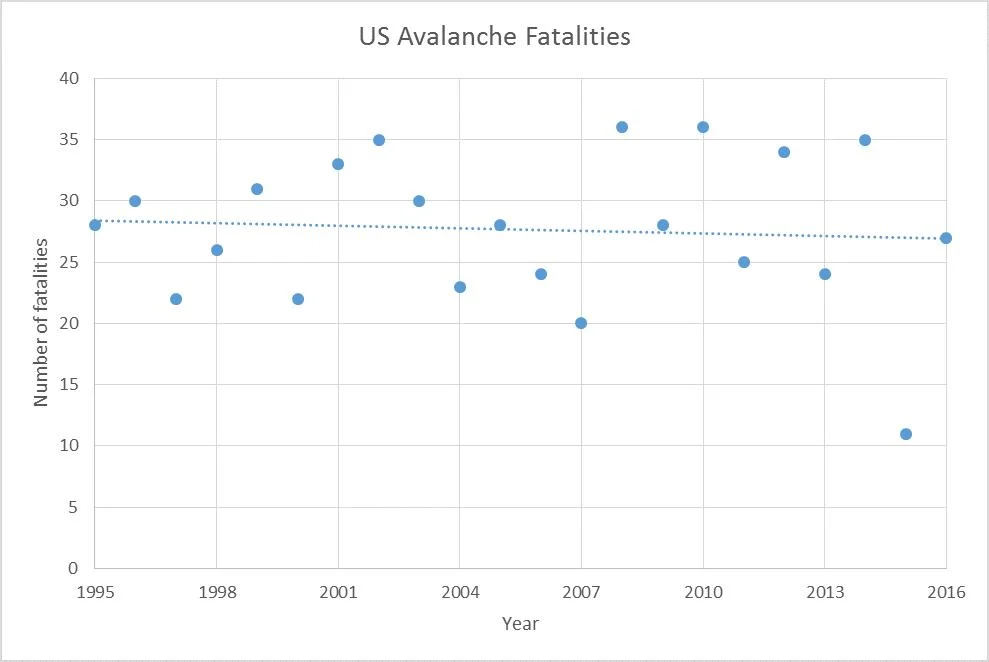
Against this backdrop of a less developed avalanche safety infrastructure and a smaller, more specialized group of backcountry users, a remarkable trend has emerged over the subsequent 22 seasons. Contrary to what one might expect given the dramatic evolution of outdoor recreation, the annual number of avalanche fatalities in the United States has remained remarkably stable. This data, compiled and analyzed by organizations like the Colorado Avalanche Information Center (CAIC), reveals a surprising resilience in safety outcomes despite a surge in participation and technological advancements.
The Data: A Flat Line of Fatalities
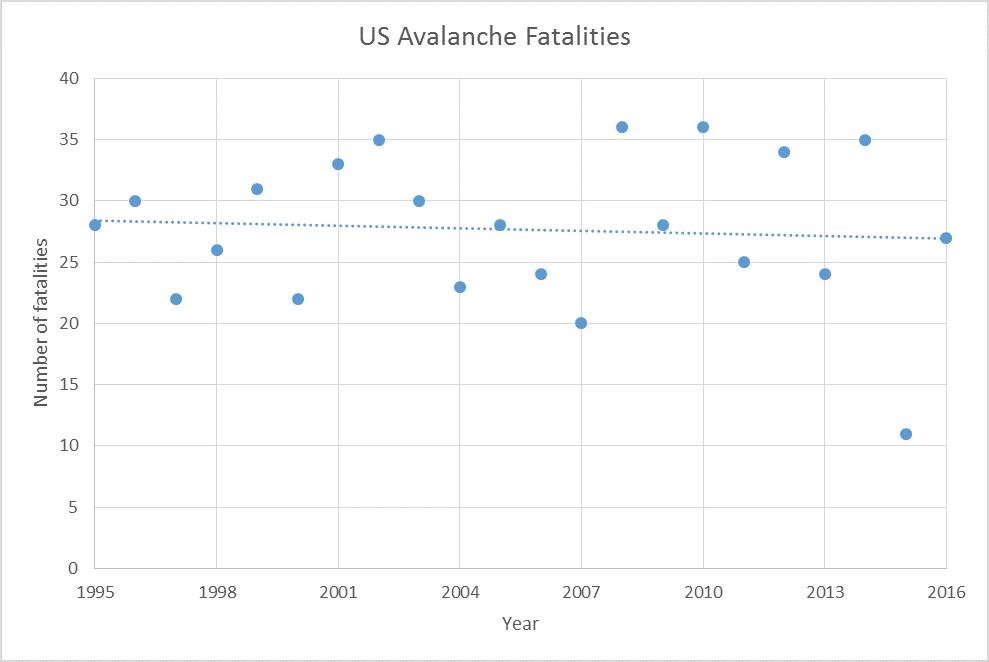
Analysis of avalanche incident data from the 1994/95 winter through the 2015/16 winter period presents a compelling narrative. Figure 1, illustrating U.S. avalanche fatalities over these 22 seasons, shows no statistically significant increase. A least squares trend line, while exhibiting a slight downward inclination, falls within the bounds of random variation, indicating no discernible upward or downward trajectory in overall fatalities. This suggests that as the nation transitioned into an era of smartphones, pervasive social media, lightweight touring (AT) gear, and significantly more powerful snowmobiles, the aggregate number of lives lost to avalanches has not escalated proportionally to the rise in backcountry activity.
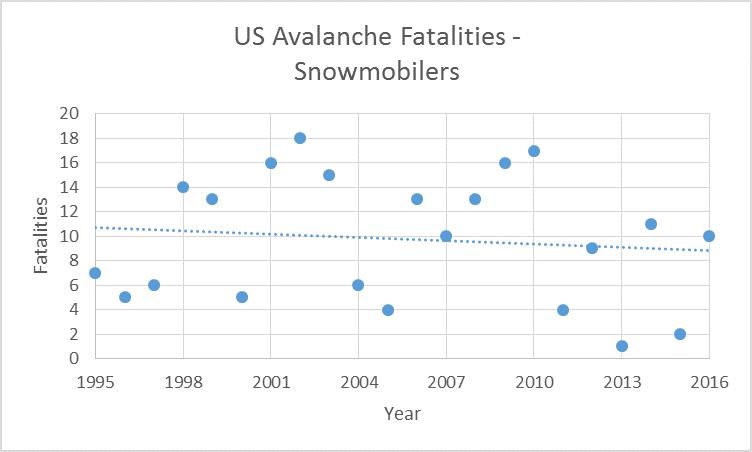
Interestingly, this stability extends to snowmobile-related avalanche fatalities as well. Figure 2 demonstrates that the number of snowmobilers killed in avalanches has also remained largely flat over the same 22-year period. While there’s a slight downward trend line, it too is not statistically significant, reinforcing the notion that the advancements in snowmobile technology and the increased accessibility of remote terrain have not translated into a greater number of avalanche deaths for this user group.
However, the data presents a more nuanced picture when examining backcountry skiers and snowboarders separately. Figure 3 indicates that while the trend is still relatively flat, there is some statistical evidence, with a p-value of 0.07, suggesting a slight, albeit marginal, increase in fatalities within this demographic. This subtle shift warrants further investigation and underscores the ongoing challenges in mitigating risk for this segment of the backcountry community.
The Backcountry Boom: A Quantifiable Surge in Participation
The stability in avalanche fatalities takes on profound significance when juxtaposed with the exponential growth in backcountry use over the past two decades. While precise, comprehensive data on dispersed winter recreation is inherently challenging to collect, proxy indicators provide compelling evidence of this surge. Avalanche advisory usage, a direct measure of how many people are actively seeking critical safety information, paints a dramatic picture.
The Utah Avalanche Center, for instance, has reported a twelvefold increase in advisory usage over the 22-season period. The Colorado Avalanche Information Center has experienced an even more significant seventeenfold increase. The Gallatin National Forest Avalanche Center has seen a staggering thirty-sixfold rise, and the Northwest Avalanche Center has witnessed a remarkable sixtyfold increase in advisory engagement. While it is acknowledged that the ease of digital access to advisories contributes to some of this increase, the sheer scale of growth undeniably reflects a substantially larger number of individuals venturing into avalanche-prone terrain.
The Dramatic Decline in Fatality Rate: A Success Story
Assuming a conservative estimate that backcountry use has increased by at least eightfold over the past 22 years, and combining this with the observed flat trend in overall avalanche fatalities, the conclusion is undeniable: the avalanche fatality rate per backcountry user day has plummeted. This implies that the risk of dying in an avalanche, relative to the number of people recreating in the backcountry, has decreased by at least a factor of eight, and likely more. Without these safety advancements and educational efforts, a simple proportional increase in fatalities, given the surge in use, could have theoretically resulted in over 200 avalanche fatalities per winter season. This projection highlights the profound impact of the evolving safety paradigm.
Pillars of Success: Education, Technology, and Information Dissemination
The consistent number of avalanche fatalities in the face of escalating backcountry use is not a matter of chance. It is a testament to the concerted efforts of a dedicated community and the successful implementation of multifaceted safety strategies.
Avalanche Education: A significant driver of this positive trend is the widespread expansion and enhancement of avalanche education programs. From professional avalanche courses offered by organizations like the American Institute for Avalanche Research and Education (AIARE) and the National Avalanche School, to crucial awareness programs like "Know Before You Go" targeted at a broader audience, the reach and effectiveness of avalanche education have grown exponentially. These programs equip individuals with the knowledge and skills to assess avalanche risk, make informed decisions in the backcountry, and understand the inherent dangers of the winter environment.
Technological Advancements: The evolution of avalanche safety equipment has played a critical role. Modern avalanche transceivers are more powerful, user-friendly, and offer enhanced search capabilities. The development and widespread adoption of avalanche airbags have provided a crucial last line of defense, increasing survivability in burial scenarios. Lightweight helmets offer protection against trauma, and innovations like the Avalung have given individuals more time to breathe in burial situations. The accessibility and affordability of this advanced gear have democratized safety, making it available to a broader spectrum of backcountry enthusiasts.
Avalanche Information Networks: The proliferation and accessibility of avalanche forecasting and information networks have been transformative. The regional avalanche center network, a vital component of the U.S. avalanche safety infrastructure, provides daily advisories, forecasts, and educational resources to the public. The integration of the internet and mobile technology has made this information readily available to anyone with a smartphone or internet connection, enabling users to access critical real-time data before and during their backcountry excursions. The increased usage figures reported by various avalanche centers are a direct reflection of the public’s engagement with these vital resources.
Looking Ahead: The Pursuit of Zero Fatalities
While the stable fatality rate represents a significant achievement, the ultimate goal remains zero avalanche fatalities. The avalanche community, comprising educators, forecasters, guides, equipment manufacturers, and recreationalists, remains committed to this objective. The ongoing efforts to refine forecasting methods, enhance educational curricula, and foster a culture of safety and responsible decision-making are crucial.
The slight upward trend observed in skier and snowboarder fatalities, though statistically marginal, serves as a reminder that complacency is not an option. Continued research into the factors contributing to these incidents, coupled with targeted educational outreach, will be essential. The increasing popularity of backcountry touring among younger demographics and a wider range of experience levels necessitates adaptive safety strategies.
A Collective Accomplishment
The story of stable avalanche fatalities amidst a burgeoning backcountry user base is a powerful narrative of collective success. It is a victory for avalanche educators who have tirelessly worked to impart critical knowledge. It is a win for backcountry guides and ski area operations that prioritize client safety and education. It is a triumph for equipment manufacturers who have innovated to create life-saving gear. And, most importantly, it is a profound success for the regional avalanche center network, which serves as the backbone of public avalanche safety in the United States.
This enduring trend is a tangible demonstration that the investments in education, technology, and information dissemination are yielding positive results. It underscores the effectiveness of the collaborative approach adopted by the avalanche community. As Karl Birkeland, a contributor to the original analysis, noted, this trend is "something that should make all of us proud." It is a clear indication that, together, we are making the backcountry a safer place for all who seek its wild beauty.
Acknowledgements and Data Sources
This analysis draws heavily on data compiled by the Colorado Avalanche Information Center (CAIC), a pivotal organization in U.S. avalanche safety. The dedication of CAIC personnel in collecting, analyzing, and disseminating this critical data is commendable. The broader avalanche community owes a significant debt of gratitude to the CAIC and to all individuals who report and document avalanche accidents, thereby contributing to the collective learning process. Constructive reviews and feedback from experts such as Simon Trautman, Doug Chabot, and Spencer Logan were invaluable in refining this analysis. The ongoing commitment of these individuals and organizations is instrumental in continuing the progress towards a future with zero avalanche fatalities.
