

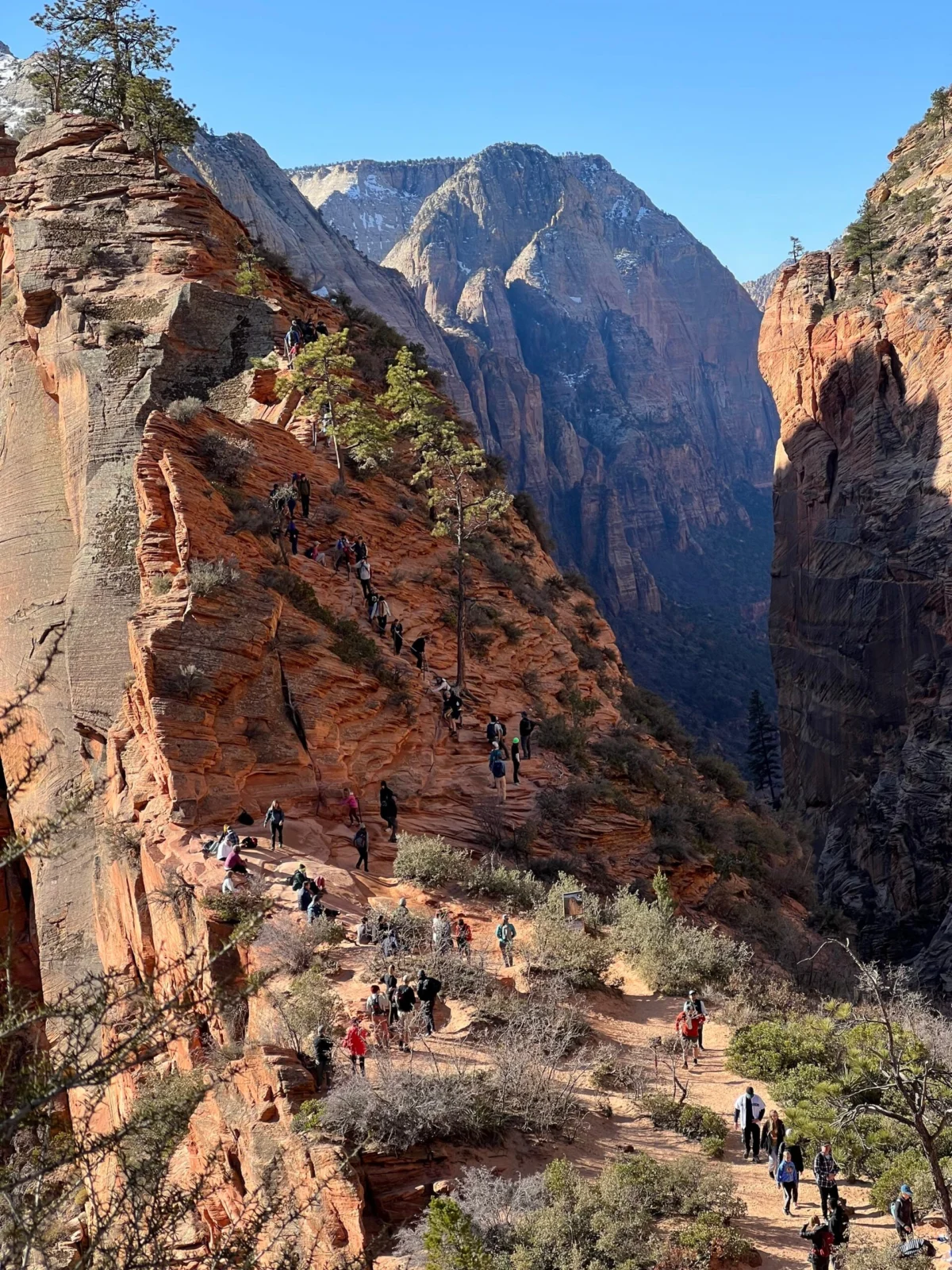
The allure of Angels Landing, a crown jewel within Zion National Park, draws thousands of visitors annually, eager to conquer its legendary half-mile ascent. Yet, as recent tragic events have underscored, the true challenge of this iconic hike lies not merely in its technical climbing difficulty, but in the complex interplay of human presence and the inherent risks of extreme exposure. While often categorized as a Class 3 scramble, a designation that might seem manageable to seasoned mountaineers accustomed to more demanding terrain, the reality of Angels Landing presents a unique set of dangers amplified by its immense popularity.
The West Rim Trail, leading to the precipice of Angels Landing, initially offers a deceptive sense of ease. The initial paved switchbacks, including the engineering marvel known as Walter’s Wiggles, are a strenuous but straightforward climb. However, the true nature of the hike transforms dramatically beyond Scout Lookout, where the path narrows into a spine of sandstone, flanked by sheer drops of approximately 1,000 feet on either side. It is this final, exhilarating half-mile that has cemented Angels Landing’s reputation, and where the risk of incident escalates significantly.
The most recent fatality, the tragic fall of a 68-year-old hiker from the chained section, serves as a stark reminder of the absolute consequences of even a momentary lapse in concentration. This incident, occurring in the wake of increased public access following the implementation of a permit system, highlights a critical concern: the juxtaposition of a technically moderate scramble with a crowd composed of individuals with vastly varying levels of outdoor experience and risk assessment. The very features designed to aid hikers – the chains bolted into the rock – become part of a complex system where a single misstep, whether by oneself or by another hiker, can have irreversible outcomes.
The Permit Lottery: A Gatekeeper to the Summit
Access to the famed Angels Landing trail is now strictly regulated through a permit system, a measure implemented by the National Park Service (NPS) in April 2022 to mitigate overcrowding and enhance safety. This lottery system, designed to distribute limited daily permits, has become the first significant hurdle for aspiring hikers. Two primary avenues exist for obtaining these coveted permits: a seasonal lottery for those who can plan months in advance, and a day-before lottery for more spontaneous adventurers.
The seasonal lottery opens for specific application windows, typically several months prior to the hiking season. For those seeking last-minute opportunities, the day-before lottery offers a daily chance. Applications for this lottery are accepted from 12:01 a.m. to 3:00 p.m. Mountain Time each day. Successful applicants are notified within hours, with permits issued for the following day. The system allows applicants to designate up to three preferred time windows for their hike: before 9 a.m., between 9 a.m. and 12 p.m., or after 12 p.m. Securing an early morning slot, particularly before 9 a.m., is widely considered the most advantageous, offering the best chance to avoid the intense midday heat and the densest crowds.

A common strategy employed by groups to maximize their chances is for each member to apply, often requesting the maximum group size permitted. This approach was successful for the author’s party, where one individual secured the permits despite others in the group not being drawn. The success of this strategy underscores the competitive nature of the lottery, where a group’s collective application can be more effective than individual attempts.
Strategic Ascent: Timing is Everything
The timing of one’s arrival at the trailhead can profoundly influence the overall hiking experience. The NPS operates a shuttle system from the Zion Visitor Center to various points within the park, including the trailhead for Angels Landing at The Grotto (Stop 6). Catching the earliest available shuttle, often around 7 a.m., is a strategy that allows hikers to ascend Walter’s Wiggles and begin the climb before the main influx of visitors. This early start enables a more serene and focused ascent, allowing individuals to establish a rhythm and maintain the heightened concentration required for the challenging sections ahead.
For those unable to secure an early permit slot or shuttle, aiming for any time between 7 a.m. and 8 a.m. is still highly recommended. The earlier the start, the greater the advantage in terms of cooler temperatures and fewer people on the trail. An even more exclusive advantage can be gained by staying at the Zion Lodge, located within the park. Guests of the lodge can access trailheads, including the one for Angels Landing, before the first public shuttle even reaches Stop 6, effectively granting them a head start on the entire park’s visitor population. This offers an unparalleled opportunity to experience the trail in relative solitude, significantly reducing the potential for bottlenecks and the associated stress.
The Dual Nature of the Trail: From Paved Path to Exposed Ridge
The hike to Angels Landing can be broadly divided into two distinct phases, each presenting its own set of challenges and characteristics. The initial segment, from The Grotto to Scout Lookout, is largely a paved trail, albeit a steep one. This section includes the renowned Walter’s Wiggles, a series of 21 tight switchbacks carved into the canyon wall, designed to reduce the gradient of the ascent. While physically demanding, this portion of the hike is characterized by its well-maintained surface, offering a stark contrast to what lies ahead. Scout Lookout serves as a natural endpoint for many visitors, offering panoramic views of the main canyon without venturing onto the more perilous chain section.
Beyond Scout Lookout, the character of the trail undergoes a dramatic transformation. This is where the final half-mile begins, a narrow sandstone fin that snakes its way towards the summit. The trail here is not paved but is a natural rock path, often only a few feet wide, with precipitous drop-offs on either side. The National Park Service has installed a series of heavy-duty chains bolted into the rock face to provide handholds and a sense of security for hikers. However, the presence of these chains, while offering assistance, also underscores the extreme exposure of the route.
The "Everest Effect": Bottlenecks and Behavioral Dynamics
The narrowness of the ridge on Angels Landing creates a unique set of logistical challenges, particularly during descent. While the ascent can be managed with careful pacing, the downward journey often devolves into a series of bottlenecks. This phenomenon, sometimes referred to colloquially as the "Everest Effect" due to its similarity to traffic jams on the world’s highest peak, arises from the need for hikers to yield to those ascending.

The ridge offers very few safe pockets where hikers can pause to allow others to pass. This leads to frequent and prolonged waits, sometimes consuming as much time as the actual movement along the trail. The inherent danger of this situation is amplified when inexperienced hikers, unaccustomed to such exposure or the etiquette of shared narrow trails, create further impediments. The author’s experience on the descent highlighted this issue, with significant time spent waiting for passing opportunities, underscoring the critical importance of patience.
The NPS has acknowledged the challenges posed by overcrowding and hiker behavior. While official statements often emphasize the permit system as a primary solution, the dynamics of human interaction on such a confined and exposed route remain a significant factor. The analysis of past incidents, including the recent fatality, points to a confluence of factors: the technical demands of the terrain, the psychological impact of extreme exposure, and the unpredictable behavior of a large and diverse group of hikers.
Pro-Tips for Navigating the Ridge
To mitigate the risks and maximize the enjoyment of the Angels Landing hike, several practical tips are crucial:
- Secure an Early Permit and Shuttle: As detailed previously, obtaining a permit for an early morning slot (before 9 a.m.) and catching the first shuttle (around 7 a.m.) provides a significant advantage in avoiding crowds and heat.
- Prioritize Patience: Understand that delays are inevitable, especially on the descent. Cultivating patience is paramount. Rushing or exhibiting impatience can lead to critical errors in judgment and execution.
- Maintain Focus: The trail demands constant attention. Avoid distractions, such as excessive photography or conversation, when navigating the chain section.
- Stay Aware of Surroundings: Be mindful of other hikers, both above and below you. Communicate intentions clearly and respect the flow of traffic.
- Proper Footwear: Wear sturdy hiking boots with good traction. The sandstone can be slippery, especially when dry.
- Hydration and Sun Protection: Zion can be extremely hot, particularly during midday. Carry ample water and wear sun protection, including a hat and sunscreen.
- Know Your Limits: If at any point the hike feels beyond your capabilities or comfort level, do not hesitate to turn back. Scout Lookout offers spectacular views without the extreme exposure of the summit ridge.
- Respect the Environment: Stay on the designated trail and pack out all trash. Leave no trace to preserve the natural beauty of Zion National Park for future generations.
Broader Implications and Future Considerations
The ongoing management of Angels Landing presents a microcosm of the challenges faced by popular national parks worldwide. Balancing visitor access with ecological preservation and public safety is a constant endeavor. The permit system, while effective in controlling numbers, has shifted the challenge to managing human behavior and ensuring that all participants are adequately prepared for the risks involved.
The "Everest Effect" on Angels Landing highlights the complex relationship between trail design, visitor capacity, and human psychology. As visitor numbers continue to rise, park managers may need to explore further strategies, potentially including more stringent guidelines for hiker behavior, enhanced ranger presence on the trail, or even more restrictive access policies if safety concerns persist. The long-term sustainability of such iconic, yet inherently risky, attractions hinges on a delicate equilibrium between accessibility and responsible stewardship.
Ultimately, Angels Landing offers an unforgettable experience, a testament to the raw power and beauty of nature. However, it is an experience that demands profound respect, meticulous preparation, and a commitment to safety. By adhering to permit requirements, strategically planning their visit, and embracing patience and focus on the trail, hikers can increase their chances of successfully reaching the summit and, more importantly, safely returning to the valley floor, becoming part of a positive memory rather than a cautionary tale. The enduring legacy of Angels Landing lies not just in its breathtaking vistas, but in the collective responsibility of all who venture upon it to ensure its beauty remains accessible and safe for generations to come.
