

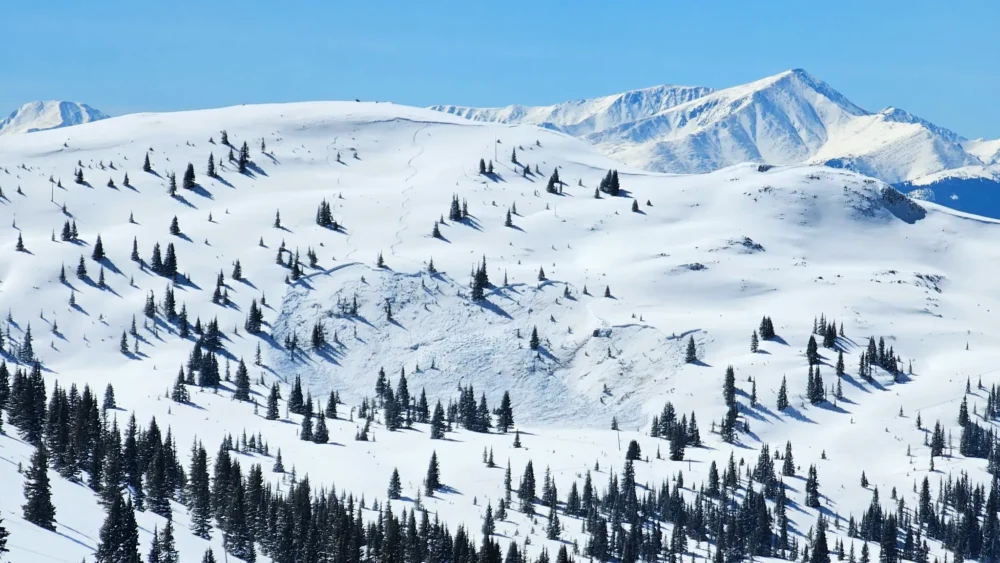
The Colorado backcountry community is in mourning following the tragic news of the state’s first avalanche fatality of the 2025-26 winter season. On Saturday evening, March 7, emergency services were alerted to a missing snowmobiler in the remote Boss Basin area, a popular recreational zone situated south of Ptarmigan Pass and within the broader vicinity of Vail Pass. This somber event serves as a stark reminder of the inherent dangers present in the mountainous terrain, particularly during periods of volatile snowpack conditions.
The incident prompted an immediate and extensive search and rescue operation, mobilizing teams from both Summit and Eagle Counties. Working tirelessly through the challenging nighttime conditions, responders faced deep snow, difficult access, and the ever-present risk of further avalanche activity. Their efforts culminated on Sunday, March 8, when the body of David Pickett-Heaps, a 58-year-old resident of Silverthorne, was tragically located. The discovery was made possible with crucial aerial support from Flight For Life, a testament to the coordinated inter-agency response required in such emergencies. Pickett-Heaps was known within his community as an experienced adventurer and an avid participant in backcountry activities, underscoring that even seasoned individuals are vulnerable to the unpredictable forces of nature.
Investigation Reveals Avalanche Characteristics
Preliminary data released by the Colorado Avalanche Information Center (CAIC), the leading authority on avalanche forecasting and education in the state, shed light on the characteristics of the fatal slide. Investigators determined that the avalanche occurred on a northeast-facing slope, positioned near the treeline—a common location for instabilities due to wind loading and solar radiation patterns. The slide was estimated to be approximately two feet deep, a depth sufficient to fully bury and incapacitate an individual, especially when combined with the immense force and debris typical of an avalanche. Crucially, the CAIC noted that the starting zone of the avalanche exhibited slope angles between 33 and 36 degrees. This specific range is widely recognized by avalanche professionals as "prime" for slab releases, where a cohesive layer of snow (the slab) fractures and slides over a weaker, underlying layer.
Slab avalanches are particularly dangerous because they can propagate across wide areas, involving a significant volume of snow, and often catch individuals by surprise. The CAIC’s detailed analysis, which is standard procedure following any avalanche incident, provides critical insights for understanding the mechanics of the event and informing future safety advisories. These investigations are vital not only for the immediate incident but also for contributing to a broader understanding of snowpack behavior and risk assessment across the region.
Colorado’s Challenging and Deceptive Snowpack
Colorado’s snowpack is notoriously complex and often described as "continental," characterized by cold, dry conditions that frequently lead to the formation of persistent weak layers deep within the snowpack. Unlike coastal snowpacks which tend to stabilize quickly, Colorado’s can remain unstable for weeks or even months after initial snowfall. This inherent instability often creates a deceptive scenario for backcountry users, where the surface may appear stable while dangerous weak layers lurk beneath.
The CAIC had issued warnings in the days leading up to the incident, emphasizing that recent storm cycles, despite bringing welcomed snow, had paradoxically made the snowpack more dangerous. New snow added weight to existing weak layers, increasing the likelihood of a collapse. The official CAIC statement following the tragedy underscored this point: "You may be able to travel on a slope multiple times before it slides." This phenomenon, known as "spatial variability" or the "terrain trap," means that even seemingly safe lines can harbor dangerous pockets of instability, and a single trigger can release a massive slide. This unpredictability is a cornerstone of avalanche education and a constant challenge for backcountry enthusiasts.

A History of Avalanche Incidents in Colorado
Colorado consistently ranks among the states with the highest number of avalanche fatalities in the United States, a grim reality owing to its expansive and accessible high-alpine terrain, coupled with a large and active backcountry user community. Historically, the state averages between six and ten avalanche-related deaths per year. The 2025-26 season, while still early, has now recorded its first, serving as a poignant reminder that even with advanced forecasting and education, the risks remain significant.
Data from previous seasons consistently highlights specific patterns: snowmobilers, skiers, and snowboarders are the most frequent victims. Human-triggered avalanches account for the vast majority of incidents, emphasizing the critical role of individual decision-making in avalanche terrain. This fatality reinforces the ongoing need for rigorous safety practices, continuous education, and a deep respect for the mountain environment.
The Perilous Corridor: Vail Pass to Berthoud Pass
Forecasters at the CAIC have specifically identified the corridor stretching between Vail Pass and Berthoud Pass as the most dangerous zone in the state during this period. This region, encompassing areas like Boss Basin, is a hub for various winter activities including snowmobiling, backcountry skiing, and splitboarding. Its accessibility from major population centers and the abundance of enticing terrain contribute to its popularity, but also to its heightened risk profile.
Recent storms had deposited significant accumulation across Colorado’s Northern Mountains, particularly within this corridor. While fresh powder is a draw for many, it also dramatically increases the avalanche hazard. The added weight of new snow on existing weak layers creates a highly unstable situation. The CAIC’s assessment of "human-triggered avalanches remaining ‘likely’" in this zone is a severe warning, indicating that even a single person’s weight or a snowmobile’s vibration can be enough to initiate a slide. This specific hazard classification underscores the extreme caution required when venturing into these areas.
Official Responses and Community Reactions
The Summit County Sheriff’s Office and Eagle County Sheriff’s Office, the primary agencies involved in the search and recovery, issued statements expressing their condolences to Pickett-Heaps’ family and reiterating the extreme challenges faced by search and rescue teams. They emphasized the professionalism and dedication of all responders, including volunteer search and rescue organizations, who routinely put themselves at risk to assist others in the backcountry. Flight For Life, a critical asset in high-alpine rescues, also highlighted the coordinated effort required for such complex operations.
The incident sent a ripple of sorrow through the close-knit backcountry community of Colorado. Many shared messages of grief and solidarity, while also using the tragedy as an opportunity to reinforce vital safety messages. Online forums and social media channels dedicated to backcountry recreation saw an uptick in discussions about avalanche awareness, gear checks, and the importance of conservative decision-making. These discussions, while somber, play a crucial role in self-policing and education within the community. Leaders from various outdoor groups and organizations echoed the CAIC’s warnings, urging members to exercise extreme caution and to prioritize safety above all else.

The Imperative of Avalanche Safety Education and Preparedness
This fatality serves as a powerful and tragic reminder of the paramount importance of avalanche safety education and preparedness for anyone venturing into the backcountry. The CAIC consistently advocates for a multi-pronged approach to safety, beginning with formal avalanche education courses (such as AIARE 1 and 2 certifications). These courses teach essential skills including snowpack assessment, terrain analysis, rescue techniques, and group decision-making.
Beyond education, carrying essential safety gear is non-negotiable. This includes an avalanche transceiver (beacon), a shovel, and a probe. Knowing how to use these tools effectively and practicing with them regularly can be the difference between life and death in the event of a burial. Furthermore, traveling with experienced partners, communicating intentions, and having a clear emergency plan are all critical components of safe backcountry travel.
As the winter season progresses and particularly as Colorado transitions into spring, the snowpack can undergo dramatic changes, sometimes becoming even more unpredictable. Warming temperatures, new snow events, and refreezing cycles can all contribute to new layers of instability. Therefore, consistent vigilance and continuous monitoring of conditions are essential.
A Call for Continued Vigilance
At organizations like TGR, which celebrate the thrill and adventure of mountain sports, there is a deep understanding that respect for the mountains is the most important gear an individual can carry. The mountains offer unparalleled beauty and exhilaration, but they also demand humility and an unwavering commitment to safety.
As we move deeper into the 2025-26 winter season, and with the first fatality already recorded, the call for continued vigilance is stronger than ever. All backcountry enthusiasts are urged to make checking the Colorado Avalanche Information Center (CAIC) forecasts an absolute prerequisite before every tour. This involves not just glancing at the hazard rating but delving into the detailed advisories, understanding the specific problems, and planning routes accordingly. Prioritizing conservative terrain choices, especially when conditions are described as "likely" for human-triggered avalanches, is paramount. This means opting for lower-angle slopes, avoiding areas prone to wind loading, and steering clear of known avalanche paths.
The loss of David Pickett-Heaps is a profound tragedy for his family, friends, and the broader backcountry community. It underscores the ever-present risks associated with recreating in dynamic mountain environments. By internalizing the lessons from such incidents and adhering rigorously to established safety protocols, the hope is to prevent future fatalities and ensure that the joy of experiencing Colorado’s majestic winter landscapes can be pursued with the utmost care and responsibility.
