

The landscape of American winter recreation has undergone a seismic shift over the last quarter-century, transitioning from a niche pursuit for dedicated enthusiasts to a mainstream cultural phenomenon. Despite an exponential increase in the number of skiers, snowboarders, and snowmobilers venturing into the backcountry, a comprehensive analysis of national data reveals a surprising and counterintuitive trend: the annual number of avalanche fatalities in the United States has remained remarkably stable. This statistical plateau, persisting amidst a period of explosive growth in mountain travel, suggests a profound improvement in safety protocols, technological efficacy, and public education.
For more than two decades, the "fatality rate"—the number of deaths per backcountry user day—has plummeted. Analysis conducted by the Colorado Avalanche Information Center (CAIC) and leading experts in the field indicates that while the raw number of annual deaths remains relatively flat, the safety of the individual user has improved by several orders of magnitude. Had the fatality rate remained constant since the mid-1990s, the U.S. would likely be recording hundreds of avalanche-related deaths each winter, rather than the current average.
The Evolution of the Backcountry: 1994 vs. 2016
To understand the significance of the current data, one must examine the state of the industry during the 1994/95 winter season. At that time, the infrastructure for avalanche safety was in its infancy. Major regional centers were led by a small circle of pioneers: Knox Williams in Denver, Bruce Tremper in Utah, and Mark Moore in Seattle. Other critical hubs, such as those in the Chugach Mountains of Alaska, the Tahoe region of California, or Mt. Shasta, had not yet been established.
The equipment of the era also imposed natural limits on movement. In 1994, the majority of backcountry skiers utilized telemark gear, often paired with leather boots that offered minimal support compared to modern composites. Snowmobiles were significantly heavier, less powerful, and lacked the maneuverability required to access the high-alpine "steep and deep" terrain that modern mountain sleds navigate with ease. Furthermore, the concept of "sidecountry"—backcountry terrain accessed via ski resort lifts—was not yet a recognized term, and most resorts maintained strictly closed boundaries.
Perhaps the most significant difference was the dissemination of information. In 1994, the internet was just beginning to gain public traction. Avalanche advisories were typically delivered via recorded telephone hotlines or posted on physical bulletin boards at trailheads. It was only at the end of the 1994/95 season that the first avalanche advisories began appearing on the World Wide Web, marking the start of a digital revolution in mountain safety.
Analyzing the Fatality Trends: A Statistical Overview
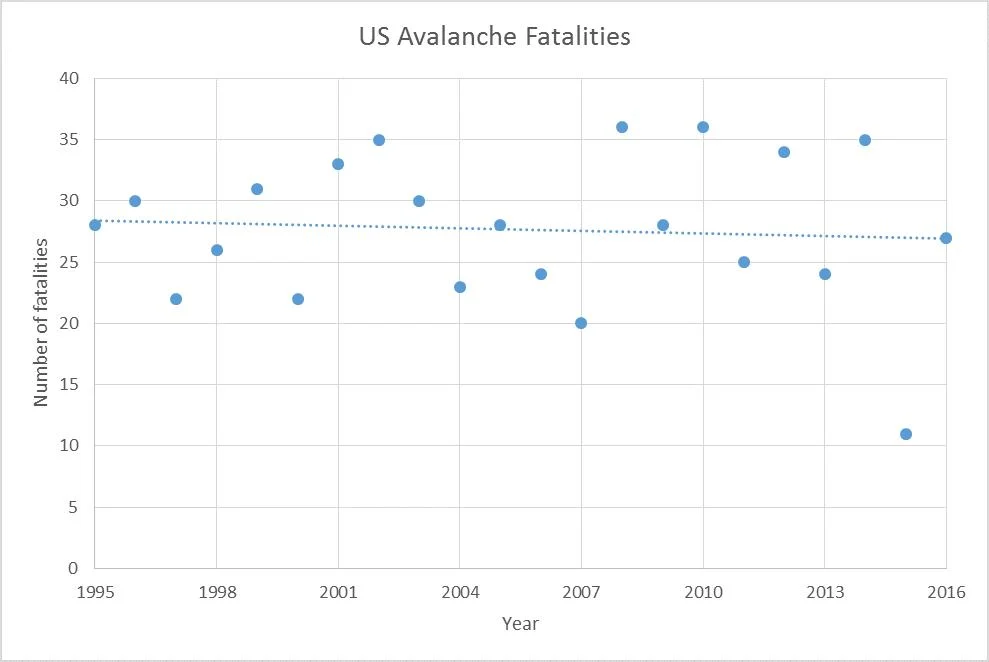
When examining the data from the 1994/95 winter through the 2015/16 winter, the stability of the fatality rate becomes statistically evident. According to the CAIC data, the overall number of U.S. avalanche fatalities shows no statistically significant increase over this 22-season period.
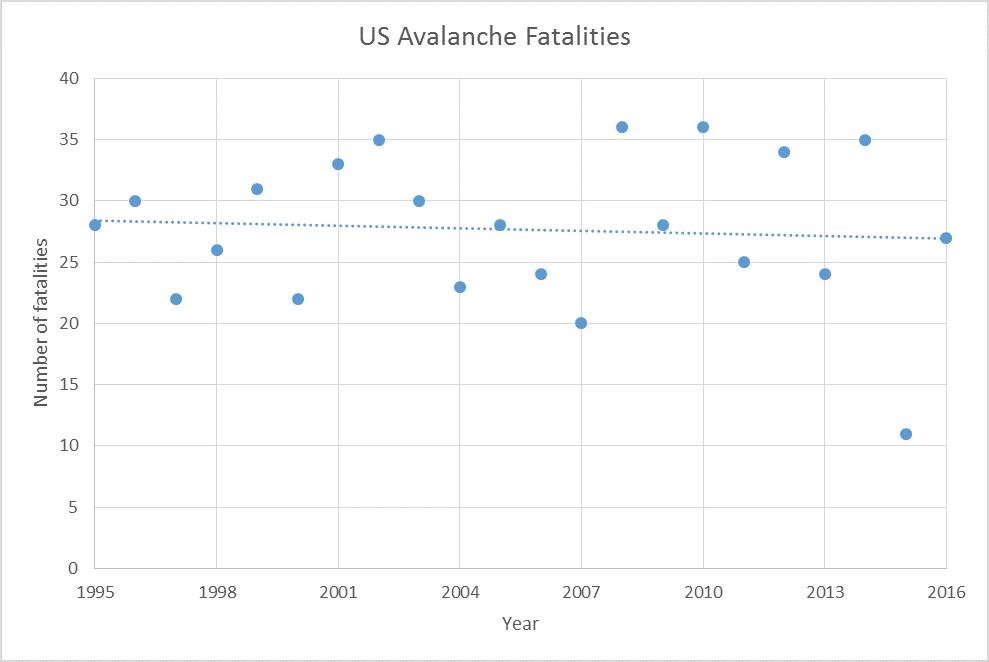
In statistical modeling, a "p-value" is used to determine the significance of a trend. For the total fatality count, the p-value was calculated at 0.7, indicating that the slight downward slope in the trend line is likely due to random variation rather than a fundamental change in the death rate. Essentially, the number of people dying in avalanches has remained a "flat line" for over two decades.
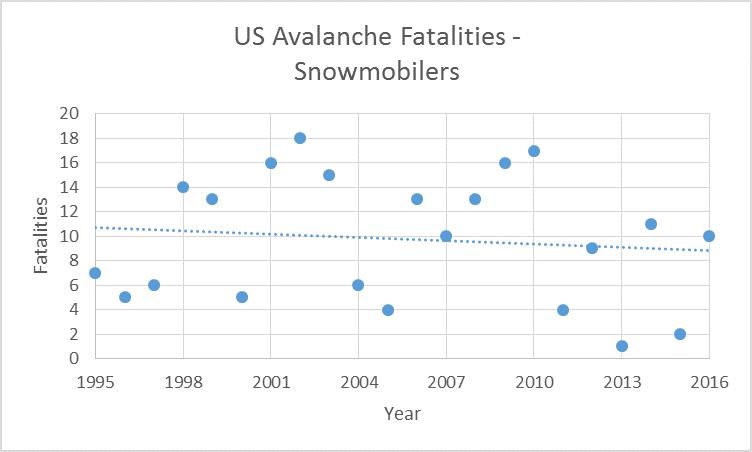
This trend extends to specific user groups:
- Snowmobilers: Despite the development of high-performance mountain sleds that allow riders to reach more dangerous terrain, the fatality rate for snowmobilers has also remained flat (p = 0.6).
- Backcountry Skiers and Snowboarders: This group showed a slight upward trend in fatalities (p = 0.07). While this figure is closer to being statistically significant, it still represents a remarkably low increase when contrasted with the massive surge in participation within these sports.
Measuring the Surge: The Proxy of Advisory Usage
The primary challenge for researchers is the lack of "denominator data"—the total number of people entering the backcountry each day. Unlike ski resorts, which track ticket sales, the backcountry is dispersed and unregulated. However, avalanche centers use the consumption of their daily advisories as a proxy for participation.
The growth in advisory usage since 1994 is staggering:
- Utah Avalanche Center: 12-fold increase.
- Colorado Avalanche Information Center: 17-fold increase.
- Gallatin National Forest Avalanche Center (Montana): 36-fold increase.
- Northwest Avalanche Center (Washington): 60-fold increase.
While some of this increase can be attributed to the ease of accessing information via smartphones and social media, the sheer scale of the growth points to a massive influx of users. Conservative estimates suggest that backcountry use has increased at least eightfold. If fatalities have remained flat while use increased eightfold, the actual risk to an individual user has decreased by a factor of eight.
Factors Driving the Safety Revolution
The stability of the fatality rate is not an accident; it is the result of a coordinated effort across the outdoor industry, government agencies, and non-profit organizations. Several key factors have contributed to this success.
1. Educational Outreach and Awareness
The mid-1990s marked the beginning of a more structured approach to avalanche education. Organizations like the American Institute for Avalanche Research and Education (AIARE) standardized curriculum, while programs like "Know Before You Go" (KBYG) brought basic awareness to a broader audience. These programs shifted the focus from simple rescue techniques to "human factors"—teaching recreationists how to recognize dangerous terrain and avoid triggering slides in the first place.
2. Technological Innovation in Gear
The tools available to the modern backcountry traveler are vastly superior to those of 1994.
- Avalanche Transceivers: The transition from analog to digital beacons with multiple antennas has made the search process faster and more intuitive for novices.
- Avalanche Airbags: These packs, which use a large inflated balloon to keep the wearer near the snow surface during a slide, have become a standard safety tool, significantly increasing survival rates in the event of a burial.
- Communication: The ubiquity of smartphones and GPS satellite messengers allows for real-time updates and faster emergency response times.
3. The Regional Avalanche Center Network
The expansion of the regional avalanche center network has been perhaps the most critical factor. These centers provide daily, high-resolution forecasts that allow users to make informed decisions before they even leave their homes. By translating complex snow science into actionable advice (e.g., "Avoid North-facing slopes above 9,000 feet"), these centers have bridged the gap between professional observers and the general public.
4. Professionalization of Guiding and Resort Operations
The rise of "sidecountry" and "slackcountry" skiing led resorts to adopt more rigorous boundary management and education for their guests. Professional guiding services have also seen increased demand, ensuring that less experienced users are led by experts who manage the risk on their behalf.
Implications for the Future of Mountain Safety
The fact that U.S. avalanche fatalities have not skyrocketed alongside participation rates is a major victory for the winter sports community. It serves as a validation of the current "forecast and educate" model. However, experts warn against complacency. As backcountry use continues to grow, the pressure on avalanche centers and educational resources will only increase.
The "flat line" in fatalities also highlights the changing demographic of the backcountry. With more users entering the terrain through resort gates or via powerful snowmobiles, the challenge for educators is reaching those who may not realize they are entering avalanche-prone territory. The next phase of safety will likely involve even more granular data, utilizing crowdsourced observations and advanced weather modeling to provide real-time risk assessments.
Conclusion: A Community Success
The data compiled by the Colorado Avalanche Information Center and analyzed by figures like Karl Birkeland offers a rare moment of optimism in the field of risk management. The "win" belongs to a diverse ecosystem of stakeholders: the manufacturers who engineered better beacons and airbags, the educators who spent thousands of hours in classrooms and on snow, and the avalanche centers that have become the "weather service" of the mountains.
Ultimately, the flat fatality trend during a period of explosive growth proves that education and information are effective tools against the inherent dangers of the winter environment. While the goal remains to push the number of fatalities toward zero, the ability of the community to hold the line against a rising tide of participation is a significant achievement in public safety. As the industry moves forward, the lessons learned over the last 22 seasons will remain the foundation for protecting the next generation of backcountry explorers.
