

Denver, CO – In a remarkable testament to the evolving landscape of avalanche safety and backcountry recreation, the annual number of avalanche fatalities in the United States has remained remarkably stable over the past two decades, despite a dramatic surge in participation. This unexpected trend, detailed in recent analyses, highlights the growing effectiveness of avalanche education, forecasting, and safety equipment in mitigating risks for a burgeoning population venturing into snow-covered wilderness.
The winter of 1994/95 serves as a pivotal reference point for this statistical analysis. During that season, the infrastructure for avalanche forecasting and safety was considerably less developed than it is today. Prominent avalanche centers were led by figures like Knox Williams in Denver, Bruce Tremper in Utah, and Mark Moore in Seattle. Jim Kanzler managed the Jackson Hole center, Brad Ray led the Mount Washington effort, and a nascent center in Bozeman was in its fifth year of operation. Critically, major backcountry regions such as the Chugach Mountains in Alaska, the Lake Tahoe area, and Mount Shasta lacked dedicated avalanche centers.
Recreational practices were also vastly different. The vast majority of backcountry skiers relied on telemark gear, often with traditional leather boots. Snowmobiles, a significant mode of backcountry access for some, were considerably less powerful and maneuverable than their modern counterparts. Ski areas typically operated with strict closed boundaries, and the concept of "sidecountry" access, which bridges the gap between in-bounds resorts and true wilderness, was not yet a widely adopted term or practice, likely to remain so for another decade. Furthermore, the internet was in its infancy, with the first rudimentary avalanche advisories only beginning to appear online towards the end of the 1994/95 season.
A Surprising Stability in Fatalities
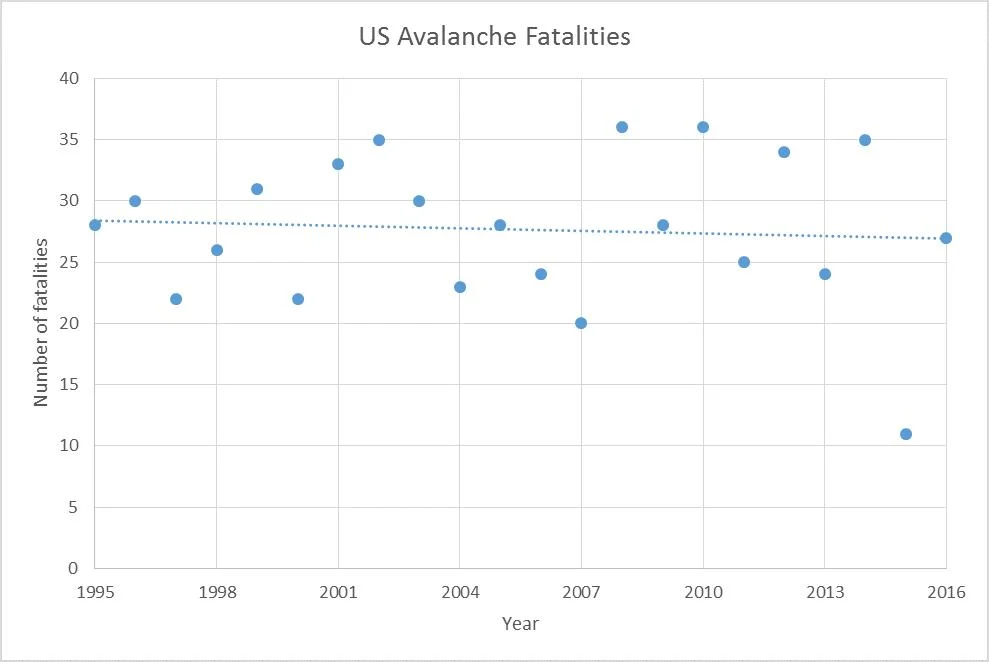
Against this backdrop, a recent examination of avalanche fatality data reveals a striking pattern: since the 1994/95 winter, the total number of U.S. avalanche fatalities has not increased. This stability has persisted for 22 consecutive seasons, a period marked by transformative technological advancements and an unprecedented explosion in backcountry activity. The proliferation of smartphones and social media has revolutionized how information is disseminated, lightweight and advanced all-terrain (AT) ski gear has become commonplace, snowmobiles have gained immense power and capability, and the overall interest in backcountry pursuits has surged dramatically.
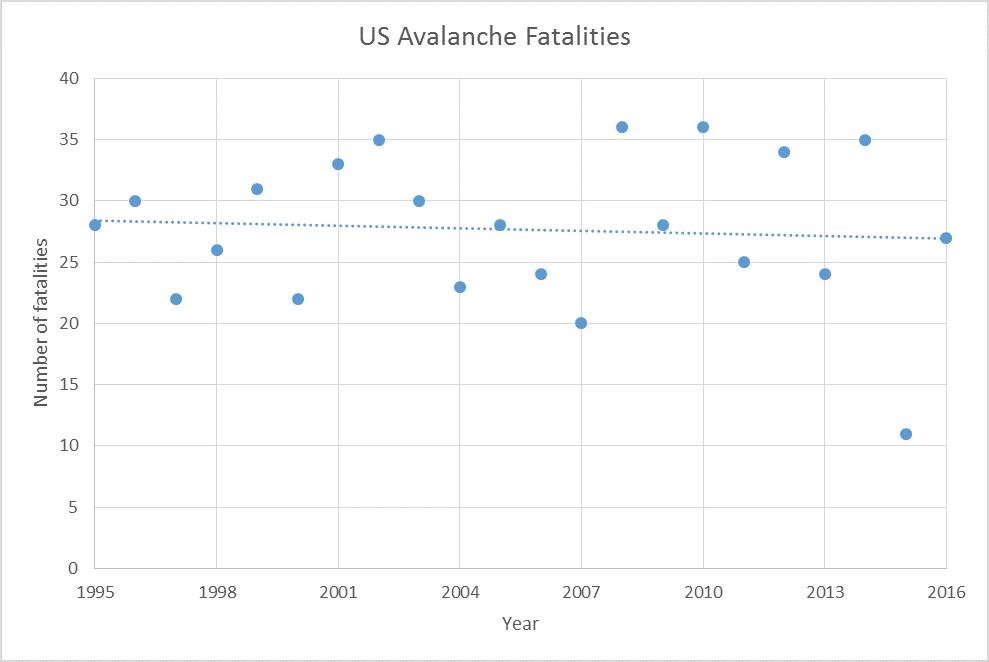
Data presented in Figure 1, which tracks U.S. avalanche fatalities from the 1994/95 winter through the 2015/16 winter, illustrates this trend. A statistical analysis of this period shows a slight, non-statistically significant decreasing trend line (p = 0.7). This indicates no statistically significant change in the overall number of avalanche fatalities over these 22 seasons.
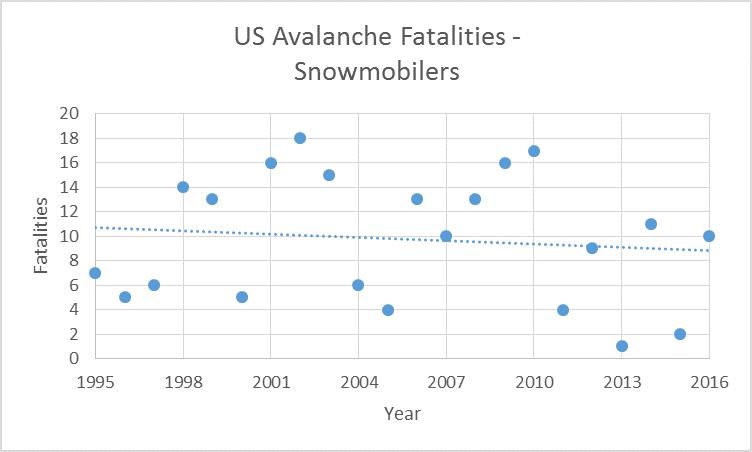
Interestingly, this trend of stability extends to snowmobile-related avalanche fatalities as well. Figure 2, depicting snowmobile avalanche fatalities over the same 22-season span, also shows a flat trend line, with a non-statistically significant decreasing slope (p = 0.6). This suggests that despite the increased power and accessibility of modern snowmobiles, the number of fatalities directly linked to avalanches while operating these machines has not risen.
However, a more nuanced observation emerges when examining fatalities specifically among backcountry skiers and snowboarders. Figure 3, illustrating this subset of data, reveals a relatively flat trend, but with some statistical evidence (p = 0.07) suggesting a slight increase in fatalities within this demographic over the observed period. While not definitively conclusive, this hints at a potential area for increased focus and vigilance.
The Unseen Surge in Backcountry Participation
The stability in the absolute number of fatalities would be less remarkable if backcountry use had also remained static. However, anecdotal evidence and proxy data strongly indicate a meteoric rise in the number of individuals venturing into the backcountry for recreation. While precise, comprehensive statistics on dispersed winter recreation are notoriously difficult to gather, the usage of avalanche advisory services provides a compelling, albeit imperfect, proxy for this growth.
For instance, the Utah Avalanche Center has reported a staggering twelve-fold increase in advisory usage over the past 22 seasons. The Colorado Avalanche Information Center has witnessed an even more dramatic seventeen-fold increase. The Gallatin National Forest Avalanche Center has experienced a thirty-six-fold surge in usage, and the Northwest Avalanche Center has seen an astonishing sixty-fold increase in people accessing their advisories. While some portion of these increases can undoubtedly be attributed to the enhanced accessibility of information through digital platforms, these figures undeniably point to a significantly larger number of people engaging in backcountry activities.
A Dramatic Decline in Fatality Rate
When this substantial increase in backcountry usage is considered in conjunction with the flat trend in overall fatalities, the implications for the fatality rate—defined as the number of avalanche fatalities per backcountry user day—are profound. Assuming a conservative estimate that backcountry use has increased by a factor of eight over the past 22 years, and combining this with the stable fatality trend, the fatality rate has plummeted by at least a factor of eight, and likely more.
To contextualize this achievement, if the fatality rate had remained constant during this period of explosive growth, the United States could have potentially seen well over 200 avalanche fatalities per winter. This hypothetical scenario underscores the critical importance of the advancements and efforts that have contributed to the current safety landscape.
A Collective Achievement in Avalanche Safety
The sustained low number of avalanche fatalities, especially in the face of such overwhelming growth in participation, represents a significant success for the entire avalanche safety community. This achievement is not attributable to a single factor but rather a confluence of dedicated efforts across various domains:
- Avalanche Education: The tireless work of educators at all levels, from professional avalanche course providers to those delivering crucial "Know Before You Go" awareness presentations, has played a pivotal role. These programs have empowered countless individuals with the knowledge and skills to assess avalanche risk and make informed decisions in the backcountry.
- Backcountry Guiding and Ski Area Operations: Professional guiding services and ski area operations that extend their safety protocols and educational outreach to clients have contributed significantly. Their commitment to client safety, often extending beyond resort boundaries where applicable, has fostered a culture of awareness.
- Equipment Manufacturers: Innovations in safety equipment have been instrumental. Manufacturers have developed and refined a range of critical gear, including significantly improved avalanche beacons with enhanced detection capabilities, Avalungs that can provide a vital air supply in burial scenarios, lightweight and protective helmets, and increasingly effective airbag packs that can significantly increase a buried person’s chance of survival.
- Regional Avalanche Center Network: The robust and expanding network of regional avalanche centers across the United States has been fundamental. These centers provide essential, up-to-date avalanche information and forecasts, enabling backcountry users to make critical go/no-go decisions based on real-time conditions. Their commitment to accessible and reliable forecasting is a cornerstone of modern avalanche safety.
Looking Forward: The Path to Zero
While acknowledging this significant accomplishment, the community remains committed to further reducing avalanche fatalities, with the ultimate goal of reaching zero. The data, however, provides a crucial moment for reflection and appreciation. The persistent flat line in fatalities during a period of unprecedented backcountry expansion is a clear indicator that current strategies and efforts are proving effective. This success should instill pride within the community, recognizing that dedicated efforts in education, forecasting, and technology are yielding tangible, life-saving results.
The data underpinning this analysis was primarily provided by the Colorado Avalanche Information Center (CAIC). The broader avalanche community owes a profound debt of gratitude to the CAIC, its dedicated personnel who meticulously compile accident data, and the many individuals who report and document avalanche incidents. Their efforts provide invaluable lessons learned, enabling continuous improvement in safety protocols and public awareness. Constructive reviews and feedback from experts such as Simon Trautman, Doug Chabot, and Spencer Logan further underscore the collaborative nature of this ongoing safety initiative.
Historical Context and Evolving Risks
To fully appreciate the current safety landscape, it is important to recall the conditions and perceptions surrounding backcountry travel in the mid-1990s. The accessibility of avalanche information was limited, relying primarily on word-of-mouth and early, often infrequent, printed advisories. The technology for avalanche rescue, such as beacons, was less sophisticated, and the concept of avalanche airbags was still largely in its nascent stages of development.
The demographic of backcountry users was also different. While dedicated enthusiasts have always explored winter wilderness, the explosion in recent decades has brought a broader spectrum of users, including those with less extensive experience. This influx of new participants, coupled with the allure of accessible terrain facilitated by modern equipment and snowmobiles, presents a complex risk environment.
The data suggesting a slight upward trend in skier and snowboarder fatalities, while not statistically definitive, warrants continued attention. This could be influenced by a variety of factors, including increased risk-taking behavior, insufficient training among a growing user base, or the inherent challenges of navigating complex avalanche terrain even with improved awareness.
The Role of Technology and Information Dissemination
The advent of the internet and mobile technology has undeniably been a game-changer. The ability for avalanche centers to disseminate daily forecasts, snowpack observations, and weather trends in near real-time, accessible via smartphones, has empowered individuals with critical decision-making tools. This rapid dissemination of information allows for more dynamic risk assessment, enabling users to adapt their plans based on evolving conditions.
Furthermore, the development of sophisticated modeling and analysis techniques within avalanche research has deepened our understanding of snowpack stability and avalanche formation. This scientific progress informs forecasting models and educational curricula, contributing to a more robust safety framework.
Future Directions and Ongoing Challenges
Despite the positive trends, the pursuit of zero fatalities remains an aspirational goal. Future efforts will likely focus on:
- Targeted Education: Developing more tailored educational programs for different user groups and experience levels.
- Enhanced Data Collection: Improving methods for collecting and analyzing backcountry usage data to gain a more precise understanding of fatality rates.
- Technological Advancement: Continued innovation in avalanche safety equipment and forecasting technologies.
- Public Awareness Campaigns: Sustained and evolving campaigns to reinforce safe practices and the importance of avalanche awareness.
The story of U.S. avalanche fatalities over the past two decades is one of remarkable progress and adaptation. It demonstrates that through concerted effort, education, technological innovation, and a deep respect for the power of nature, significant strides can be made in mitigating the inherent risks of backcountry recreation, even as participation soars to unprecedented levels. This ongoing success is a shared victory for all who love and engage with the winter wilderness.
