

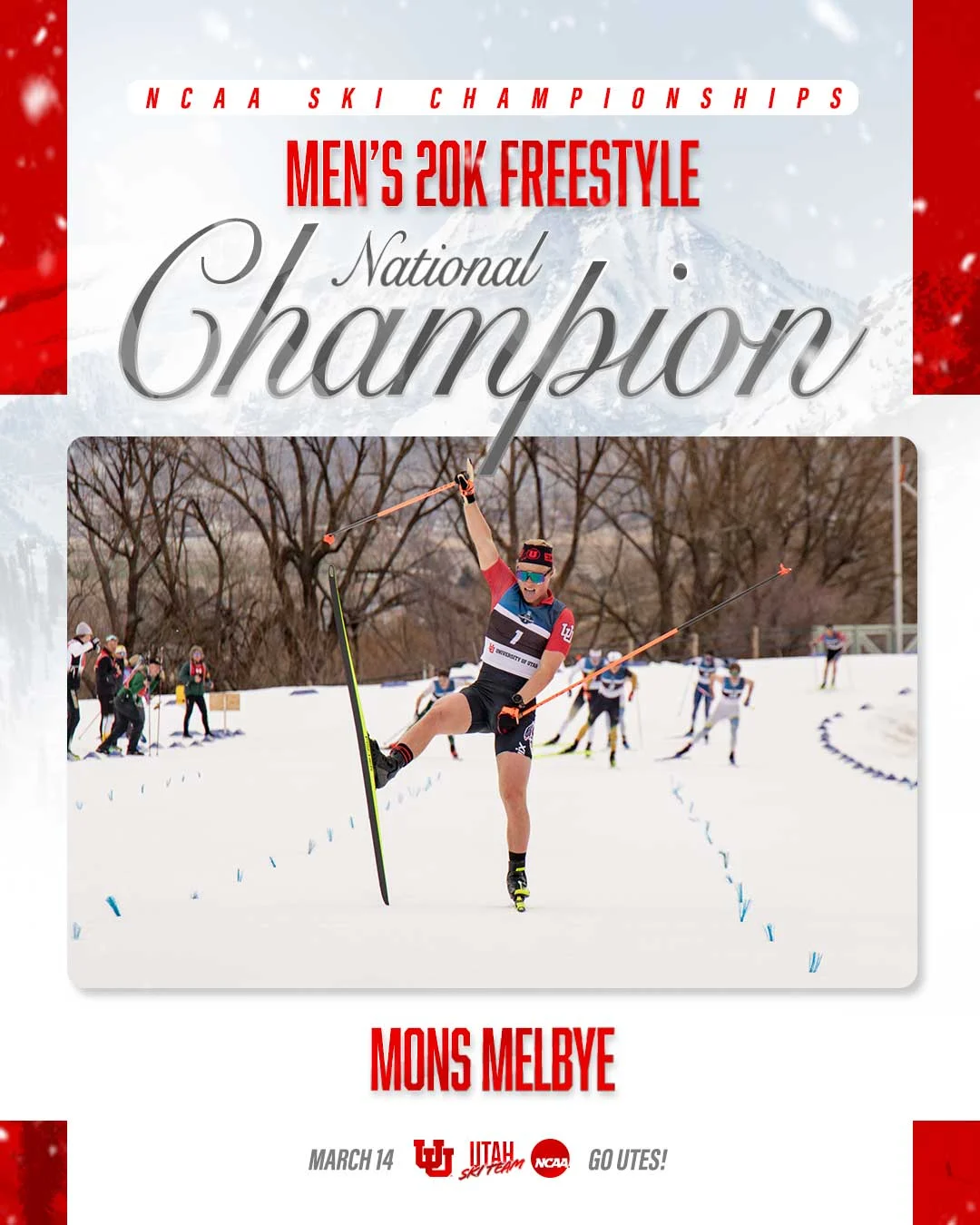
The 2026 NCAA Skiing National Championships concluded with a dramatic flourish at Soldier Hollow Nordic Center, culminating in the University of Utah securing its 18th national title. The four-day competition, held on home snow in Midway, Utah, saw the Utes triumph in a razor-thin battle against fierce rivals, ultimately clinching the championship with 549.5 points, narrowly ahead of the University of Colorado’s 539 points. This victory marks Utah’s sixth national championship in the past seven seasons, solidifying its reputation as a dominant force in collegiate skiing. The decisive moment arrived in the men’s 20K freestyle cross-country race, where Utah freshman Mons Melbye delivered an electrifying performance, securing an individual national championship in one of the tightest finishes of the entire week.
A Freshman’s Defining Moment: Melbye’s Epic Sprint
The men’s 20K freestyle cross-country race on the final day of the championships was poised to be a pivotal event, with team points hanging precariously in the balance. As the leaders entered the final kilometers, the tension was palpable across the meticulously prepared course at Soldier Hollow. Utah freshman Mons Melbye, demonstrating poise beyond his years, found himself locked in a strategic battle, tucked just behind Dartmouth’s John Steel Hagenbuch. Hagenbuch, a highly accomplished and seasoned skier, had been a formidable presence throughout the season and was widely regarded as one of the NCAA field’s most formidable competitors.
In the grueling final stretch, as the course narrowed and the finish line loomed, Melbye executed a masterful tactical move. Recognizing the critical juncture, he slipped past Hagenbuch, initiating a breathtaking sprint to the line. For agonizing meters, the two athletes were nearly stride for stride, their poles digging furiously into the snow, every muscle strained in a desperate bid for victory. The crowd’s roar intensified, a wave of sound echoing across the Wasatch mountains. In a moment that will undoubtedly become part of Utah skiing lore, Melbye edged out his competitor by the smallest of margins—a mere four-tenths of a second. His winning time of 46:14.6 was not just an individual triumph; it was a seismic shift in the team standings, providing the crucial points Utah needed in its neck-and-neck fight for the overall title.
"It was an unbelievable feeling crossing that line and knowing I had done it," Melbye reportedly remarked after the race, still catching his breath. "John is an incredible skier, and I knew it would come down to the very last meters. I just trusted my training, dug deep, and pushed through the pain. To win it for Utah, especially on our home snow, means everything." His victory underscored the depth and talent within the Utah program, especially its ability to recruit and develop top-tier international athletes who can perform under immense pressure.
Championship Climax: Utah Secures the Overall Title
Melbye’s dramatic win was the emotional and statistical lynchpin of a hard-fought championship week. The final point tallies reflected the intensity of the competition: Utah finished with a commanding 549.5 points, but the margin over second-place Colorado (539 points) was a testament to the Utes’ consistent performance across all disciplines and the razor-thin nature of the battle. The University of Denver rounded out the top three with 386.5 points.
The 2026 title represents Utah’s 18th NCAA Skiing National Championship in school history, further cementing its legacy as the most successful collegiate skiing program in the nation. This remarkable achievement also marks the program’s sixth championship in the last seven seasons, a period of sustained excellence that speaks volumes about the coaching staff, athlete development, and program infrastructure. This run of dominance places Utah in an elite category, rivaling the historical prowess of programs like the University of Colorado and the University of Vermont, but currently surpassing them in recent history.

"This championship is a testament to the incredible grit, resilience, and teamwork of every single athlete and staff member," said a proud Utah Head Coach, reflecting on the victory. "To win on our home mountain, with the added pressure and the challenging conditions, makes this even more special. Mons’s finish was truly heroic, but it was built on the foundation laid by every skier, both men and women, who battled throughout the week. This was a true team effort, and the home advantage certainly played a role in pushing us across the finish line." The crowd, predominantly clad in Utah crimson, erupted in cheers as the final scores were announced, celebrating not just a win, but a legacy upheld and extended.
The Women’s Crucial Contribution: Setting the Stage
While Melbye’s sprint captured the headlines, the University of Utah women’s team had earlier laid a critical foundation for the overall championship victory. Their performances in the women’s 20K freestyle were instrumental in positioning the Utes within striking distance of the title, especially in the tight battle against Colorado.
Erica Lavén led the charge for the Utah women, delivering a stellar performance to secure a third-place finish. Her time of 52:22.7 not only earned her a spot on the podium but also contributed a substantial block of points to the team’s overall tally. Close on her heels was teammate Witta Walcher, who skied a strong race to claim fifth place, finishing just seconds behind Lavén. Their top-five finishes showcased the strength and depth of Utah’s women’s Nordic squad. Rounding out the scoring for the Utes was Sofia Pedersen, who battled hard to cross the finish line in 24th place, adding valuable points that proved vital in the final calculations.
The impact of these performances cannot be overstated. In a championship that saw the lead swing back and forth between Utah and Colorado over the four-day event, the women’s 20K freestyle was a crucial turning point. Utah’s collective effort in this race earned them 70 points, securing a second-place finish in the event standings. In contrast, Colorado’s women’s team finished fourth in the event, accumulating 56 points. This 14-point differential from a single event underscored the strategic importance of every athlete’s contribution and highlighted how the women’s strong showing provided the necessary buffer heading into the men’s race, setting the stage for Melbye’s heroics.
"We knew going into our race that every point would count," Lavén reportedly stated. "The energy from the crowd and knowing we were fighting for a national title on our home course really pushed us. Witta and I, and Sofia, we all gave it everything we had. Seeing our points go up and knowing we helped the team get closer to the trophy was an incredible feeling. It’s truly a collective effort."
Depth Across the Roster: Men’s Supporting Performances
Beyond the dramatic individual victory, the University of Utah men’s team demonstrated significant depth, securing crucial points that further solidified the Utes’ championship aspirations. While Melbye’s first-place finish was undoubtedly the highlight, the consistent performances of his teammates were indispensable to the overall team score.
Zachary Jayne delivered a strong race, finishing ninth with a time of 46:28.7. His top-ten placement contributed a significant number of points, preventing any major gaps in Utah’s scoring and ensuring a robust team total. Following Jayne, Max Kluck crossed the finish line in 22nd place, clocking 49:13.7. While not a podium finish, Kluck’s performance was equally vital, adding valuable points that are often overlooked in the glare of individual triumphs but are absolutely essential in the cumulative scoring of a national championship.

Collectively, the Utes men’s team posted an impressive 71 points in the 20K freestyle race. This score placed them second only to the University of Alaska Fairbanks in the event standings, who had a particularly strong showing in the men’s Nordic race. However, for the overall championship narrative, Utah’s 71 points were far more critical, as they directly contributed to the narrow lead over Colorado in the total team standings. This demonstrated that while star power is important, the consistent performance of the entire roster across all positions is what ultimately wins championships in NCAA skiing, where every point contributes to the cumulative total.
Soldier Hollow: The Unforeseen Yet Steadfast Host
The 2026 NCAA Skiing National Championships were not without their unique challenges, particularly concerning the venue. The event was originally slated to take place in Montana, but an unseasonably warm winter and a significant lack of snowfall forced organizers to make a critical decision: relocate the championships to Soldier Hollow Nordic Center in Midway, Utah. This move proved to be a stroke of good fortune for the University of Utah, transforming a neutral site into a de facto home-field advantage.
The conditions at Soldier Hollow itself added an unusual element to the competition. While the surrounding landscape in Midway experienced dry, spring-like weather with bright skies and warm temperatures, the course itself remained remarkably solid. This was not by chance, but rather a testament to the extensive and meticulous preparation undertaken by the Soldier Hollow staff. Utilizing advanced snow-farming techniques, significant snow reserves, and continuous grooming, organizers managed to maintain a high-quality racecourse despite temperatures that saw several athletes opting to race in shorts. The firmness of the snowpack was crucial, allowing for fair and fast racing conditions that minimized the impact of the warm weather.
"Relocating an event of this magnitude is never easy, but the team at Soldier Hollow rose to the occasion magnificently," commented an NCAA event official, acknowledging the logistical challenges. "Their expertise in snow management and their dedication ensured that despite the warm spring conditions, the athletes competed on a truly world-class course. It’s a huge credit to their professionalism and commitment to the sport."
Soldier Hollow holds a storied history in winter sports, having famously hosted the cross-country skiing and biathlon events during the 2002 Salt Lake City Winter Olympics. Its Olympic legacy, combined with its state-of-the-art facilities and experienced staff, made it an ideal emergency host, allowing the championships to proceed without significant compromise to the competitive integrity of the races. The venue’s ability to adapt and deliver under pressure further cemented its reputation as a premier Nordic skiing destination.
A Legacy Cemented: Utah’s Enduring Dominance in Collegiate Skiing
The University of Utah’s 18th NCAA Skiing National Championship victory in 2026 is more than just another trophy; it is a profound reinforcement of a legacy of excellence that few collegiate programs in any sport can rival. With six titles in the last seven seasons, the Utes have established a period of dominance that speaks to a multi-faceted approach to building and sustaining a championship-caliber team.
This consistent success can be attributed to several key factors. Firstly, Utah’s robust recruitment pipeline, drawing talent from both domestic and international pools, ensures a continuous influx of elite skiers. The program’s ability to attract top-tier athletes like Mons Melbye, Erica Lavén, and Witta Walcher highlights its global reputation. Secondly, the coaching philosophy, led by a dedicated and experienced staff, focuses not only on technical prowess but also on strategic race planning, mental fortitude, and team cohesion. This holistic approach prepares athletes not just for individual glory, but for collective success.

Furthermore, Utah benefits from unparalleled training facilities, including access to world-class venues like Soldier Hollow, which provides ideal conditions for both alpine and Nordic disciplines. The institutional support from the university, coupled with a strong alumni network, ensures that the skiing program has the resources necessary to maintain its competitive edge. Historically, programs like Colorado and Vermont have enjoyed periods of dominance, but Utah’s current run places it firmly at the pinnacle of collegiate skiing. This latest victory, achieved under challenging conditions and against a formidable opponent like Colorado, only strengthens its position as the program to beat.
Winning a national title on home snow, in front of a supportive local crowd, adds another layer of significance to this championship. It allows the community to directly partake in the celebration and witness firsthand the culmination of years of hard work, dedication, and strategic planning.
Looking Ahead: Momentum Towards 2027
As the snow settled at Soldier Hollow and the celebrations commenced, the University of Utah skiing program was already looking ahead. The most exciting implication of the 2026 victory is the fact that the Utes are slated to return their entire NCAA roster for the upcoming 2027 season. This continuity, especially after such a triumphant campaign, provides an invaluable foundation for continued success.
The blend of experienced veterans and burgeoning stars like freshman Mons Melbye suggests that Utah is not just a team of the moment but a program built for sustained excellence. The psychological boost of winning a national title, particularly in such a dramatic fashion and on home turf, will undoubtedly fuel their motivation and confidence as they prepare to defend their crown.
This period of sustained dominance by the University of Utah is also beneficial for collegiate skiing as a whole. It elevates the profile of the sport, draws more attention to the incredible athleticism and strategic depth involved, and inspires a new generation of skiers. The intense rivalry with teams like Colorado and Denver further enhances the competitive landscape, pushing all programs to strive for higher levels of performance. With momentum firmly on their side and a full roster returning, the Utes depart Soldier Hollow not only as national champions but as the clear frontrunners heading into the next collegiate skiing season, poised to extend their remarkable dynasty.
