

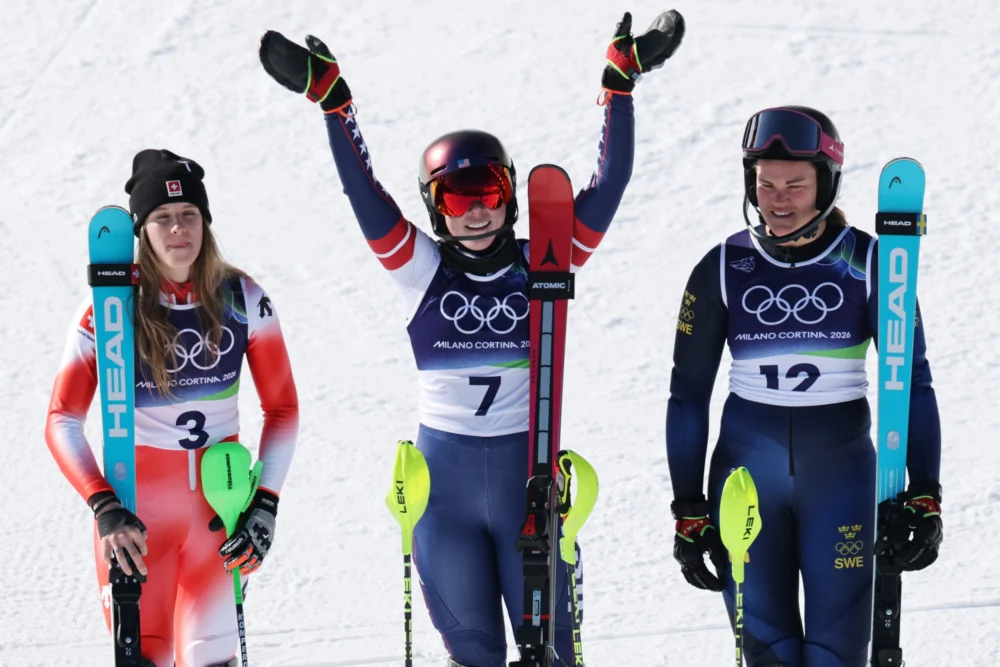
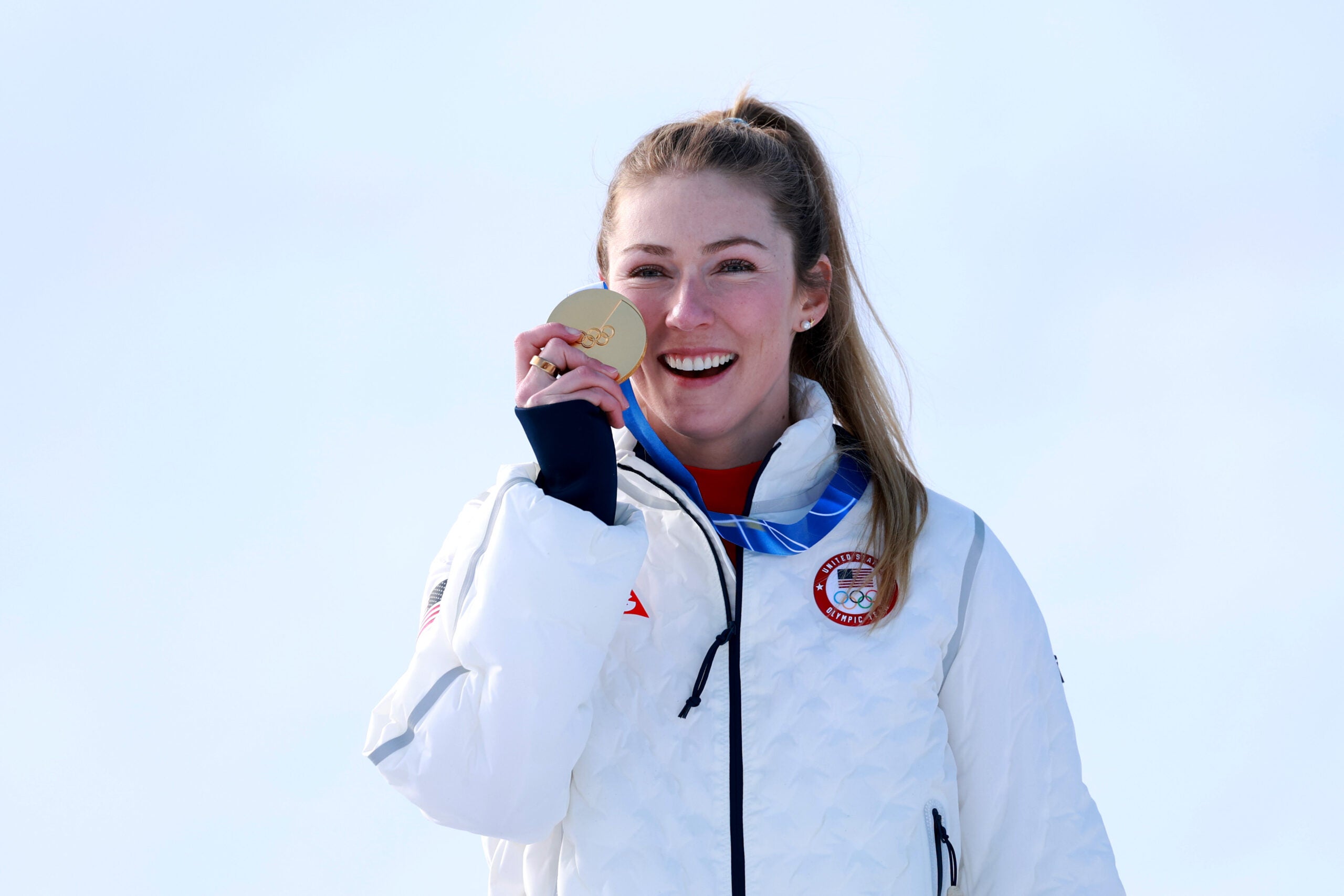
Under the brilliant, high-altitude sun reflecting off the jagged peaks of the Tofane mountain range, Mikaela Shiffrin cemented her status as the most successful American alpine skier in Olympic history. On February 18, 2026, the 30-year-old veteran delivered a masterclass in technical precision to claim the gold medal in the women’s slalom. This victory, coming twelve years after her first Olympic gold in Sochi as a teenager, marks her third career Olympic gold medal—a feat never before achieved by an American alpine skier. The win also serves as a definitive answer to critics who questioned her longevity and mental fortitude following a challenging period in her Olympic career.
Shiffrin’s performance at the Tofane Alpine Skiing Centre was not merely a win; it was a statistical anomaly in a sport often decided by hundredths of a second. Finishing with a combined time that placed her 1.5 seconds ahead of her nearest competitor, Switzerland’s Camille Rast, Shiffrin demonstrated the same dominance that has defined her record-breaking World Cup career. In a discipline where the margin of error is razor-thin, Shiffrin’s ability to maintain an aggressive line while others struggled with the icy conditions proved to be the deciding factor of the day.
A Legacy Twelve Years in the Making
The trajectory of Mikaela Shiffrin’s Olympic career is one of the most storied in modern athletics. When she won her first slalom gold in Sochi 2014 at the age of 18, she became the youngest slalom champion in Olympic history. Twelve years later, at 30, she has become the oldest American woman to win an alpine gold, effectively bookending her career with records of age and endurance.
Between those two points lies a journey of immense highs and publicized lows. After a successful PyeongChang 2018 Games, where she took giant slalom gold and combined silver, Shiffrin faced a grueling and medal-less campaign at the Beijing 2022 Olympics. Critics at the time wondered if the "Shiffrin Era" had reached its twilight. However, her performance in Cortina d’Ampezzo has recalibrated that narrative. By securing her third gold, she surpasses the Olympic gold medal tallies of American legends such as Ted Ligety and Andrea Mead Lawrence, standing alone at the pinnacle of U.S. alpine achievement.
Technical Dominance in the First Run
The competition began under ideal weather conditions, but the course itself, set by the Austrian coaching staff, proved to be a minefield for the field of elite racers. The first run featured a rhythmic but punishing gate sequence that demanded high-frequency transitions and absolute edge control. The difficulty of the set was evidenced by the 27 athletes who failed to finish (DNF), including American hopeful Nina O’Brien.
Shiffrin, wearing bib 7, attacked the course with a level of "clean" skiing that observers have come to expect but rarely see executed under Olympic pressure. While many skiers struggled with the firm, injected snow—which had been prepared to be significantly harder and more responsive than in previous days—Shiffrin utilized the surface to her advantage. She crossed the finish line of the first run with a staggering 0.82-second lead over Germany’s Lena Duerr.
"It felt really clean, really active, but also a little bit on the limit," Shiffrin remarked following the first heat. "There were a couple of moments when I thought I could easily be off this course, but I just kept pushing and fighting." Her ability to find the limit without crossing it was the hallmark of a skier who had already secured seven out of eight World Cup slalom victories in the 2025-2026 season leading up to these Games.
The Second Run: Risk Versus Reward
As the sun began to cast longer shadows across the Tofane finish area, the tension for the second run mounted. The "reverse 30" start order meant that Shiffrin would be the final skier to leave the gate, with the knowledge of exactly what time she needed to beat.
The drama intensified when Germany’s Lena Duerr, sitting in the silver medal position after the first run, straddled the very first gate of her second run. This error meant that Shiffrin entered the gate with a massive 1.05-second cushion over the current leader, Camille Rast. In such scenarios, many athletes choose a conservative "safety run" to ensure a podium finish. Shiffrin, haunted by a lackluster fourth-place finish in the Team Combined earlier in the week, chose the opposite path.
She increased her intensity through the steep middle section of the course, gaining time at every interval. By the time she reached the final flat towards the finish, she had extended her lead to 1.5 seconds. The crowd in Cortina, a town with a deep-seated appreciation for technical skiing, erupted as the scoreboard flashed green.
Team USA Performance and Moltzan’s Remarkable Recovery
While Shiffrin took the headlines, the depth of the American tech team was on full display through Paula Moltzan. After a disappointing first run that saw her finish in 28th place—nearly three seconds off the pace—Moltzan executed what would become the fastest second run of the entire day.
Starting early in the second heat, Moltzan took advantage of the relatively fresh course to post a time of 51.39 seconds. Her aggressive skiing allowed her to leapfrog 20 competitors, ultimately finishing in 8th place. "I didn’t really think I’d be able to climb this much," Moltzan said. "But I’m really happy with the second run I put down. My first run ski was also good; it just wasn’t clean, and that sets you back in a really strong field."
The American contingent was rounded out by AJ Hurt, who finished in 19th place. The collective performance of the U.S. women’s team in Cortina underscores a period of revitalization for the program, which has faced significant pressure to perform following the retirement of several veteran stars in the early 2020s.
International Reactions and the Podium Finishers
The silver medal went to Camille Rast of Switzerland, who has emerged this season as Shiffrin’s most consistent challenger. Rast, 26, acknowledged the gap between Shiffrin and the rest of the field. "After my first run, I knew that the gold was gone, but silver and bronze were open," Rast stated with pragmatic grace. Her silver adds to a strong showing for the Swiss team, which continues to be a powerhouse in technical disciplines.
Sweden’s Anna Swenn Larsson claimed the bronze medal at the age of 34. For Swenn Larsson, the medal represented a career-defining achievement at what she confirmed would be her final Olympic appearance. "It feels extra special to put it together today and walk away with this medal. It’s really huge for me," she said, visibly emotional in the finish area.
The competition was also notable for the "changing of the guard" moments, such as the Olympic debut of 20-year-old Swede Cornelia Oehlund. Despite a promising first run that placed her in third, Oehlund’s second run ended in a DNF after a broken pole led to a loss of balance.
Analysis: The "Shiffrin Factor" and Mental Resilience
Shiffrin’s victory is being analyzed by experts not just as a physical feat, but as a psychological triumph. Following the 2022 Beijing Games, where Shiffrin failed to finish three of her individual races, the media narrative often focused on the immense pressure placed on her shoulders.
Her performance in Cortina suggests a shift in perspective. Shiffrin noted that she "came here for the skiing," rather than the records. This process-oriented approach allowed her to overcome a disappointing 11th-place finish in the Giant Slalom earlier in the week—a result attributed to her ongoing recovery from a knee injury sustained at Killington during the previous season.
By focusing on the "feeling" of the runs rather than the weight of the history, Shiffrin managed to execute under the highest possible stakes. Her victory also highlights the importance of course conditions; the firm, "icy" snow of the slalom event played directly into her technical strengths, contrasting with the softer, more variable snow that contributed to her struggles in the GS.
Broader Implications for Alpine Skiing
The 2026 Milano Cortina Games will likely be remembered as the event that solidified Mikaela Shiffrin’s argument as the greatest alpine skier of all time (GOAT). With over 100 World Cup victories and now three Olympic golds across a 12-year span, her longevity is unparalleled in the modern era of the sport.
For U.S. Ski & Snowboard, Shiffrin’s success provides a vital boost in visibility and funding. As the most decorated American skier, she remains the face of the sport, driving interest in alpine racing in a non-traditional market.
Following the conclusion of the Olympic slalom, the tech teams will have a brief hiatus before the World Cup circuit resumes in Are, Sweden, on March 14. For Shiffrin, the focus will shift back to securing the Overall World Cup crystal globe, a trophy she has already positioned herself to win with her dominant performance throughout the winter.
As she stood on the podium in Cortina, Shiffrin was asked what advice she would give to her 18-year-old self who stood on the podium in Sochi. Her response was a reflection of the tumultuous, rewarding, and historic decade that followed: "Buckle up!"
