

The intricate dance of moving on snow, whether carving down a pristine slope on skis or mastering freestyle maneuvers on a snowboard, is fundamentally a sophisticated exercise in force management. Gravity and momentum, ever-present forces, impart energy that snowsports participants deftly store within their equipment—skis or boards—and then strategically release to generate speed, dictate direction, and execute precise turns. Just as the rigidity of a boot or the flex of a board critically influences the efficiency of energy transfer, a strong and stable core serves as an indispensable anatomical platform, significantly enhancing control and boosting overall performance. This central pillar of stability empowers the legs to operate against a fixed point, optimizing leverage and power delivery. Beyond its direct impact on athletic prowess, a well-conditioned core, synergistically working with improved balance and appropriate muscle recruitment patterns, has been extensively demonstrated to be effective in mitigating lower back pain in the short term and substantially lowering the risk of sustaining further injuries on the slopes.
The Pervasive Training Gap: Acknowledging a Critical Oversight
Despite the overwhelming evidence supporting the profound benefits of core training, a notable disparity often exists between theoretical knowledge and practical application, particularly among snowsports instructors and enthusiasts. Time constraints, coupled with perceived limitations in access to suitable training environments, frequently lead to the neglect of core conditioning. This oversight persists even among those who fully understand its importance, creating a performance and injury prevention gap that warrants immediate attention. Recognizing this prevalent challenge, sports scientists and conditioning specialists have increasingly focused on developing highly efficient, adaptable core exercises that can be seamlessly integrated into daily routines, requiring minimal equipment and space. The goal is to provide maximum performance benefits in the least amount of time, making core conditioning accessible to everyone, even during those often-wasted micro-moments, such as waiting for transportation or riding a chairlift.
Foundational Principles: Establishing a Stable Platform
Effective core training begins not with complex movements, but with a fundamental understanding and consistent application of neutral posture and core activation. Without these foundational elements, exercises risk being ineffective or even detrimental, potentially reinforcing poor movement patterns.
Finding Your Neutral Posture: The cornerstone of spinal stability is maintaining a neutral posture, characterized by the natural curves of the spine. To achieve this, whether seated or standing, one should actively lengthen the spine, imagining a string pulling the head upwards. A small, natural curve should be present in the lower back, avoiding both excessive arching (lordosis) and flattening (kyphosis). Shoulders should be gently drawn down and back, preventing them from rounding forward or shrugging towards the ears. Crucially, the rib cage should remain aligned with the pelvis, not excessively lifted, which can lead to an overextension of the lumbar spine. The head should be oriented forward, with the gaze level, avoiding tilting up or down. A key anatomical checkpoint involves ensuring the hip bones—specifically the anterior superior iliac spines and the pubic bone—are in the same horizontal plane, indicating a neutral pelvic tilt, neither tipped excessively forward nor backward. This conscious alignment serves as the starting point for all subsequent core engagement.
Activating Your Core: Once neutral posture is established, the next critical step is to activate the deep core musculature. This involves a subtle, internal contraction, rather than a bracing or hollowing of the abdomen. The objective is to gently pull the lower belly in and up, as if drawing the navel towards the spine, but without creating a rigid, vacuum-like sensation. The goal is to generate a slight, internal tension, signaling the engagement of the transverse abdominis. Concurrently, the pelvic floor muscles should be gently lifted, akin to the sensation of holding back urination. This integrated activation of the deep abdominal and pelvic floor muscles establishes the essential internal pressure and stability required to protect the spine and optimize force transfer. This neutral starting position, with activated core, forms the bedrock upon which all effective core exercises are built.
The Training Regimen: Optimizing for Snowsports
For optimal results, a structured approach is recommended. Begin with 10 repetitions of each exercise, gradually increasing the volume to 30 repetitions for two to three sets per exercise. Consistency is paramount; completing this routine two to three times per week will yield tangible benefits in performance and injury prevention. The following exercises are selected for their efficacy, adaptability, and ability to be performed in snowsports boots without needing to lie on the floor.
Exercise 1: Seated Pelvic Stabilizer
- Description: Begin in your meticulously established neutral posture with an activated core. While maintaining absolute stillness in the pelvis and upper body, slowly lift one foot approximately an inch off the floor. Hold this position for a deliberate count of three, focusing intently on preventing any rotational or lateral movement in the hips or torso. Gently lower the foot back to the ground. Alternate legs, performing the prescribed 10 to 30 repetitions on each side.
- Correction Check: To ensure correct execution, place two fingers lightly over the prominent bones at the front of your hips (anterior superior iliac spines). Throughout the exercise, these points should remain stationary, with no discernible twisting, tilting, or shifting of the pelvis. If pelvic movement is detected, reduce the load by either shortening the lift range or, if necessary, simply focusing on core activation and weight transfer without lifting the foot. Progress gradually, only increasing the leg movement as stability improves.
- Scientific Rationale: This exercise is a cornerstone of stability training, differentiating between core strength (moving external loads) and core stability (resisting unwanted movement). In dynamic snowsports, the legs must operate independently to initiate edges, absorb terrain variations, and steer, while the spine and pelvis must provide an unyielding platform for the center of mass (CM) and pressure adjustments. The Seated Pelvic Stabilizer specifically targets and activates the deep muscles of the abdomen (transverse abdominis, internal obliques), hips (hip flexors, deep rotators), and lower back (multifidus), which are crucial for maintaining spinal and pelvic integrity during these independent leg actions. Research has shown that even subtle perturbations, like lifting a foot, significantly engage these deep stabilizers, improving proprioception and neuromuscular control.
- Make it Harder:
- Increase the hold time for each lift.
- Lift the foot higher, increasing the lever arm.
- Perform the exercise on an unstable surface (e.g., a thick mat, balance cushion, or folded towel).
- Add a controlled, small upper body movement (e.g., reaching forward with the opposite hand) while maintaining pelvic stability.
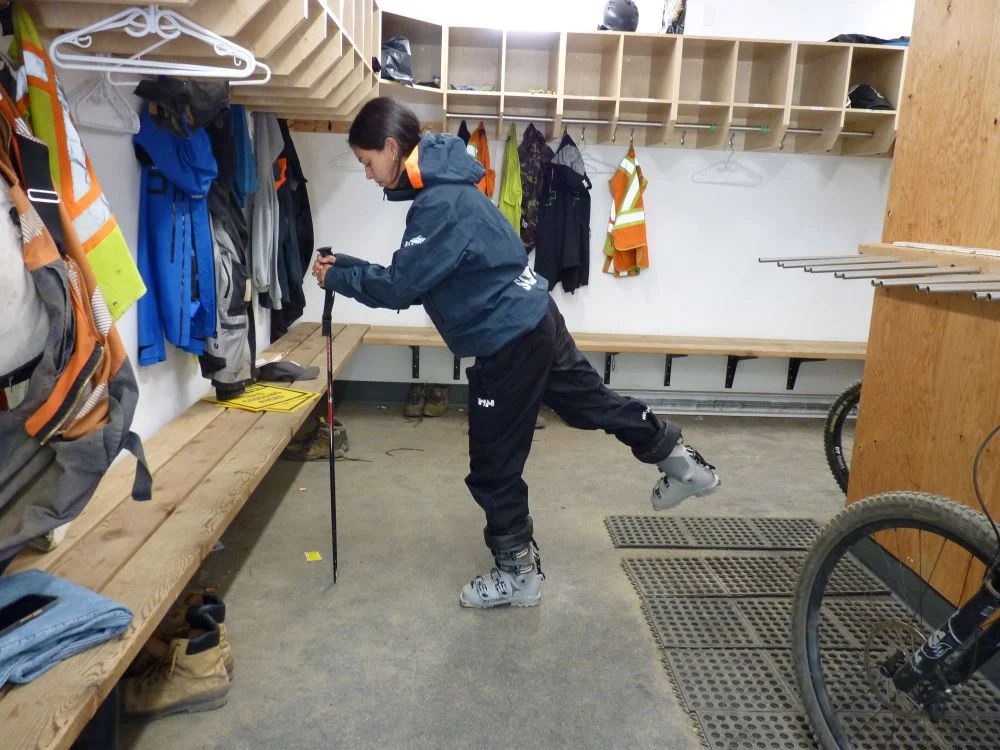
Exercise 2: Single-Leg Deadlift
- Description: From your neutral, activated core stance, shift your weight onto one leg. As you extend the free leg straight backward, simultaneously allow your upper body to hinge forward from the hips, maintaining a straight line from the head through the extended leg. Crucially, keep your shoulders and hips perfectly square, facing forward throughout the movement; avoid any opening, twisting, or hiking of the hip. Strive to reach a horizontal position with both your torso and extended leg, forming a ‘T’ shape. Then, with controlled motion, return to the upright starting position.
- Progression: Mastering this exercise demands significant balance and core strength. If maintaining balance on one leg is challenging, begin by using a ski pole or chair for light support. Alternatively, keep the toes of the extending leg lightly on the ground, making the movement more akin to a staggered-stance row, gradually building strength and balance before lifting the back foot completely.
- Scientific Rationale: The Single-Leg Deadlift is lauded as one of the most effective stability exercises for snowsports due to its comprehensive recruitment of the gluteal muscles (gluteus maximus, medius, and minimus), crucial for hip extension and abduction, alongside demanding high levels of spine and pelvic stability. It also inherently challenges balance, further intensifying the load on the core musculature. Snowsports involve controlling powerful downhill momentum, necessitating a high proportion of eccentric muscle contractions—where muscles lengthen under tension (e.g., absorbing bumps, extending through a turn). The single-leg deadlift specifically loads the posterior chain muscles (hamstrings, glutes, lower back erectors) eccentrically, mimicking the demands of snow sports and preparing them to absorb and control forces, thereby preventing common issues like sore quads or lower back pain often associated with unconditioned eccentric loading. This translates directly into improved ability to precisely control the center of mass and fine-tune edge angulation.
- Make it Harder:
- Hold a light weight (e.g., a water bottle, small dumbbell) in the hand opposite the standing leg, increasing the lever arm and core challenge.
- Perform the movement slower, emphasizing the eccentric (lowering) phase.
- Increase the range of motion, reaching further forward and backward.
- Close your eyes briefly at the peak of the movement to challenge proprioception.
Exercise 3: Standing Rotational Stability (Imaginary Pole/Ski Twist)
- Description: Adopt your neutral posture with an activated core. Hold your hands together as if gripping a ski pole or the handle of a snowboard, extended forward at chest height. Keeping your hips absolutely stationary and facing forward, slowly rotate your upper body and arms approximately 45 degrees to one side. Focus on resisting any pelvic movement or twisting. Hold briefly, then return to the center with control, and repeat on the other side. The movement should be initiated and controlled by your core, not momentum.
- Scientific Rationale: Rotational stability is paramount in snowsports for absorbing forces, initiating turns, and maintaining balance across varied terrain. This exercise specifically targets the oblique muscles (internal and external obliques) and the transverse abdominis, training them to resist unwanted rotation of the lumbar spine and pelvis. By maintaining a stable lower body while the upper body rotates, the core learns to decouple movements, a critical skill for carving and mogul skiing where the upper body often remains relatively still while the lower body is highly active. This anti-rotational strength protects the spine from torsional stresses and enhances power transfer through turns.
- Make it Harder:
- Increase the range of motion slightly, ensuring no pelvic rotation.
- Perform with slightly bent knees, mimicking an athletic stance on snow.
- Hold a light resistance band or a small weight to increase the resistance.
- Perform on one leg (if stability allows) to further challenge balance and anti-rotational strength.
Exercise 4: Standing Hip Hike/Drop
- Description: Stand tall in your neutral posture with an engaged core, feet hip-width apart. Shift your weight slightly onto one leg, keeping that knee softly bent. Allow the hip of the non-weight-bearing leg to drop slowly towards the floor, as if you are letting that side of your pelvis sink. The movement should be controlled and initiated from the standing leg’s hip. Avoid leaning your torso excessively. Once the hip has dropped as far as comfortable without compromising your upper body posture, slowly "hike" it back up, lifting the non-weight-bearing hip higher than the standing hip, again, without leaning your torso. Repeat for 10-30 repetitions on each side.
- Scientific Rationale: Lateral pelvic stability is crucial for effective edging, traversing, and absorbing lateral forces in snowsports. This exercise specifically targets the gluteus medius and minimus, key abductor muscles responsible for stabilizing the pelvis in the frontal plane. Weakness in these muscles can lead to a "Trendelenburg gait" (hip drop) and is a significant contributor to knee pain (e.g., IT band syndrome) and lower back issues among athletes. By consciously controlling the hip hike and drop, individuals strengthen these critical stabilizers, improving their ability to maintain a strong edge, distribute pressure evenly, and protect the knees and lower back from excessive strain.
- Make it Harder:
- Increase the range of motion of the hip drop and hike.
- Perform the exercise while standing on an unstable surface (e.g., a balance disc or folded mat).
- Hold a light weight in the hand on the side of the dropping hip to increase the challenge to the standing leg’s abductors.
- Slow down the movement, especially the "drop" phase, to emphasize eccentric control.
Exercise 5: Isometric Wall Press with Core Activation
- Description: Stand with your back against a sturdy wall, ensuring your feet are about 6-12 inches away from the wall, knees slightly bent, in your neutral posture with an activated core. Press your entire back flat against the wall, engaging your abdominal muscles to eliminate any arch in your lower back. Now, actively push your hands or forearms against the wall in front of you (or simply press your shoulder blades into the wall), as if you are trying to push the wall away. Maintain constant core engagement and spinal alignment. Hold this isometric contraction for 20-30 seconds.
- Scientific Rationale: Isometric contractions, where muscles generate force without changing length, are highly effective for building sustained core endurance and stability. In snowsports, athletes constantly engage their core in an isometric fashion to maintain body position against varying forces and terrain. This exercise specifically trains the entire core cylinder (transverse abdominis, obliques, rectus abdominis, erector spinae) to work synergistically to brace and stabilize the spine under load. The act of pressing against the wall creates an external resistance that forces the core to activate deeply, mimicking the compressive and shear forces experienced on snow. This builds the sustained strength needed to prevent fatigue-related technique breakdown and injury during long runs or demanding conditions.
- Make it Harder:
- Increase the duration of the hold.
- Move your feet further away from the wall, increasing the angle of your body and the load on the core and legs.
- Perform the press with one arm at a time, challenging unilateral core stability.
- Add a subtle, controlled leg lift while maintaining the wall press, if balance and stability allow.
Integrating Core Training: A Pragmatic Approach
The true value of these exercises lies in their accessibility. By designing them to be performed anywhere, anytime, without the need to get on the floor, they remove common barriers to consistent training. Snowsports instructors, who often spend hours on their feet, can easily incorporate these movements during breaks, while supervising groups, or even during lift rides. For the recreational enthusiast, these micro-training sessions can be slotted into commutes, queues, or commercial breaks. The key is to transform "wasted" moments into productive opportunities for strengthening, fostering a habit of continuous core engagement.
The Evolution of Athletic Conditioning in Snowsports
The emphasis on core stability in snowsports training reflects a broader evolution in athletic conditioning. Historically, training often focused on generalized strength and endurance. However, advancements in sports science, particularly biomechanics and injury epidemiology, have led to a more nuanced understanding of sport-specific demands. Around the turn of the millennium, a significant shift occurred, with a growing recognition of the core’s critical role, moving beyond merely targeting the "six-pack" muscles to focusing on the deep, stabilizing musculature. This shift was fueled by research highlighting the core as the central link for kinetic chain efficiency—the sequence of body segments that transfer energy. Leading sports physiologists, such as those contributing to publications like "32 Degrees," have consistently advocated for integrated, functional core training, moving away from isolated exercises towards movements that mimic real-world athletic demands. Coaching academies globally now routinely integrate core stability protocols into their curricula, emphasizing that a stable core is not just about preventing injury, but about unlocking higher levels of performance. This progressive understanding has led to more effective, injury-preventative training programs for athletes of all levels.
Broader Implications: Performance, Longevity, and Coaching
The implications of prioritizing core strength extend far beyond individual performance gains. For professional snowsports athletes, superior core stability translates into milliseconds shaved off race times, higher scores in freestyle competitions due to greater aerial control, and extended careers due to reduced injury rates. For recreational skiers and snowboarders, a strong core means longer, more enjoyable days on the mountain, less fatigue, enhanced control in varied conditions, and a significantly lower risk of common ailments such as lower back pain, knee ligament strains, and shoulder injuries often resulting from falls.
Economically, the reduction in snowsports injuries through proactive conditioning represents substantial savings in healthcare costs, rehabilitation, and lost workdays. For the snowsports industry, it fosters a more confident and engaged participant base, encouraging repeat visits and lifelong participation. Coaching methodologies have also adapted, with a greater emphasis on pre-season conditioning programs that build a robust foundation, and in-season maintenance routines that reinforce stability and endurance. The collective wisdom, increasingly shared through platforms like "32 Degrees," underscores that core strength is not merely an adjunct to snowsports training; it is an intrinsic, non-negotiable component for anyone aspiring to maximize their potential and ensure lasting enjoyment on the snow.
In conclusion, the scientific consensus is clear: a strong, stable core is the fundamental bedrock for achieving peak performance and ensuring long-term health in snowsports. By integrating these accessible, evidence-based exercises into daily life, participants can unlock their full potential, carving out a path to more controlled, powerful, and injury-free experiences on the mountain.
