

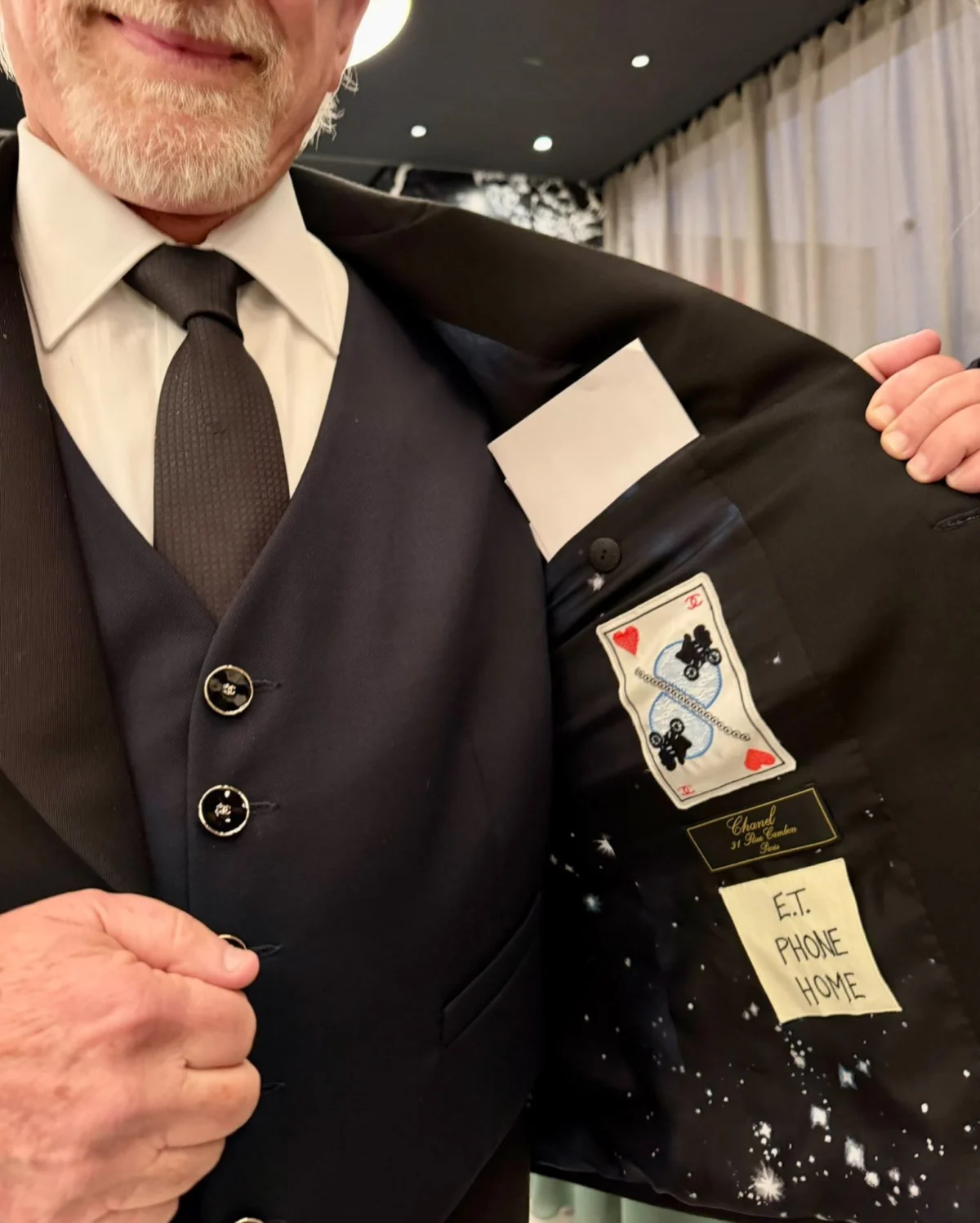
The illustrious Museum of Modern Art’s annual Film Benefit, a cornerstone event in the cultural calendar, recently played host to a poignant demonstration of fashion’s capacity for deeply personal expression. Esteemed filmmaker Steven Spielberg, honored at the Thursday night gala, provided a captivating glimpse into the meticulous details of his custom Chanel tuxedo jacket, a creation that transcended mere sartorial elegance. The jacket, a bespoke offering from the atelier of Matthieu Blazy, was not merely defined by its classic black tailoring. Upon closer inspection, its lining revealed a celestial tapestry of embroidered stars, a whimsical playing card depicting the iconic E.T. on his bicycle, and a discreet yet emphatic patch proclaiming "E.T. PHONE HOME." Spielberg’s deliberate unveiling of these hidden embellishments underscored a growing trend within high fashion: the integration of profoundly personal narratives into the very fabric of garments.
This personalized touch is characteristic of Matthieu Blazy’s evolving vision for Chanel. His spring 2026 haute couture debut marked a significant departure from traditional runway presentations by inviting models to imbue their ensembles with personal significance. Each model was encouraged to contribute a meaningful element—be it a love letter, a birth date, a cherished lucky symbol, or an intimate thought. These personal sentiments were then exquisitely translated into intricate embroideries by the renowned Lesage atelier, either directly integrated into the garments or subtly placed within delicate, translucent Chanel handbags as tiny silk notes. The reported choice of model Stephanie Cavalli, a letter from her husband, exemplifies the profound emotional resonance these handcrafted details can carry, blending exquisite craftsmanship with deeply held sentiment.

Blazy has continued to explore this notion of clothing as a vessel for memory and personal history. In the lead-up to the spring 2027 Chanel collection, models Bhavitha Mandava and Awar Odhiang discovered embroidered playing cards concealed within their jacket linings. These cards depicted Gabrielle Chanel herself, adorned in looks that the models had previously showcased on the runway, creating a meta-narrative that linked the house’s heritage with its present-day muses. This innovative approach suggests a new dialogue between the past and the present, woven into the very material of the collection.
The allure of such personalization extends to Chanel’s couture clientele. Clients reportedly have the option to commission garments that incorporate their own unique stories and symbols. This sentiment was echoed at the Academy Museum Gala in October, where Hailey Bieber’s custom bubblegum-pink Chanel gown featured a tender, handwritten detail: a note concealed within the garment bearing the name of her son, Jack, accompanied by an elegantly rendered arrow-pierced heart. This intimate detail, known only to Bieber and perhaps a select few, transformed the gown from a public statement into a private testament of maternal love.
The practice of embedding hidden messages within clothing is not a new phenomenon; indeed, it boasts a rich and sometimes rebellious history within fashion. Alexander McQueen, a designer renowned for his provocative artistry, famously employed this technique. During his tenure at Romeo Gigli in Milan, the young McQueen, reportedly frustrated by repeated demands to reconstruct a jacket, is said to have left an audacious, albeit less romantic, message: "Fuck you, Romeo." Historical anecdotes, though often debated, also speak of profanities allegedly hidden within suits crafted for Prince Charles during his Savile Row apprenticeship. On a more poignant note, McQueen himself incorporated locks of his own hair into the linings of his groundbreaking 1992 graduate collection, Jack the Ripper Stalks His Victims, and later utilized them in his clothing labels, a deeply personal and artistic signature.

The Evolution of Clothing Labels: More Than Just a Brand Name
Beyond the hidden messages within garments, the clothing label itself has long served as a canvas for designers to express their brand identity and even a touch of personality. A thorough exploration of vintage clothing reveals a diverse array of embroidered crests, ornate script fonts, whimsical illustrations, and earnest mottos from both independent dressmakers and renowned fashion houses. Even established brands like Burberry demonstrate the narrative power of their labels. The evolution from the classic "Burberrys" name and the original Equestrian Knight emblem, introduced in 1901, to the streamlined modernist aesthetic of recent years, and Daniel Lee’s 2023 reintroduction of the knight, showcases a miniature history of the brand’s enduring legacy and its adaptability. Labels, therefore, transcend their basic function of identification; they can encapsulate heritage, convey brand philosophy, and even hint at the artistry involved.
A new wave of designers is actively embracing and revitalizing the art of these small, characterful details. Sofia Testino, founder of her eponymous label, has cultivated a distinctive brand identity through meticulously designed woven labels. These labels often feature evolving colorful geometric borders, winged crests, and the tagline "Style, Quality, Value." Her brand’s visual language extends to shoeboxes adorned with a cartoonish depiction of human evolution, culminating in a figure wearing high heels. Testino has articulated her inspiration, drawing from her collection of vintage labels and old flight-attendant uniforms, and her desire to create a unique visual identity by blending these elements. "I feel like labels and packaging and all these little details have been lost," she recently shared with Welcome.jpeg. In an era where many brands gravitate towards minimalist anonymity, Testino is constructing an entire universe, meticulously detailing every stitch and element, including her packaging.
A New Generation of Designers Embraces Intimate Details
In London, knitwear designer Oscar Ouyang has established a charming signature with a recurring motif of a sweet little lamb, which graces his whimsical knits and appealing clothing labels. For her recent collaboration with Frankies Bikinis, Devon Lee Carlson partnered with her long-time friend Francesca Aiello. Together, they revisited cherished vintage pieces from their personal wardrobes, adorning them with charming pink co-branded labels featuring a small dog and floral embellishments. Meanwhile, in another London studio, Sinéad O’Dwyer is thoughtfully evolving her brand identity in tandem with her growing customer base. Her newly reimagined logo is now subtly incorporated into the stitching on the back of her jeans, offering a contemporary yet intimate connection with her audience.

For London-based demi-couture designer Ellie Misner, a clothing label serves as a personal love letter, commemorating significant moments in her clients’ lives. Misner, who specializes in bespoke creations, meticulously hand-embroiders her clients’ names above her own handwritten logo on each piece. For the artist Raye, who achieved a long-held aspiration by headlining the Reading and Leeds Festival, Misner stitched Raye’s name in burgundy thread onto a crimson corseted gown. Similarly, for Tems, whose performance on the main stage at Glastonbury marked a significant career milestone, Misner created a cobalt-blue signature embroidered onto the interior of a midnight-blue ensemble. "My labels are my handwriting," Misner explains to Vogue. She details her process of handwriting the wearer’s name and then embroidering it, often selecting a thread color that complements the garment. This thoughtful gesture transforms a custom commission into a deeply personal memento, a "love note to their garment," as she describes it. The time-intensive nature of this process ensures that each embroidered label is a unique and cherished detail, even if not always visible to the public. These are not strictly couture gestures, but they embody a shared spirit of individuality and the profound pleasure found in details that can be cherished privately.
The Counterpoint to Impersonal Consumption
The resurgence of these intimate and idiosyncratic details in fashion holds particular resonance in an era increasingly defined by AI-generated imagery, algorithmically driven trends, and a growing sense of impersonal consumption. Fashion, it seems, is actively asserting its human element, reminding us of the skilled artisans and genuine emotions that lie at the heart of its creations. At Chanel’s fall 2026 couture show, artist Joël Blanc captured the spectacle in real-time, painting the runway live with watercolors. Similarly, recent holiday campaigns from major brands like Prada, Dior, and Bottega Veneta have embraced the nostalgic appeal of illustration and animation. Prada, in particular, has made a deliberate point of celebrating hand-drawn artistry, enlisting veteran animator John Pomeroy to create a whimsical winter wonderland populated by snow lynxes and playful mice, underscoring a commitment to handcrafted narratives.
In a world where near-perfect reproduction is commonplace, the unique and the intimate are acquiring an ever-greater preciousness. The most profound meaning we derive from our attire may, in fact, reside in the unseen, the details that connect us personally to the garments we wear and the stories they tell. The deliberate inclusion of these personal touches, whether a filmmaker’s beloved cinematic icon or a mother’s tender tribute, serves as a powerful reminder of fashion’s enduring ability to convey not just style, but also sentiment, history, and the deeply human desire for individual expression.
