

Analysis of longitudinal data from the United States avalanche industry reveals a surprising statistical trend: despite a massive surge in backcountry recreation over the past twenty-two years, the annual number of avalanche-related fatalities has remained remarkably steady. This phenomenon suggests a significant decline in the per-capita fatality rate, pointing toward the success of modern avalanche education, technological advancements in safety gear, and the expansion of regional forecasting networks.
The Evolution of the Backcountry Landscape Since 1994
To understand the significance of current safety trends, one must look back at the winter of 1994/95, a pivotal era for the American avalanche industry. During this period, the infrastructure for avalanche safety was in its infancy. Notable figures such as Knox Williams in Denver, Bruce Tremper in Utah, and Mark Moore in Seattle led the primary avalanche centers. Meanwhile, smaller operations were just beginning to take root, such as the Gallatin National Forest Avalanche Center in Bozeman, which was then entering only its fifth season.
The technological and cultural landscape of the mid-1990s was vastly different from today. In 1994, the internet was a nascent tool, and the first digital avalanche advisories were only beginning to appear on the web by the end of that season. Communication was largely dependent on recorded telephone hotlines and physical bulletin boards. In terms of equipment, the "backcountry" was the domain of a niche group of enthusiasts. Telemark skiing was the standard, often performed in leather boots that offered minimal support compared to modern standards. Snowmobiles of the era lacked the power, suspension, and specialized tracks that allow modern riders to access steep, high-elevation terrain today.
Furthermore, the concept of "sidecountry"—recreation occurring just outside the boundaries of established ski resorts—had not yet entered the common lexicon. Most ski areas maintained strictly closed boundaries, and those who ventured beyond them did so without the benefit of the widespread "Know Before You Go" awareness that defines the modern era.
Analyzing the Fatality Data: A Statistical Flat Line
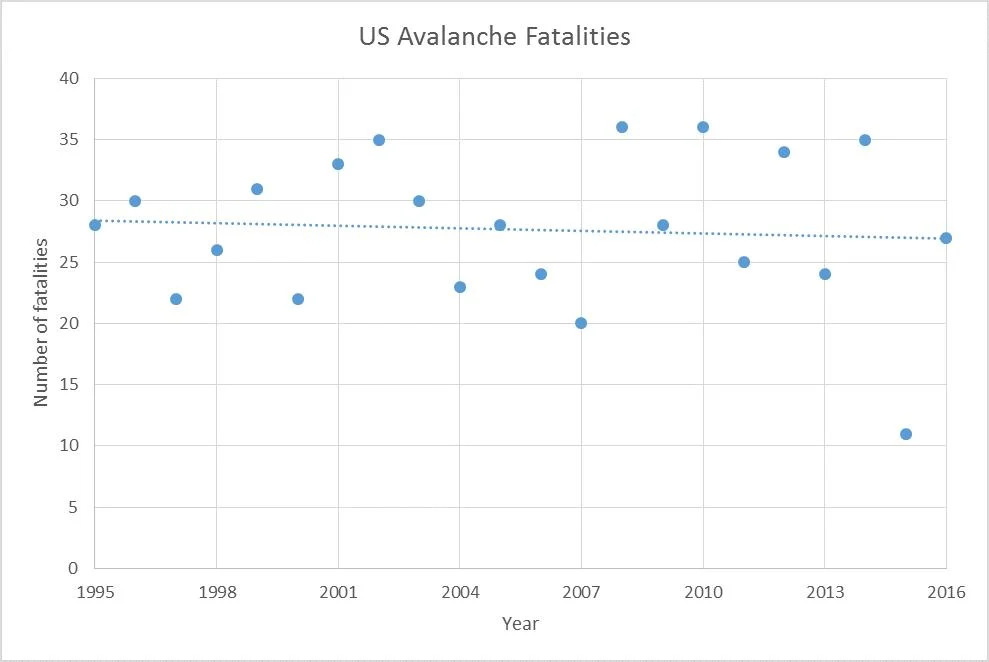
Despite these primitive beginnings and the subsequent explosion in the number of people venturing into uncontrolled terrain, data provided by the Colorado Avalanche Information Center (CAIC) shows that the number of annual fatalities has not seen a statistically significant increase since the 1994/95 season.
Statistical analysis of fatalities between 1994 and 2016 reveals a "flat line" in the trend. According to Figure 1 of the study, the least squares trend line for total U.S. avalanche fatalities shows a slight decrease, though this is not considered statistically significant (p = 0.7). In the world of statistics, a p-value of 0.7 indicates that there is no evidence of a definitive change in the number of deaths over the 22-season period.
When the data is disaggregated by user group, the results remain consistent but offer more nuance:
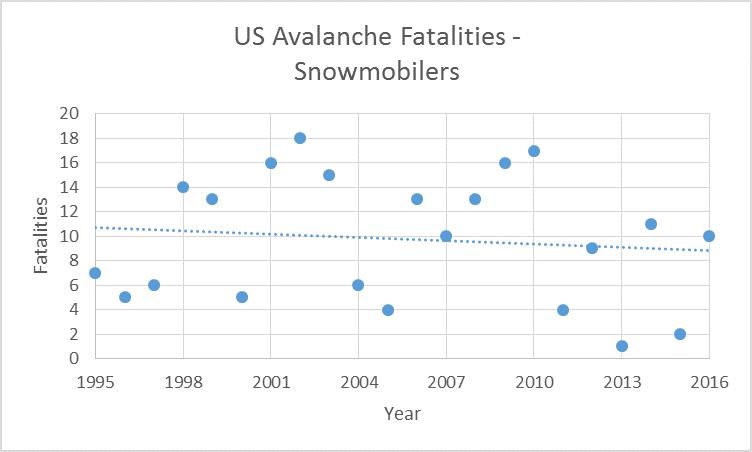
- Snowmobile Fatalities: Figure 2 illustrates that the number of snowmobile-related avalanche deaths has remained flat over the past two decades. The trend line shows a slight, non-significant decrease (p = 0.6), despite the fact that modern snowmobiles are far more capable of reaching dangerous slopes than their 1990s counterparts.
- Skier and Snowboarder Fatalities: Figure 3 shows that while the overall trend is relatively flat, there is some statistical evidence (p = 0.07) suggesting a slight increase in fatalities for this specific demographic. However, this increase is marginal when compared to the massive growth in the number of people participating in these activities.
Measuring the Growth of Backcountry Recreation
The true significance of the flat fatality rate becomes clear only when contrasted with the growth in backcountry usage. While obtaining precise numbers for dispersed winter recreation is notoriously difficult due to the lack of centralized entry points, experts utilize avalanche advisory usage as a reliable proxy for public engagement.
The growth in the number of people accessing avalanche forecasts is staggering. Over the 22-year study period, the Utah Avalanche Center reported a 12-fold increase in advisory usage. The Colorado Avalanche Information Center saw a 17-fold increase, and the Gallatin National Forest Avalanche Center experienced a 36-fold increase. Most remarkably, the Northwest Avalanche Center in Seattle saw usage skyrocket by 60 times its 1994 levels.
While some of this increase can be attributed to the transition from phone hotlines to high-speed internet and mobile apps, the sheer scale of the growth indicates a fundamental shift in how the public interacts with the mountains. Even using a conservative estimate that overall backcountry use has increased by a factor of eight, the math suggests a profound victory for public safety. If the fatality rate had remained constant relative to the number of users, the United States could theoretically be experiencing upwards of 200 avalanche deaths per winter, rather than the current average which typically fluctuates between 20 and 30.
The Role of Technology and Education
The dramatic drop in the per-capita fatality rate is attributed to a multi-pronged approach involving education, equipment, and professional services.
Advancements in Safety Equipment:
The transition from basic tools to sophisticated life-saving technology has played a critical role. In the mid-90s, avalanche transceivers were often analog and required significant practice to master. Modern digital transceivers are faster, more intuitive, and feature multiple-burial marking functions. Additionally, the introduction and widespread adoption of avalanche airbag packs have provided users with a tool that can significantly increase the chances of remaining on the surface of a slide. Other innovations, such as lightweight helmets and the Avalung, have further contributed to survival rates.
The Rise of Professional Education:
The "Know Before You Go" (KBYG) program and the standardization of American Institute for Avalanche Research and Education (AIARE) courses have transformed the culture of the backcountry. What was once a "learn-by-doing" environment has become one where formal education is often seen as a prerequisite for entry. Professional guiding services have also expanded, providing safe avenues for novices to explore the backcountry under expert supervision.
Regional Avalanche Centers:
The expansion of the regional avalanche center network has provided the public with high-quality, daily information. These centers do more than just issue forecasts; they provide a community hub for observations, incident reports, and educational outreach. The ability of these centers to reach users via social media and smartphone apps has ensured that safety information is available at the "point of decision" for many recreators.
Official Perspectives and Industry Acknowledgments
Karl Birkeland, a prominent figure in the avalanche research community and the author of the analysis, emphasizes that the current trend is a testament to the collective efforts of the entire industry. Birkeland acknowledges that while the goal is always to reach zero fatalities, the community should take pride in the fact that they have successfully mitigated the risks associated with such explosive growth.
The Colorado Avalanche Information Center (CAIC), which provided the foundational data for this analysis, continues to lead the way in documenting accidents and near-misses. This documentation is vital for the "lessons learned" approach that informs modern safety curriculum. Experts like Simon Trautman, Doug Chabot, and Spencer Logan have also been instrumental in reviewing these trends to ensure that safety messaging remains effective and evidence-based.
Broader Implications and Future Challenges
The fact that the fatality rate has dropped by at least a factor of eight is a significant achievement in public health and outdoor safety. It suggests that the "avalanche problem" is being managed effectively through public policy, professional forecasting, and individual responsibility.
However, challenges remain. As technology continues to allow people to push further into the wilderness, the "human factor"—the psychological traps that lead people to ignore warnings—remains the most difficult variable to control. The slight upward trend in skier and snowboarder fatalities suggests that as equipment becomes more capable, users may be taking greater risks or venturing into more complex terrain.
Furthermore, the "sidecountry" phenomenon continues to blur the lines between controlled resort environments and the unpredictable backcountry. Ensuring that resort-based skiers understand that an "out of bounds" sign signifies a complete transition in risk management is a continuing priority for ski patrols and avalanche educators.
Conclusion
The 22-year period from 1994 to 2016 represents a transformation in American winter recreation. What was once a niche pursuit for a few has become a mainstream industry. The statistical flat line of fatalities during this era of growth is not a sign of stagnation, but rather a sign of remarkable progress. It represents thousands of lives potentially saved through the tireless work of forecasters, the innovation of engineers, and the commitment of backcountry users to educate themselves. As the industry looks toward the future, the focus remains on maintaining this downward pressure on fatality rates, even as the mountains become more crowded than ever before.
