

The ambitious "Ski the South Tour," a journey more accurately described as "The Ski a Whole Bunch of Places Tour," had brought its intrepid chronicler, "The Scribe," to the picturesque landscapes of Pennsylvania. With over seven hundred miles still separating him from his home base, The Scribe was operating on a carefully constructed plan. A primary objective of this extensive tour was to experience skiing in a multitude of states he had never before visited. This goal had been largely met, with the singular exception of Hidden Valley, a Vail-Epic area near St. Louis in Missouri, a state that still awaited his ski boots. Nevertheless, the allure of adding a few more states to his growing list on the homeward stretch proved irresistible.

A Pennsylvania Detour and a Lesson in Logistics
The Scribe’s itinerary led him to Seven Springs in Pennsylvania, a resort with a rich history dating back to its establishment in 1937. Recognizing its status as an Epic Resort, The Scribe anticipated seamless lift access with his existing EpicPass. In an effort to gather information for an upcoming feature, he contacted the resort, only to be directed through an automated customer service system. His attempts to connect with a media representative proved unexpectedly challenging; despite explaining his purpose – to write a story about his visit – the customer service representative was unable to provide contact details for a media liaison.
Following an approximate hour-and-a-half detour to reach the resort, The Scribe encountered a significant logistical hurdle: the resort was closed. This unforeseen closure meant that any plans for skiing at an establishment with nearly ninety years of operational history were rendered impossible. This unexpected development necessitated a swift alteration of his route, redirecting him towards Massachusetts for his final planned stop: Berkshire East.

The Schaefer Family and the Spirit of Thunder Mountain
Berkshire East, a well-respected ski area in the Berkshire Mountain region, presented itself as a fitting and auspicious final destination for The Scribe’s extensive tour. The resort, formerly known as Thunder Mountain, has cultivated a loyal following among skiers and snowboarders for decades. The Schaefer family’s involvement with the ski area began in 1975 when Roy Schaefer took on a management role, guiding the resort through a period of financial difficulty and eventual emergence from bankruptcy. The family’s deep-rooted connection to the snow sports industry is widely acknowledged, with many knowledgeable individuals in the field attesting to the Schaefer clan’s expertise in skiing and resort operations. In recent years, this esteemed family’s influence has begun to expand.
Berkshire East has consistently championed alpine racing, serving as a vital training ground for aspiring athletes from both New York and Western Massachusetts. This commitment to competitive skiing has been further solidified by the family’s acquisition of Catamount ski area. The expansion of their operational portfolio continued with the acquisition of Burke Mountain in northern Vermont. This past winter, the ski and snowboard community took note as Smuggler’s Notch, situated on the backside of the renowned Stowe Mountain Resort complex, announced its integration into the Berkshire East group. This news was met with considerable excitement by the local Stowe community. With this backdrop of expanding influence and a history of dedicated operations, The Scribe arrived at Berkshire East to find a bustling parking lot, indicating a significant event was underway. To his surprise, his arrival coincided with the U-14 Eastern Alpine Finals, a testament to the resort’s continued role in fostering competitive youth skiing.

Exploring the Vertical
Upon arrival, The Scribe connected with Nate Marr, Berkshire East’s Marketing Manager. Marr was instrumental in providing insights into the resort’s long-standing commitment to being a family-focused ski destination. He also informed The Scribe that his afternoon arrival at approximately 4 p.m. would allow ample opportunity to experience the resort’s well-established night skiing operations, a feature that would enable extensive exploration of the mountain’s terrain. Despite the prevailing grey skies, which may have detracted from the postcard-perfect aesthetics of sun-drenched powder, the quality of the skiing experience remained paramount for The Scribe.
An initial ascent on one of the resort’s lifts revealed that Berkshire East is far from a modest hill. The rugged topography of the Berkshire Mountains, forming the western boundary between Massachusetts and Connecticut, is a well-known characteristic for those familiar with the region’s challenging cycling routes. With a substantial 1,200 feet of vertical drop, 45 meticulously maintained trails, and a highly effective snowmaking operation, Berkshire East has firmly established itself as a significant player in the regional ski landscape. The resort’s accessibility is facilitated by four chairlifts and a pair of surface lifts, ensuring efficient transit across its varied terrain.

Mountain History and Local Legends
The Scribe’s inaugural run down the mountain took him along a side route, where he encountered consistent pitch and excellent snow coverage, a welcome discovery even after a week of less-than-ideal weather conditions. The atmosphere was serene, punctuated only by the cautious movements of a few skiers and riders making their way down the slope. Approximately two-thirds of the way down this initial run, he encountered a ski patroller who was in the process of roping off an area not designated for night skiing. The two observed a small group of individuals attempting to navigate a section of ungroomed terrain that lacked adequate snow cover. The patroller, with a gentle demeanor, advised the individuals to redirect their efforts to the marked trails where snow was readily available.
Jay Gagliarducci, a veteran ski patroller, proved to be an exceptionally engaging source of information. Experienced patrollers often possess a wealth of knowledge, and Gagliarducci readily shared a variety of anecdotes and historical details pertaining to both Berkshire East and the broader region. The history of skiing in the Berkshire hills, he explained, is as deeply rooted as that found in many established New England ski locales. He noted that a significant number of the storied 10th Mountain Division ski soldiers hailed from the Berkshire region, underscoring the area’s historical connection to military skiing and its subsequent influence on civilian ski culture.

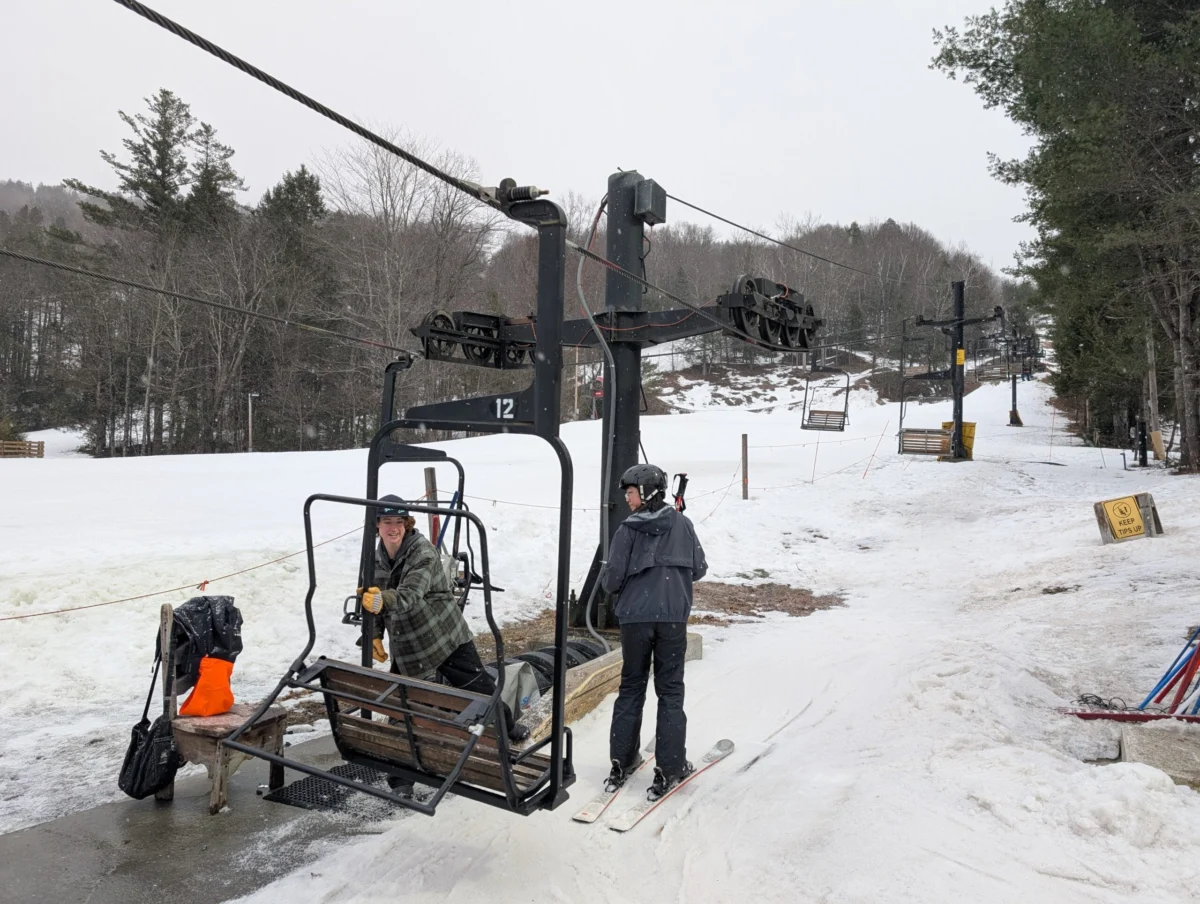
Before concluding their conversation, Gagliarducci guided The Scribe to an older double chairlift that had been relocated from Mount Tom to its current position on the resort’s beginner slope. He recounted a persistent rumor suggesting that a double chairlift, removed from Stowe Mountain Resort in 1986 during its installation of its first high-speed quad, had been re-installed at the Rio Castillo ski area in northern New Mexico. The persistent rumor further suggested that upon Rio Castillo’s closure, this same lift had eventually found its way to Berkshire East. However, upon closer inspection, Gagliarducci concluded that the Topnotch Double chairlift did not appear to be the original Mount Mansfield Double Chair, a detail that added a layer of historical intrigue to the resort’s infrastructure.
Glades and Hidden Gems
The Scribe’s exploration of Berkshire East continued with several ascents on the Wilderness Quad. One of these runs traversed the boundary of the ski area, offering a glimpse into the expansive terrain available for exploration. The significant natural snowfall experienced in this region, coupled with a dedicated local skiing and riding community – many of whom are also accomplished summer mountain bikers – suggests that when conditions are favorable, these enthusiasts actively explore the area’s excellent gladed skiing opportunities.

The limited time remaining in The Scribe’s schedule allowed for only a few more runs, as his determination to reach home that very night remained a priority. He expressed considerable enjoyment in finally experiencing a mountain that had been consistently recommended to him for decades as one of New England’s best-kept secrets. After completing approximately 10,000 vertical feet of skiing at Berkshire East, The Scribe departed with a firm conviction that a return visit during the heart of winter, when the resort’s steepest terrain is fully accessible, would be a worthwhile endeavor.
A 7,000-Mile Odyssey Comes to a Close
As The Scribe’s electric vehicle navigated the scenic banks of the Deerfield River, embarking on its final leg towards Interstate 91, the culmination of a remarkable 7,192-mile odyssey was in sight. This extensive journey had spanned 29 states, all in pursuit of discovering and experiencing lesser-known ski areas. Ultimately, the tour encompassed skiing at 22 distinct locations across 19 states over a period of 28 days. The experience provided The Scribe with invaluable insights into the vibrant state of skiing and snowboarding culture across diverse regions of the United States. He observed that well-supported ski hills, many with over forty years of operational history, are thriving in states such as Rhode Island, New Jersey, Maryland, Virginia, North Carolina, Tennessee, and even Alabama.

Throughout his travels, The Scribe encountered a multitude of dedicated local ski and snowboard enthusiasts. These individuals, some of whom hold roles as patrollers or instructors, while others simply embody a passion for the mountains, underscored the enduring appeal of snow sports. The Midwest, in particular, boasts a remarkable density of ski areas, with over one hundred facilities. For residents of Michigan, Wisconsin, Minnesota, North Dakota, South Dakota, and Indiana, the tradition of local skiing often spans over fifty years, a testament to the sport’s deep roots in these communities. An especially striking revelation was the success of young skiers from Indiana’s Perfect North Slopes, located a mere 44 miles from The Scribe’s birthplace in Cincinnati. Graduates from this modest facility have achieved remarkable success, securing medals in the last four Winter Olympic Games, a testament to the widespread talent and dedication found within American skiing.
