

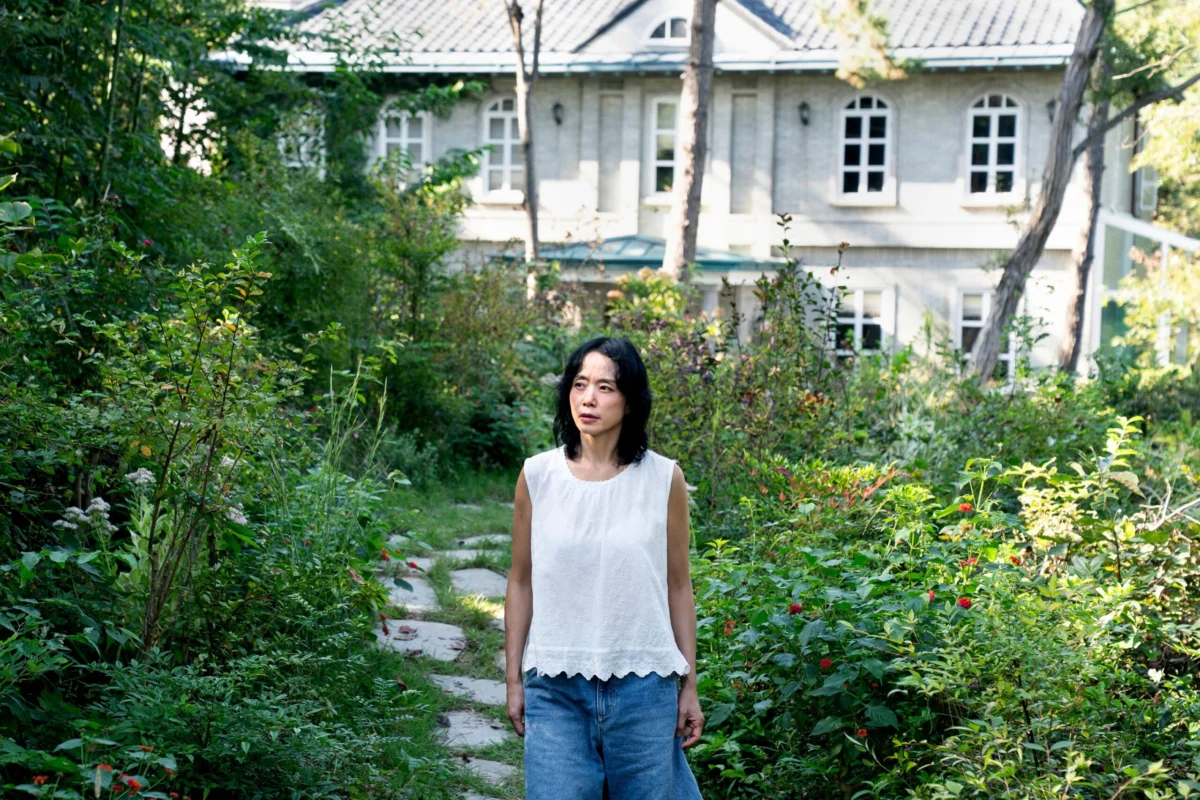
In the nearly three decades since her impactful big-screen debut in 1997’s The Contact, Jeon Do-yeon has solidified her status as a titan of South Korean cinema, her performances often transcending the boundaries of acting to become profound embodiments of her characters. Her international acclaim was significantly amplified by her searing portrayal in 2007’s Secret Sunshine, a role that not only garnered critical adoration but also made her the first Korean performer to achieve an acting award at the prestigious Cannes Film Festival. This landmark achievement marked a pivotal moment, signaling the growing global recognition of Korean talent on the world stage.
Despite a career marked by such profound achievements, the label of "fearless" often attached to her by critics is something Jeon Do-yeon herself deflects with a disarming laugh during a recent Zoom conversation from Seoul, concluding a demanding press schedule. “I’m always scared, and I’m full of fear, especially in front of the camera,” she admits. “I’ve been working as an actor for quite some time, but it’s an ongoing process.” This admission underscores a deeply ingrained professional philosophy: a deliberate avoidance of complacency. “I actually enjoy having that fear and anxiety, and trying my best to work through it, because sometimes something completely new comes out of that struggle.” This continuous engagement with her own vulnerability, rather than a lack of it, appears to be the wellspring of her consistently powerful performances.
This very willingness to confront and navigate discomfort is palpable in her latest critically acclaimed film, Possible Love. Released on Netflix following a theatrical run in October, the film has already been selected as South Korea’s official submission for the 2027 Academy Awards, a testament to its international potential. Possible Love also signifies the highly anticipated return of legendary auteur Lee Chang-dong, whose 2018 masterpiece Burning achieved unprecedented critical success, becoming the first Korean film shortlisted for the Best International Feature Oscar and topping year-end lists across Western media. The film marks Lee’s first directorial effort in eight years, and importantly, a reunion with Jeon Do-yeon nearly two decades after their seminal collaboration on Secret Sunshine.
A Novelistic Sweep: The Narrative Fabric of Possible Love
Lee Chang-dong’s signature novelistic approach to filmmaking is evident in Possible Love, which intricately weaves the complex dynamics between two married couples from vastly different socioeconomic strata of contemporary Korean society. Jeon Do-yeon embodies Mi-ok, a pragmatic mask-factory worker whose quiet existence with her young son and husband, Ho-seok (portrayed by her frequent screen partner, Sul Kyung-gu), is disrupted. Ho-seok remains deeply scarred by the trauma of a past mass factory layoff and a violently suppressed labor strike. Their lives intersect with Ye-ji (Cho Yeo-jeong), an intellectual documentary filmmaker known for her work on laid-off laborers, and her affluent, enigmatic husband, Sang-woo (Zo In-sung).

The narrative pivots when Ye-ji proposes to film Mi-ok and her family’s daily lives. What begins as an exploration of liberal empathy and a poignant depiction of solidarity across societal divides gradually transforms into something far more disquieting and ambiguous. The film delves into the fault lines of privilege, the clandestine nature of hidden desires, and the unsettling implications of voyeurism, creating a rich tapestry of human connection and societal critique.
Oscar Buzz and Pragmatic Reflections
Since its premiere at the Venice Film Festival in September, Possible Love has been enveloped in Oscar buzz, particularly for Jeon Do-yeon’s performance. Critics have lauded her work as a “stunning and powerfully subtle tightrope walk of stoicism and simmering longing.” However, Jeon remains grounded about the potential impact of such accolades. “When I won the award at Cannes 20 years ago, I remember thinking, Is this going to change my life? Probably not. Am I going to change as an actor because I have a Cannes award?” she reflects. “I’m very happy that we’re competing at the Oscars, and it’s wonderful that people are talking about the film, but I don’t think it will change me or the way I perform in any way.” This sentiment echoes her earlier assertion about embracing fear; her focus remains on the artistic process rather than the external validation it may generate.
A Decade in the Making: The Genesis of Possible Love
The genesis of Possible Love is a testament to Director Lee Chang-dong’s meticulous approach to filmmaking. Jeon Do-yeon reveals that the director had been conceptualizing this particular narrative for over a decade. “I do know that Director Lee worked on this project for quite a long time—he had it in his mind for more than 10 years,” she explains. “Sometimes that story diverged into different paths, and sometimes they were scrapped; I know there were a lot of different versions along the way.” This extended gestation period allowed for a deeply considered script, which Jeon eagerly awaited. “When I knew that he finally had a script, I really wanted to know what it was about. I was waiting for that script. [Laughs.]”
Upon reading the script, Jeon was profoundly moved, recognizing the depth of Lee’s decade-long commitment. “When I first read the script, I could feel the 10 years’ worth of thought and effort that Director Lee put into it. I was very touched reading it, and I was like, ‘Of course this is a Chang-dong film. It is this good.’” Her connection to the character of Mi-ok stemmed from a profound understanding of her internal landscape. “Of all the traits that she has, I think she holds this anxiety, and that anxiety stems from her wish to protect certain things. Although Mi-ok may seem a little bit fragile or weak from the outside, I think she’s a very strong woman inside, so that is something that I took note of.” This duality—an outward fragility masking an inner strength—is a hallmark of Jeon’s nuanced portrayals.
The Art of Embodiment: Physicality and Lee Chang-dong’s Method
Jeon Do-yeon’s performance in Possible Love is particularly lauded for its subtle yet potent physicality. The way Mi-ok carries herself is integral to the storytelling, conveying unspoken emotions and a lifetime of experiences. When asked about the development of this physical presence, Jeon attributes much of it to Lee Chang-dong’s directorial philosophy. “If I hadn’t worked with Director Lee before, then I would have spent a lot of time trying to learn more about this character and to deeply understand her,” she states. However, her familiarity with his methods shifted the preparation process.

“But I know how he works, and he always stresses emptying my mind as an actor. He wants me not to express, but to feel the character.” This approach encourages a more organic embodiment, where the character’s essence permeates the actor’s being. “The preparation process for me was mostly about making sure that I get very accustomed to the lines that my character speaks, so it really feels like it’s me speaking, but it’s actually Mi-ok speaking through me.” This emphasis on internalization rather than overt expression allows for a more authentic and often more profound connection with the audience.
A Chemistry Forged in Time: The Reunion with Sul Kyung-gu
The film’s central relationship between Mi-ok and Ho-seok, portrayed by Jeon Do-yeon and Sul Kyung-gu, is the emotional anchor of Possible Love. Having collaborated on multiple projects, their on-screen chemistry is a testament to their enduring professional and personal rapport. “I think I really know him well in real life, and as an actor as well,” Jeon says of Sul Kyung-gu. “But while we were working on this project, and as he transformed into the character of Ho-seok, I discovered new facets of him. There’s always a new side of him that would surprise me, so I’m still looking forward to working with him on another project so I can discover yet another new side of him.”
This deep-seated trust and understanding between the actors proved invaluable in portraying the complexities of a long-standing marital relationship. “We have this friendship and trust that we’ve built over the years, and I’m pretty sure that they helped,” Jeon explains. “When you’re trying to express the chemistry of a very long relationship of a married couple, sometimes you have to make efforts to show that aspect. But we didn’t have to try too hard because we already had that trust built between us. If we do look like a real married couple in the movie, I think it’s partly thanks to that.” Their shared history allowed them to tap into a reservoir of genuine connection, which translated seamlessly onto the screen.
Navigating Nuance: The Delicate Dance with Cho Yeo-jeong
In contrast to her established rapport with Sul Kyung-gu, Possible Love marked Jeon Do-yeon’s first collaboration with Cho Yeo-jeong, who plays the documentary filmmaker Ye-ji. The dynamic between their characters is particularly compelling, teetering on the edge of empathy and exploitation. This delicate balance was, according to Jeon, intentionally left to unfold organically on set, in line with Lee Chang-dong’s unconventional approach.
“We actually didn’t talk about our characters before going into production,” Jeon reveals. “When you work with Director Lee, he’s sort of against the actors having too many biases or prejudices or information about characters before going into the shoot, because he believes something very novel and fresh can come out when it’s your first time being in that scene, when it’s your first time talking.” This deliberate absence of pre-production discussion about character motivations fostered an environment of raw discovery. “I didn’t want to jinx that by speaking with her about our characters beforehand.”

Jeon elaborates on Mi-ok’s initial perspective: “In the beginning, my character, Mi-ok, believes that if Ye-ji films us, then that is a way of protecting my family—a way of finding hope.” However, as their interactions deepen, Mi-ok begins to perceive a growing chasm. “But as they get closer, she realizes that there is a gap between the two people, herself and Ye-ji, and the wall grows higher and higher as they get closer.” This subtle yet significant shift in Mi-ok’s understanding of Ye-ji’s intentions forms a crucial part of the film’s thematic exploration of class and empathy.
Lee Chang-dong’s Naturalism: An Unconventional Creative Process
Director Lee Chang-dong is renowned for his commitment to naturalism, a directorial style that often involves extensive takes to achieve authentic performances. However, Jeon Do-yeon clarifies that Lee’s approach, while naturalistic, is not necessarily about an exhaustive number of takes. “Director Lee is not actually the type who shoots a lot of takes, because he doesn’t really tell us exactly what it is that he wants from a scene,” she explains. Instead, his method focuses on fostering an environment where genuine interactions can emerge.
“What he tries to do instead is to look into the chemistry and the conversation between the actors and try to find something new from it,” Jeon continues. “Instead of Director Lee saying, ‘Okay, let’s do the lines,’ he would just say, ‘Why don’t we talk? Let’s talk.’ He likes everything very lively and raw, so that’s how we did it, and he didn’t want us to have a lot of rehearsals.” This emphasis on spontaneous dialogue and unscripted moments allows for performances that feel less rehearsed and more akin to lived experience. “And regarding whether the direction of a scene actually changed after working—it didn’t happen, because there was no fixed direction in the beginning.” This iterative process, driven by the actors’ organic responses, is central to Lee’s unique filmmaking ethos.
The Global Reach of Korean Cinema: Transcending Borders
The past decade has witnessed a remarkable surge in the global popularity of Korean cinema, a phenomenon that Possible Love is now a part of. Jeon Do-yeon, while not actively pursuing a “global” career path, expresses optimism about this trend. “I don’t have plans on ‘going global’ or anything as an actor! But I do hope that Korean content and Korean cinema will be beloved around the globe going forward as well.”
She views this international embrace as an opportunity for profound cultural exchange. “It’s just such a joy to be able to share different stories and different emotions with people that speak different languages and have different cultures. It’s such a good opportunity for us to transcend borders, transcend language. I hope more of those opportunities will come.” This sentiment underscores the power of cinema to bridge cultural divides and foster universal understanding.

Local Roots, Universal Themes: The Resonance of Possible Love
While Possible Love is deeply rooted in a specific Korean tragedy—the impact of industrial decline on working-class communities—its themes resonate far beyond its national context. The hollowing out of industrial working-class communities is a global phenomenon, a reality experienced in various forms across the world. Jeon Do-yeon acknowledges that the filmmakers harbored some apprehension about the story’s universal appeal.
“When we were filming, we actually did think about how this is a very Korea-specific sort of incident. Would people around the world be able to resonate with this story?” she admits. “Particularly because there is no dramatic event that happens throughout the movie; it’s just about the four people and their emotions, and that’s what really brings a narrative towards the end. We were a little bit worried.”
However, subsequent screenings and audience reception have eased these concerns. “But I actually realized after screening overseas that the issue of laid-off workers is not something that’s specific to Korea—it’s happening all around the world, and it is still happening in some parts of the world,” Jeon observes. “I could feel that a lot of people who are not Korean, who don’t live in Korea, are resonating with the themes and the emotions that are captured in the movie.”
The film’s ability to connect with a global audience on an emotional level is further exemplified by its subtle yet powerful closing imagery. “And the moon at the very end of the movie? Anybody in any part of the world can see the moon. That’s something that’s very universal.” This concluding thought highlights how even the most specific narratives can tap into universal human experiences, fostering a sense of shared understanding and connection across diverse cultures and backgrounds. The enduring power of Korean cinema, as exemplified by Possible Love and the artistry of Jeon Do-yeon and Lee Chang-dong, lies in its capacity to explore the particular with a depth that ultimately reveals the universal.
