

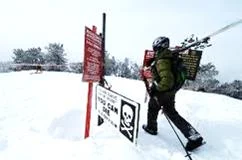
The distinction between the groomed, patrolled runs of a modern ski resort and the wild, unpredictable terrain of the backcountry has become increasingly blurred for many recreational skiers and snowboarders. This ambiguity is often encapsulated in the term sidecountry, a colloquialism used to describe terrain that is outside of a resort’s managed boundary but accessible via the resort’s lift infrastructure. While the term suggests a middle ground between the safety of a ski area and the isolation of the wilderness, avalanche experts and mountain safety officials warn that this linguistic distinction is dangerously misleading. In the eyes of nature and search-and-rescue professionals, there is no such thing as sidecountry; once a rider passes through a boundary gate, they are in the backcountry, where the terrain is uncontrolled, unpatrolled, and potentially lethal.
The "Rated R" designation applied to these areas serves as a stark metaphor for the adult-level responsibility and the mature understanding of risk required to navigate them. Unlike the controlled environment of a ski resort, where professional ski patrols use explosives and physical mitigation to minimize avalanche risks, the public lands adjacent to these resorts offer no such protections. In these areas, the responsibility for safety shifts entirely from the resort operator to the individual rider. This shift in liability and safety management has profound implications for recreationalists, their families, and the emergency services tasked with responding when things go wrong.
The Evolution of Access and the Open Boundary Policy
The current landscape of sidecountry access is the result of decades of evolving land management policies. In the United States, a significant number of ski areas operate on permits issued by the U.S. Forest Service (USFS). Historically, many resorts maintained "closed boundaries," where leaving the permitted area was strictly prohibited and could result in the loss of skiing privileges or even criminal trespassing charges. However, as the demand for off-piste and "extreme" terrain grew in the 1990s and early 2000s, many resorts transitioned to an "open boundary" policy.
Under an open boundary system, resorts install designated access gates that allow skiers to exit the managed area and enter adjacent public lands legally. This policy was intended to provide a safer, regulated way for experienced backcountry travelers to access the mountains without ducking ropes or creating conflict with resort management. While the gates are often adorned with prominent warning signs—frequently shaped like skulls or featuring bright orange "Danger" warnings—the ease of access has had an unintended side effect. It has created an "illusion of safety," leading many unprepared riders to believe that the terrain just beyond the gate is an extension of the resort’s safety net.
The Illusion of Safety and the Human Factor
The primary danger of sidecountry skiing is not just the terrain itself, but the psychological state of the people entering it. Avalanche educators often discuss "heuristic traps," which are mental shortcuts that lead to poor decision-making. In the sidecountry, these traps are amplified. Because a rider can see the resort, hear the hum of the chairlift, or see the tracks of previous skiers, they often experience a false sense of security.
The presence of tracks is one of the most common and deadly deceptions in the backcountry. A slope that has been skied ten times without incident can still slide on the eleventh. Unlike a resort run, which is "packed down" by thousands of skiers and stabilized by patrol work, sidecountry slopes remain a complex puzzle of snow layers. A single rider may trigger a "deep slab" avalanche that was unaffected by previous tracks. Furthermore, many riders entering through gates lack the essential "Big Three" of avalanche safety: a transceiver (beacon), a probe, and a shovel. Without these tools and the knowledge of how to use them, a companion rescue is impossible, and the chances of surviving a burial drop to near zero within minutes.
Statistical Overview of Avalanche Fatalities and Trends
Data provided by the Colorado Avalanche Information Center (CAIC) and the American Avalanche Association (A3) highlights a concerning trend regarding incidents near ski area boundaries. Over the last two decades, as equipment technology has improved and "touring" setups have become more accessible, the number of people venturing out-of-bounds has skyrocketed.
Statistically, the United States averages approximately 25 to 30 avalanche fatalities per year. While the majority of these occur in the deep backcountry, a significant and persistent percentage involves riders who exited a ski area through a gate. According to CAIC historical data, there is a recurring pattern where high-fatality years often correlate with early-season snowpack instability followed by heavy mid-winter storms—conditions that are particularly enticing to "sidecountry" enthusiasts looking for fresh powder.
Analysis of these accidents often reveals a lack of formal avalanche education among the victims. While a "Green" or "Blue" run skier would never dream of climbing a 12,000-foot peak without a guide, the same skier might feel comfortable traversing into expert-only, avalanche-prone terrain simply because it is accessible from the top of a high-speed quad chairlift. This gap between physical ability and mountain literacy is the "Rated R" reality that experts like Doug Abromeit, former director of the U.S. Forest Service National Avalanche Center, have long emphasized.
The Logistics and Risks of Search and Rescue
A critical point of misunderstanding for many sidecountry users is the nature of rescue operations. Within the ski area boundary, a ski patrol response is typically measured in minutes. Patrollers are professional medical first responders trained in mountain extrication. However, once a rider crosses the boundary, the jurisdiction for rescue typically shifts to the local County Sheriff and volunteer Search and Rescue (SAR) teams.
The logistics of a backcountry rescue are vastly different:
- Communication: Cell phone service is often spotty or non-existent in the drainages behind ski resorts.
- Response Time: It can take hours for a SAR team to mobilize, reach the resort, and transit to the accident site.
- Risk to Rescuers: SAR teams must evaluate the same avalanche hazards that caused the initial accident. If the conditions are too dangerous, they will not deploy until the snowpack stabilizes, meaning a "rescue" may become a "recovery" mission.
- Cost: While resort rescues are generally included in the price of a lift ticket, backcountry rescues can incur significant costs depending on the state and the need for helicopter support.
The statement "rescue is the responsibility of the rider" is not merely a legal disclaimer; it is a physical reality. In a sidecountry avalanche, your only immediate hope for survival is the person you are skiing with. If neither of you has gear or training, the outcome is almost certainly fatal.
Expert Perspectives and the Responsibility of Knowledge
The "Doug" referenced in recent safety literature is often associated with the legacy of Doug Abromeit and other veteran avalanche professionals who have spent decades trying to bridge the education gap. Their primary concern is the "R-rated" nature of the terrain—terrain that demands a level of maturity and preparation that many young or casual riders do not yet possess.
The question posed to parents—"after a parent waves goodbye in the ski area parking lot do they know what the kids are doing?"—strikes at the heart of the social issue. There is a culture of "sending it" and "chasing stoke" fueled by social media, where the consequences of a mistake are often edited out of the video. Experts argue that the industry must move away from the term "sidecountry" altogether to reinforce the idea that there is only "resort" and "backcountry."
"The mountain doesn’t know you have a lift ticket in your pocket," is a common refrain among instructors. This objective reality forms the basis of the AIARE (American Institute for Avalanche Research and Education) curriculum, which encourages riders to check the daily avalanche forecast, carry the proper gear, and, most importantly, be willing to turn back if the conditions are not right.
Broader Implications for the Ski Industry and Public Land Use
The ongoing debate over sidecountry access has broader implications for the future of mountain recreation. As incidents continue, some resorts are facing increased pressure to reconsider their open boundary policies. However, closing boundaries is often seen as a step backward in terms of personal freedom and land use rights. Instead, many resorts are investing in "beacon parks" (practice areas for transceiver use) and increasing the visibility of avalanche forecasts at lift terminals.
The legal landscape is also shifting. While the Skier Safety Acts in various states generally protect resorts from liability regarding the "inherent risks" of skiing, the legal waters get murkier when accidents occur just outside a gate that the resort provides. So far, the courts have largely upheld that the responsibility lies with the individual once they exit the managed area, but the cost of litigation and the tragedy of preventable deaths continue to weigh heavily on the industry.
Conclusion: Navigating the Mature Landscape
Venturing beyond the ski area boundary offers some of the most rewarding experiences in winter sports—untouched snow, silence, and a sense of true adventure. However, these rewards come with a price of entry that cannot be paid at a ticket window. The "Rated R" nature of the sidecountry demands that every participant be their own guide, their own snow scientist, and their own rescuer.
To mitigate the risks, the path forward is clear: education must precede exploration. Understanding that the gate is not a door to a playground, but a portal to a wilderness, is the first step in ensuring that a day in the mountains ends with a safe return to the parking lot. As the boundaries between managed and unmanaged lands continue to be a focal point of mountain culture, the emphasis must remain on personal accountability, proper equipment, and a profound respect for the power of the natural world.
