

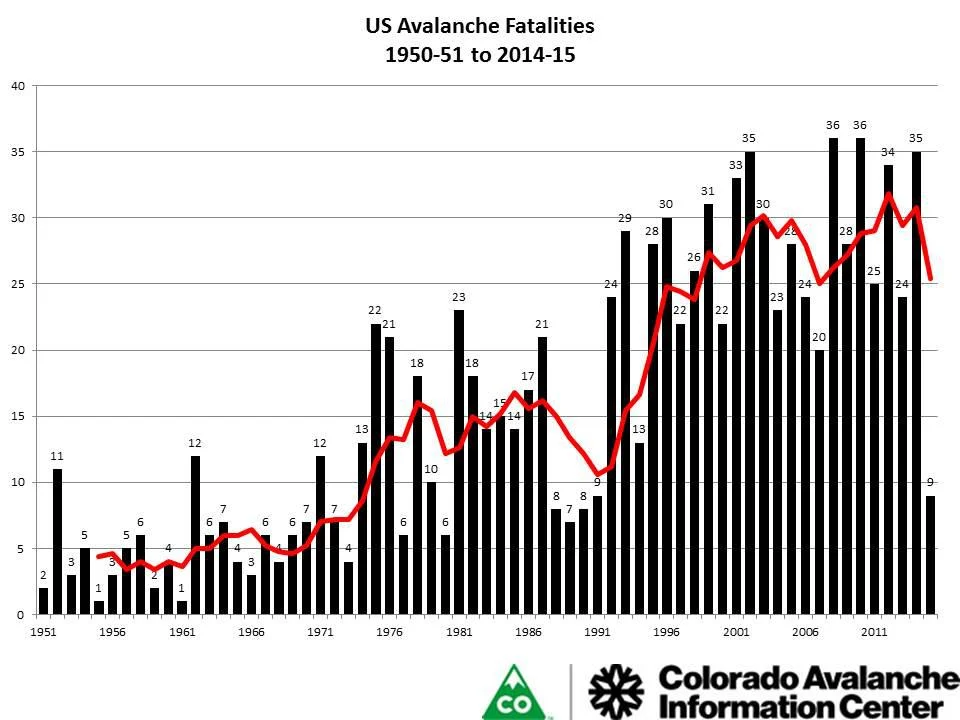
As the 2014-2015 winter season draws to a close, federal and state agencies have released preliminary data indicating a significant and historic decline in avalanche-related deaths across the United States. While the season technically concludes on April 30, the current tally of nine fatalities marks the lowest number of avalanche deaths recorded in the country since 1991. This development comes as a surprise to many industry experts, given the exponential growth in backcountry recreation over the last decade. However, a combination of anomalous weather patterns, specific snowpack conditions, and intensified public education campaigns has created a unique statistical window that safety officials hope to replicate in future seasons.
The record-low figure is particularly striking when compared to the preceding five-year average, which typically sees between 25 and 30 fatalities annually. The reduction in deaths is being attributed to a multifaceted set of circumstances, ranging from the meteorological—specifically a "snow drought" in the Western United States—to the sociopolitical, involving the increased reach of the U.S. Forest Service (USFS) and the Colorado Avalanche Information Center (CAIC).
Historical Context and Comparative Analysis
To understand the significance of the nine fatalities recorded in the 2014-2015 season, one must look back nearly a quarter-century. In 1991, the backcountry landscape was vastly different; the equipment was less sophisticated, and the number of skiers, snowboarders, and snowmobilers venturing outside of maintained resort boundaries was a fraction of today’s figures. Since the early 1990s, the trend in avalanche fatalities generally tracked upward as the "sidecountry" and "backcountry" movements gained mainstream popularity.
By the early 2000s, annual fatalities frequently peaked above 30, driven by the accessibility of high-performance snowmobiles and lightweight touring gear. Despite this surge in participation, the 2014-2015 season has broken the upward trajectory. For comparison, the 2013-2014 season saw 35 fatalities, while the 2012-2013 season recorded 28. The drop to single digits represents a nearly 75% decrease from the previous year, a statistical anomaly that warrants a deep dive into the contributing environmental factors.
Meteorological Factors: The Role of the "Snow Drought"
The primary driver behind the decrease in fatalities appears to be the uncharacteristic weather patterns that defined the 2014-2015 winter. Across much of the West Coast, particularly in the Sierra Nevada of California and the Cascades of Washington and Oregon, the winter was characterized by a severe lack of precipitation and record-high temperatures.
In California, the snowpack reached historic lows, with some monitoring stations reporting 0% of the long-term average. While a lack of snow is detrimental to the ski industry and water reservoirs, it inherently reduces avalanche risk. Without the accumulation of significant "slabs"—large plates of cohesive snow—the primary mechanism for catastrophic avalanches was absent in regions that typically account for a significant portion of annual accidents.
Further inland, in the Rocky Mountains and the Intermountain West, the weather was similarly anomalous. While these regions did receive precipitation, it was often accompanied by warmer temperatures. In the world of snow science, warmth can be a double-edged sword. While rapid warming can trigger "wet" avalanches, sustained moderate temperatures often help a snowpack "bridge" or settle more quickly, creating a more stable and cohesive structure. In Colorado and Utah, the traditional "persistent weak layers"—buried frost or sugary snow that stays dangerous for months—were less prevalent or were buried under less weight than in previous "high-load" years.
Chronology of the 2014-2015 Season
The season began with a typical degree of caution. In November and December 2014, early-season storms in the Rockies created a thin, fragile base, leading experts to predict a dangerous winter. However, as the calendar turned to 2015, the expected heavy mid-winter storms failed to materialize in many regions.
- Early Winter (November – December): Initial fatalities occurred in the early season as enthusiasts pushed into the high country on a shallow, unstable snowpack. These incidents followed the traditional pattern of "human-triggered" slides on north-facing slopes.
- Mid-Winter (January – February): This period, usually the deadliest, saw a remarkable lull. A high-pressure ridge, often referred to by meteorologists as the "Ridiculously Resilient Ridge," diverted storms away from the West Coast and into the Northeast. While Boston saw record-breaking snowfall, the traditional avalanche corridors of the West remained dry and relatively safe.
- Spring (March – April): As the season transitioned into spring, the focus shifted to wet-snow avalanches. However, because the total snow volume was so low in the Cascades and Sierras, the threat of massive spring cycles was significantly mitigated. The Colorado Avalanche Information Center noted that while danger levels fluctuated, the "extreme" ratings were rarely issued compared to the 2013-2014 cycle.
The Impact of Educational Initiatives
While weather played a undeniable role, safety officials are also crediting a "culture of safety" that has begun to take root in the backcountry community. Organizations like the American Institute for Avalanche Research and Education (AIARE) and the Northwest Avalanche Center (NWAC) have reported record enrollment in Level 1 and Level 2 safety courses.
The Colorado Avalanche Information Center (CAIC), which maintains the national database for avalanche accidents, has been at the forefront of this educational push. Through the use of social media, mobile apps, and real-time mapping, the CAIC has transformed how information is disseminated. Spencer Logan, a lead researcher at the CAIC, has emphasized that the goal is not just to provide data, but to provide "actionable intelligence."
The "Know Before You Go" program, a collaborative effort between various avalanche centers and industry partners, has also been credited with reaching a younger, more aggressive demographic of skiers and riders. By focusing on five simple steps—Get the Gear, Get the Training, Get the Forecast, Get the Picture, and Get out of Harm’s Way—the program has simplified the complex science of snow safety into digestible, life-saving habits.
Statistical Breakdown and Long-Term Trends
Despite the record low of nine deaths this season, the five-year moving average remains a more sobering metric for policy makers. This average has stayed relatively stable, hovering between 25 and 30 deaths per year. This stability is, in itself, a minor victory. Data from the Outdoor Industry Association indicates that participation in backcountry skiing and splitboarding has increased by over 200% in the last 15 years.
If fatality rates had tracked linearly with participation, the US would be seeing upwards of 60 to 70 deaths per year. The fact that the average has remained flat suggests that education and technology (such as avalanche transceivers, probes, shovels, and increasingly, avalanche airbags) are effectively mitigating the increased "human exposure" to the terrain.
Fatalities by activity in the 2014-2015 season also showed a shift. Historically, snowmobilers have represented a large plurality of victims. However, this year, the few incidents that did occur were distributed more evenly among skiers, snowmobilers, and climbers, suggesting that the "low-tide" snow year affected all user groups equally.
Official Responses and Institutional Analysis
Spokespersons for the U.S. Forest Service have expressed a "cautious optimism" regarding the season’s numbers. In a statement regarding the preliminary data, officials noted that while nine deaths is a historic low, "the goal remains zero." The Forest Service continues to fund regional avalanche centers, recognizing them as essential public safety infrastructure similar to fire departments or search and rescue teams.
Ethan Greene, Director of the CAIC, has often pointed out that avalanche safety is a game of probabilities. "We cannot control the weather, and we cannot control the snowpack," Greene has noted in various safety seminars. "We can only control our exposure to it." The 2014-2015 season is being viewed by his office as a "perfect storm" of low-hazard weather and high-quality information. The concern among professionals is that a "return to normal" in terms of snowfall could lead to a spike in fatalities if the public becomes complacent due to this year’s benign conditions.
Broader Implications and the Future of Backcountry Safety
The 2014-2015 season serves as a critical case study for the "Human Factor" in avalanche safety. In the field of snow science, the "Human Factor" refers to the psychological heuristics—such as social pressure, familiarity, or "powder fever"—that lead people to make poor decisions in dangerous terrain.
This year, the lack of snow may have inadvertently solved the "powder fever" problem. With fewer "epic" days to chase, fewer recreationists were tempted to take high-stakes risks. However, the long-term implication is the need for "climate-resilient" safety education. As climate change continues to make winter weather more volatile, avalanche centers will need to adapt to seasons that may swing from extreme drought to extreme, heavy loading.
Furthermore, the role of technology continues to evolve. The 2014-2015 season saw a higher percentage of backcountry users carrying avalanche airbags than any previous year. While no specific data point in this year’s nine fatalities can be directly linked to an airbag save, the general trend toward better equipment is undeniable.
As the USFS and CAIC finalize their reports for the 2014-2015 cycle, the message to the public remains clear: the record-low fatality count is a welcome reprieve, but it is not a signal that the mountains have become inherently safer. Instead, it is a reminder of how much impact weather and education have on the survival of those who seek adventure in the winter wilderness. The focus now shifts to the 2015-2016 season, with the hope that the lessons learned during this historic low can be carried forward, regardless of how much snow falls.
